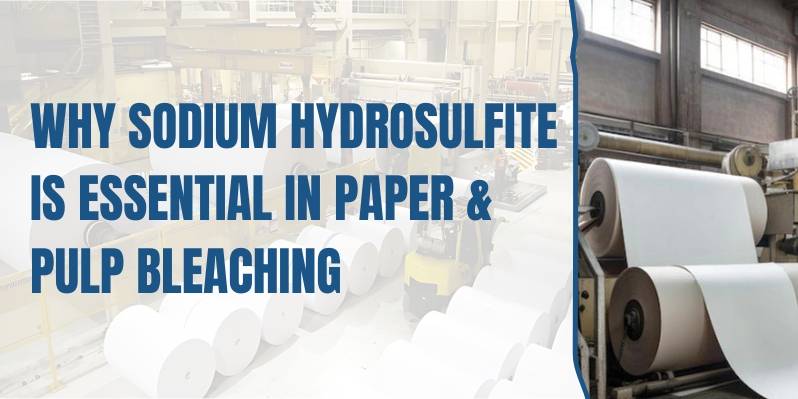
Why Sodium Hydrosulfite Is Essential in Paper & Pulp Bleaching
Bleaching is a critical stage in the paper-making process, where the goal is to remove color, impurities, and residual lignin to achieve bright, high-quality paper. One of the most important chemicals used in this process is sodium hydrosulfite. Its strong reducing capability makes it a preferred bleaching agent for various types of pulp. Understanding the role of sodium hydrosulfite in the paper industry and sodium hydrosulfide in pulp production helps in optimizing paper quality, reducing costs, and improving production efficiency.
Why Sodium Hydrosulfite Is Essential in Paper & Pulp Bleaching
Sodium hydrosulfite (also known as sodium dithionite) is widely used across the global pulp and paper industry due to its effectiveness in reducing color-causing compounds. Below are the key reasons why this chemical is indispensable.
1. Excellent Brightening Capability
One of the primary reasons sodium hydrosulfite is essential in bleaching is its ability to significantly increase pulp brightness.
- It reduces chromophores that cause unwanted color.
- Produces a clean, bright pulp suitable for high-grade paper.
This explains the importance of sodium hydrosulfite in the paper industry, especially for producing fine printing and writing papers.
2. Effective Removal of Residual Lignin
Lignin is responsible for the natural brown color of pulp. Sodium hydrosulfite helps reduce and decolorize lignin components without damaging fibers.
- Ensures smoother pulp texture
- Reduces yellowing during storage
- Enhances long-term brightness stability
This reaction is also part of the chemical functions associated with sodium hydrosulfide in pulp production.
3. Ideal for Mechanical & Recycled Pulp
Sodium hydrosulfite works exceptionally well on:
- Mechanical pulp
- Thermomechanical pulp (TMP)
- Recycled wastepaper pulp
It brightens recycled fibers by removing ink residue and contaminants, improving the final paper quality. This increases the importance of sodium hydrosulfite in the paper industry, where recycled paper production is growing rapidly.
4. Lower Environmental Impact Compared to Chlorine-Based Bleaching
Traditional chlorine bleaching methods are associated with high pollution levels. Sodium hydrosulfite serves as a safer alternative because:
- It produces fewer harmful by-products.
- It reduces chemical load in wastewater.
- It supports eco-friendly paper production.
This aligns with modern demands for sustainable pulp and paper manufacturing.
5. Improved Efficiency and Cost Savings
Using sodium hydrosulfite offers operational benefits, including:
- Faster bleaching stages
- Less chemical consumption
- Lower energy requirements
- Increased mill productivity
Due to these advantages, mills using sodium hydrosulfide in pulp production experience improved cost-effectiveness and process consistency.
How Sodium Hydrosulfite Works in Bleaching
The bleaching action of sodium hydrosulfite operates through a reduction process. It targets colored compounds and lignin, breaking them down into colorless substances. This mechanism:
- Works under mild temperature conditions
- Reduces oxidative stress on fibers
- Produces a brighter, cleaner pulp
Its chemical stability and performance make sodium hydrosulfite in the paper industry a trusted solution for high-grade paper production.
Applications of Sodium Hydrosulfite in the Paper Industry
Below are some common applications:
1. Bleaching of Mechanical Pulp
Ensures improved brightness and reduced dirt specks.
2. Deinking of Recycled Paper
Helps remove ink, dyes, and color residues to recover clean fibers.
3. Brightening of Chemi-mechanical Pulp
Improves overall quality and reduces yellowing.
4. Final Stage Bleaching
Used as a finishing agent to enhance final paper whiteness.
5. Stabilizing Optical Brightness
Supports optical brightening agents (OBAs) for premium paper products. Each of these applications highlights the versatile role of sodium hydrosulfite in the paper industry.
Conclusion
Sodium hydrosulfite plays a crucial role in producing high-quality paper by improving brightness, removing lignin, and enhancing the appearance of recycled pulp. Its effectiveness, safety advantages, and cost efficiency explain why it remains a key ingredient in bleaching processes worldwide. When evaluating bleaching agents, industries often select this chemical due to the reliable performance of sodium hydrosulfite in the paper industry and the operational flexibility offered by sodium hydrosulfide in pulp production.
Frequently Asked Questions
Q1. Why is sodium hydrosulfite used in paper bleaching?
Ans. Because it effectively reduces and eliminates color-causing compounds, improving pulp brightness.
Q2. Is sodium hydrosulfite safe for recycled pulp?
Ans. Yes, it is highly effective for removing ink and contaminants during recycling.
Q3. Does sodium hydrosulfite reduce environmental impact?
Ans. Yes, it produces fewer harmful byproducts compared to chlorine-based bleaching.
Q4. What role does it play in lignin removal?
Ans. It decolorizes lignin, preventing yellowing and improving long-term brightness.
Q5. Is it cost-effective for large-scale mills?
Ans. Yes, its efficiency and lower chemical usage make it cost-saving for industrial pulp production.
Get in touch with us!
×