What Is Sodium Hydrosulfite? Properties, Uses & Industrial Applications
Sodium hydrosulfite is one of the most widely used industrial reducing agents, known for its powerful bleaching and dyeing capabilities. From textiles to paper, leather, and water treatment, this chemical plays a crucial role in multiple manufacturing processes. In this blog, we will explore what sodium hydrosulfite is, examine its key properties, and discuss its major industrial applications and uses across various sectors.
What Is Sodium Hydrosulfite?
To understand what is Sodium Hydrosulfite, it is important to know that it is a white crystalline powder with strong reducing properties. Chemically known as sodium dithionite (Na₂S₂O₄), this compound is widely used for its ability to break down colored impurities in materials.
Sodium hydrosulfite is highly reactive, dissolves easily in water, and is extremely effective in removing unwanted colors. Whether it is textile dyeing, paper brightening, or mineral processing, sodium hydrosulfite is a preferred chemical due to its speed, efficiency, and stability when handled properly. Industries rely on it extensively because it delivers consistent performance and can operate under controlled temperature and pH conditions.
Properties of Sodium Hydrosulfite
Understanding the properties of sodium hydrosulfite helps evaluate its effectiveness in industrial applications. Here are the key characteristics:
1. Strong Reducing Agent
One of the most important properties of sodium hydrosulfite is its ability to reduce dyes and pigments, making it ideal for bleaching and color removal.
2. Solubility in Water
Sodium hydrosulfite dissolves quickly in water, creating a stable reducing solution used in textile dyeing and pulp bleaching.
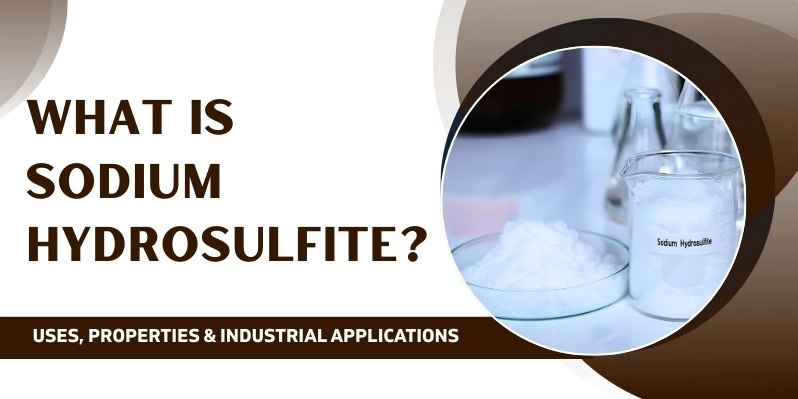
3. White Crystalline Appearance
It usually appears as a white to pale yellow crystalline powder.
4. Reactivity with Air & Moisture
It decomposes when exposed to moisture and oxygen, releasing sulfur dioxide. Therefore, proper storage is essential.
5. Thermal Sensitivity
Sodium hydrosulfite is sensitive to heat and should be stored in cool, dry conditions to prevent degradation.
Industrial Applications & Uses of Sodium Hydrosulfite
There are numerous industrial applications & uses of sodium hydrosulfite due to its versatility. Here are the major sectors where it is widely used:
1. Textile Industry
The textile industry is the primary consumer of sodium hydrosulfite. Its strong reducing ability makes it essential in processes like:
- Vat dyeing
- Indigo dye reduction
- Color stripping
These are some of the key industrial applications of sodium hydrosulfite, helping achieve bright and consistent textile colors.
2. Paper & Pulp Bleaching
Another major sector using this chemical is the pulp and paper industry. Sodium hydrosulfite helps:
- Improve paper brightness
- Remove residual lignin
- Reduce yellowing
This underscores its essential role among the industrial applications and uses of sodium hydrosulfite.
3. Water Treatment
Sodium hydrosulfite is extensively used in water treatment for:
- Removing chloramines
- Dechlorination
- Neutralizing dissolved oxygen
Because of its effectiveness, water treatment plants consider this chemical a reliable solution.
4. Chemical Processing Industry
One of the specialized industrial applications and uses of sodium hydrosulfite is its role in:
- Organic synthesis
- Reductive bleaching
- Mineral flotation
- Leather processing
It helps in achieving high-quality chemical outputs and enhances process efficiency.
5. Food Packaging & Cosmetics (Limited Use)
In controlled quantities, sodium hydrosulfite may be used for:
- Removing oxygen from food storage
- Stabilizing certain cosmetic formulations
These niche applications further broaden the range of important industrial uses of sodium hydrosulfite.
Safety, Handling & Storage of Sodium Hydrosulfite
Since sodium hydrosulfite decomposes easily when exposed to heat or moisture, safety guidelines must be followed:
- Store in an airtight, cool, dry environment
- Avoid direct contact with water.
- Follow industry-grade packaging
- Use protective gear during handling.
Proper safety ensures the chemical remains stable and effective.
Conclusion
Understanding what sodium hydrosulfite is, its key properties, and its wide range of industrial applications helps industries select the right reducing agent for bleaching, dyeing, and purification processes. Its efficiency, versatility, and broad availability make it an essential chemical across many sectors.
Frequently Asked Questions
Q1. What is sodium hydrosulfite used for?
Ans. It is primarily used for textile dyeing, vat dye reduction, paper bleaching, water treatment, and chemical processing.
Q2. Is sodium hydrosulfite safe to handle?
Ans. Yes, when proper safety precautions are followed. It must be stored in dry, cool conditions.
Q3. Why is sodium hydrosulfite used in textile industries?
Ans. It is a powerful reducing agent that helps in color stripping, dye removal, and indigo dyeing.
Q4. What are the key properties of sodium hydrosulfite?
Ans. Its reducing strength, water solubility, reactivity, and crystalline form are the main properties of sodium hydrosulfite.
Q5. What industries use sodium hydrosulfite the most?
Ans. Textiles, paper & pulp, water treatment, mineral processing, cosmetics, and chemical manufacturing.
Get in touch with us!
×