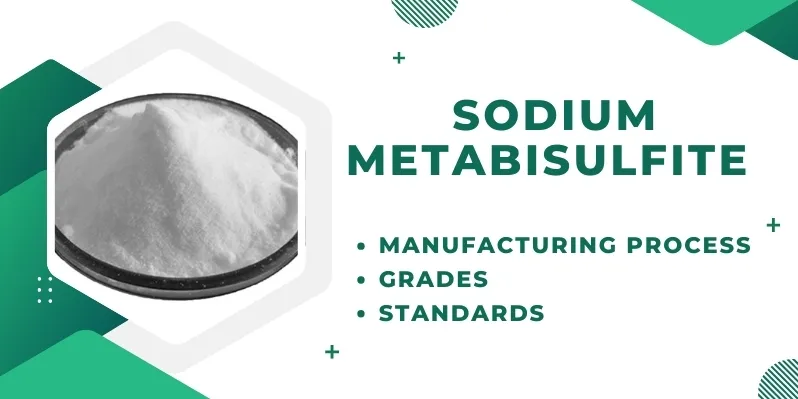
Sodium Metabisulfite Manufacturing Process, Grades & Standards
Sodium metabisulfite is an important inorganic chemical widely used across food processing, pharmaceuticals, water treatment, textiles, mining, and chemical industries. Its effectiveness as a preservative, antioxidant, disinfectant, and reducing agent makes it a high-demand compound worldwide. Understanding the sodium metabisulfite manufacturing process, along with its grades and quality standards, helps buyers and industries choose the right product for their specific applications.
This article provides a clear, technical, and industry-focused explanation of how sodium metabisulfite is manufactured, the different grades available, and the international standards that govern its quality.
What Is Sodium Metabisulfite?
Sodium metabisulfite is a white or slightly yellowish crystalline powder with a strong sulfur odor. Its chemical formula is Na₂S₂O₅. When dissolved in water, it releases sulfur dioxide, which gives it strong antimicrobial and antioxidant properties.
Because of these characteristics, sodium metabisulfite plays a critical role in food preservation, chemical processing, and industrial manufacturing.
Overview of the Sodium Metabisulfite Manufacturing Process
The Sodium Metabisulfite Manufacturing Process is based on the controlled reaction between sulfur dioxide and sodium-based alkaline compounds. The process is designed to ensure high purity, uniform particle size, and compliance with industry standards.
Manufacturing is usually carried out in closed systems to prevent contamination and maintain safety, as sulfur dioxide gas is reactive and hazardous if improperly handled.
Step-by-Step Sodium Metabisulfite Manufacturing Process
1. Generation of Sulfur Dioxide (SO₂)
The process begins with the production of sulfur dioxide gas. This is typically achieved by burning elemental sulfur or roasting sulfur-containing compounds in a controlled environment. The resulting sulfur dioxide gas is cooled and purified before use.
Purity at this stage is essential, as impurities in sulfur dioxide can affect the final product quality.
2. Absorption of SO₂ in Sodium Carbonate or Sodium Hydroxide
The purified sulfur dioxide gas is absorbed into a solution of sodium carbonate (Na₂CO₃) or sodium hydroxide (NaOH). This reaction produces sodium bisulfite as an intermediate compound.
Careful control of temperature, pressure, and concentration is required to ensure complete absorption and prevent the formation of unwanted by-products.
3. Conversion to Sodium Metabisulfite
The sodium bisulfite solution is then heated or concentrated under controlled conditions. During this step, water is removed, and sodium bisulfite molecules combine to form sodium metabisulfite.
This stage is critical in the sodium metabisulfite manufacturing process, as it determines product purity, stability, and chemical composition.
4. Crystallization
The concentrated solution is cooled to allow sodium metabisulfite crystals to form. Controlled crystallization ensures uniform crystal size, which is important for handling, solubility, and application performance.
Crystallization conditions are adjusted depending on the grade being produced.
5. Drying and Filtration
The crystals are removed from the liquid through filtration or centrifugation processes. They are then dried using hot air dryers or vacuum dryers to achieve the desired moisture content.
Proper drying ensures longer shelf life and prevents degradation during storage and transportation.
6. Grinding, Sieving, and Packaging
Once dried, the sodium metabisulfite is ground and sieved to achieve the required particle size. The final product is packed in moisture-resistant packaging to prevent oxidation and loss of potency.
Grades of Sodium Metabisulfite
Different industries require sodium metabisulfite of varying purity levels. Manufacturers typically produce multiple grades to meet these needs.
1. Food Grade Sodium Metabisulfite
Food-grade sodium metabisulfite is manufactured under strict hygienic conditions and complies with food safety regulations. It is commonly used as a preservative and antioxidant in:
- Dried fruits and vegetables
- Fruit juices and beverages
- Wine and brewing industries
- Wine and brewing industries
This grade has very low impurity levels and controlled sulfur dioxide content.
2. Pharmaceutical Grade
Pharmaceutical-grade sodium metabisulfite is produced with extremely high purity standards. It is used as an antioxidant and stabilizing agent in injectable medicines and formulations.
This grade must comply with pharmacopeia standards such as USP, BP, or EP.
3. Industrial Grade Sodium Metabisulfite
Industrial grade is widely used in non-food applications, including:
- Water treatment and dechlorination
- Textile dyeing and printing
- Pulp and paper bleaching
- Mining and mineral processing
While still chemically effective, this grade may have slightly higher impurity levels compared to food or pharmaceutical grades.
Quality Standards and Certifications
The Sodium Metabisulfite Manufacturing Process is governed by national and international quality standards to ensure safety and performance.
The Sodium Metabisulfite Manufacturing Process is governed by national and international quality standards to ensure safety and performance.
- Food Chemicals Codex (FCC)
- USP / BP / EP for pharmaceutical applications
- ISO-certified manufacturing systems
- FSSAI compliance (for India)
- Codex Alimentarius guidelines
Manufacturers perform rigorous testing for purity, sulfur dioxide content, heavy metals, moisture, and pH levels before releasing the product to the market.
Safety and Handling Considerations
Sodium metabisulfite should be kept in a cool, dry environment, protected from moisture and direct sunlight. Proper ventilation is recommended during handling, as it may release sulfur dioxide gas when exposed to water or acids.
Workers should use protective gloves, masks, and eye protection in industrial environments.
Applications Across Industries
Thanks to a reliable sodium metabisulfite manufacturing process, this compound is used globally in:
- Food preservation and processing
- Pharmaceuticals and healthcare
- Chemical manufacturing
- Water and wastewater treatment
- Textile and leather industries
Its versatility and cost-effectiveness make it a preferred chemical for multiple sectors.
Conclusion
The Sodium Metabisulfite Manufacturing Process is a carefully controlled chemical operation designed to produce a stable, high-purity compound for diverse applications. From sulfur dioxide generation to crystallization and packaging, every step plays a vital role in ensuring product quality.
Understanding the manufacturing process, grades, and standards helps businesses select the right sodium metabisulfite for food, pharmaceutical, or industrial use. With strict quality control and compliance with international standards, sodium metabisulfite remains a trusted and essential chemical in modern industry.
×