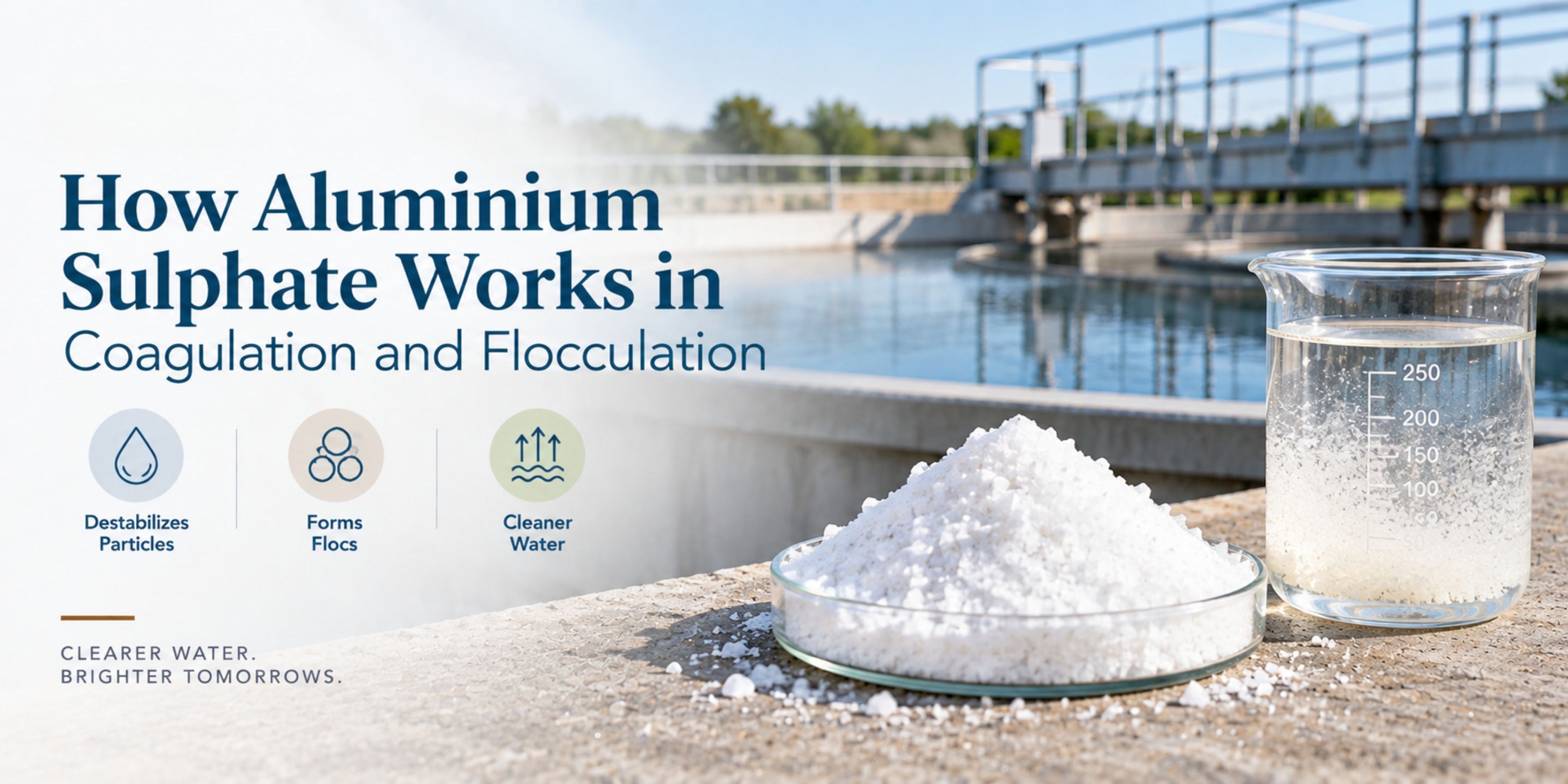
How Aluminium Sulphate Works in Coagulation and Flocculation
Clean water does not happen by accident. Behind every clear glass of drinking water and every treated wastewater stream, there is a chemical process working hard to remove dirt, silt, and invisible particles. One chemical has powered this process for well over a century, and it is still the most trusted name in water treatment plants across the world.
Aluminium Sulphate in Coagulationand Aluminium Sulphate in Flocculation are two closely connected steps that turn murky, contaminated water into clear, usable water.
In this blog, we will explain how this chemical works, why it is so effective, and where it is used, in simple language that anyone can follow.
What Is Aluminium Sulphate?
Aluminium sulphate, often called alum, is a white crystalline compound with the chemical formula Al2(SO4)3. It dissolves easily in water and has been used for water purification since ancient times, though it became a standard part of modern treatment plants during the nineteenth century. Because it is affordable, easy to handle, and highly effective, it remains one of the most widely used coagulants in the water treatment industry today.
Before we get into how it works, it helps to understand the two processes it drives: coagulation and flocculation. These are not the same thing, even though people often use the words together.
Coagulation vs Flocculation: What Is the Difference?
Coagulation is a fast chemical reaction. When aluminium sulphate is added to raw water during rapid mixing, it dissociates almost instantly into positively charged aluminium ions. These ions neutralize the negative charge that naturally surrounds tiny suspended particles like clay, silt, and organic matter, allowing them to stop repelling each other.
Flocculation, on the other hand, is a slower, physical process. Once the particles lose their charge, they need gentle stirring to bump into each other and stick together, forming larger clumps called floc. This is why water treatment plants follow coagulation with a slow mixing stage rather than continuing rapid agitation.
Understanding this difference is important because Aluminium Sulphate Coagulant performs both roles at once, first neutralizing charge, then supporting floc growth, making it a complete solution for water clarification in a single dose.
How Aluminium Sulphate Works Step by Step
The full Aluminium Sulphate Coagulation Process can be broken down into a few clear stages.
- Dosing and rapid mixing: Aluminium sulphate is added to raw water in a flash mix tank, where high-speed mixing spreads the chemical evenly through the water within seconds.
- Hydrolysis and ion release: Once dissolved, the compound breaks apart into aluminium ions and sulphate ions. The aluminium ions react with water molecules and undergo hydrolysis, forming positively charged aluminium hydroxide species.
- Charge neutralization: These positively charged species attach to the negatively charged surfaces of suspended particles, cancelling out the repulsive forces that normally keep particles apart in water.
- Micro-floc formation: As particles lose their charge, they begin to collide and form tiny clusters known as micro-floc.
- Slow mixing and floc growth: Water then moves to a flocculation basin, where gentle stirring, usually between 100 and 200 rpm, encourages micro-flocs to combine into larger, visible floc particles.
- Sedimentation: The heavier floc particles settle to the bottom of a sedimentation tank due to gravity, leaving clear water above.
- Filtration: Any remaining fine particles are removed through sand or media filters, producing water that meets purity standards.
This process shows exactly why Aluminium Sulphate for Water Purification remains a preferred method across the globe. It relies on a natural chemical reaction combined with simple physical settling, making it both effective and economical.
The Science Behind Charge Neutralization and Sweep Flocculation
Aluminium sulphate purifies water mainly through two mechanisms working together.
Charge neutralization happens when positively charged aluminium species directly cancel the negative charge on suspended particles, allowing them to come together instead of repelling each other. This mechanism works best at lower coagulant doses and is common in water with moderate turbidity.
Sweep flocculation happens at higher doses, where aluminium hydroxide forms a gel like precipitate that physically traps and drags down suspended particles as it settles. This mechanism is often used for water with very high turbidity or heavy pollutant loads.
Depending on the raw water quality, treatment plants may rely more heavily on one mechanism or a combination of both to achieve the best clarity.
Why pH Matters in the Coagulation Process
One factor that heavily influences how well Aluminium Sulphate in Coagulation performs is the pH level of the water. Aluminium sulphate works best within a fairly narrow pH range, typically between 6.5 and 7.5. If the pH drops too low or rises too high, the aluminium hydroxide floc does not form properly, and coagulation becomes far less effective.
This is why treatment plants closely monitor pH and alkalinity before and during dosing. Since aluminium sulphate reacts with natural alkalinity in water and can lower pH as it dissolves, operators often need to balance the dose with alkalinity adjusters like soda ash to keep the process stable and efficient.
Typical Dosage and Operating Parameters
| Parameter | Typical Range | Purpose |
|---|---|---|
| Coagulant dose | 10 to 150 mg/L | Depends on raw water turbidity and pollutant load |
| Optimal pH range | 6.5 to 7.5 | Ensures proper floc formation |
| Flash mix speed | High speed, few seconds | Even distribution of coagulant |
| Flocculation speed | 100 to 200 rpm | Encourages gentle floc growth |
| Settling time | 30 minutes to a few hours | Allows floc to sink in sedimentation tank |
These figures can vary depending on the specific water source, so most treatment plants run jar tests to determine the ideal dose before scaling up to full plant operations.
Applications of Aluminium Sulphate in Water Treatment
The use of Aluminium Sulphate for Water Purification spans several sectors, not just municipal drinking water supply.
- Municipal drinking water treatment: Used as the primary coagulant to remove turbidity, color, and microorganisms from raw water before it reaches households.
- Industrial wastewater treatment: Helps industries meet discharge standards by removing suspended solids, phosphorus, and organic pollutants before water is released into the environment.
- Paper manufacturing: Used in sizing processes to improve paper quality and control ink absorption.
- Swimming pool and pond maintenance: Applied in smaller doses to clear cloudy water and improve overall water quality in recreational water bodies.
- Textile and dyeing industries: Assists in removing dyes and suspended particles from industrial effluent before discharge.
Advantages of Using Aluminium Sulphate as a Coagulant
- Cost-effective compared to many alternative coagulants
- Widely available and easy to store and handle
- Works efficiently across a broad range of turbidity levels
- Proven track record with over a century of use in water treatment
- Compatible with standard treatment plant infrastructure, requiring no special equipment
Limitations to Keep in Mind
While Aluminium Sulphate in Flocculation is highly effective, a few practical points need attention.
- It performs best only within a specific pH range, so pH monitoring is essential
- Overdosing can leave residual aluminium in treated water, which needs to be controlled through careful dosing
- It generates sludge that requires proper thickening, dewatering, and disposal
- Very cold water can slow down the reaction rate, requiring dose adjustments in winter conditions
Despite these limitations, proper dosing control and regular jar testing allow treatment plants to manage these challenges effectively, which is why aluminium sulphate continues to dominate the coagulant market worldwide.
Sourcing Reliable Aluminium Sulphate for Water Treatment
The success of any coagulation and flocculation process depends heavily on the purity and consistency of the aluminium sulphate used. Impurities or inconsistent alumina content can affect dosing accuracy and treatment results, which is why sourcing from a trusted manufacturer matters.
HTMC Group is a leading mineral and chemical manufacturer and supplier in India, offering high-purity aluminium sulphate along with a wide range of industrial minerals to sectors including water treatment, textile, paper, and chemical processing. With decades of manufacturing experience, in-house quality testing labs, and a strong global supply network, HTMC Group ensures consistent product quality that water treatment plants and industries can rely on for stable, predictable results.
Conclusion
From ancient purification methods to modern municipal treatment plants, aluminium sulphate has remained a cornerstone chemical for clearing water of impurities. The combination of fast charge neutralization during coagulation and gentle floc building during flocculation makes the Aluminium Sulphate Coagulation Process one of the most reliable and economical methods available today. As water demand continues to grow across the world, dependable and high-purity aluminium sulphate will remain essential to keeping water supplies safe, clear, and fit for use.
Get in Touch with HTMC Group
Looking for high-purity aluminium sulphate for your water treatment or industrial process needs? HTMC Group is ready to support your supply chain with consistent quality and reliable delivery.
- Call Us: +91 33 2226 8228, +91 98 1140 9161
- Enquire Now: [email protected]
Frequently Asked Questions
It is used as a coagulant to remove turbidity, suspended solids, and organic matter from raw water, making it a key chemical in both drinking water and wastewater treatment.
When added to water, it releases positively charged aluminium ions that neutralize the negative charge on suspended particles, allowing them to clump together and settle out.
Coagulation is a fast chemical reaction that neutralizes particle charge, while flocculation is a slower physical process where gentle mixing helps particles combine into larger, settleable floc.
Aluminium sulphate works best within a pH range of 6.5 to 7.5. Outside this range, floc formation becomes weak and treatment efficiency drops.
Yes, when dosed correctly and monitored for residual aluminium levels, aluminium sulphate is considered safe and has been used in drinking water treatment for over a century.
It reacts with natural alkalinity in water during hydrolysis, which consumes alkalinity and can reduce pH, so operators often adjust alkalinity separately to keep the process stable.
Raw water turbidity, temperature, alkalinity, and the type of pollutants present all influence the required dose, which is why jar testing is commonly used to find the optimal amount.
Yes, it is widely used to remove suspended solids, phosphorus, and organic pollutants from industrial effluent before it is discharged or reused.
The settled floc forms sludge, which is collected and treated further through thickening and dewatering before final disposal or reuse.
HTMC Group is a trusted mineral and chemical manufacturer in India offering high-purity aluminium sulphate suitable for water treatment and industrial applications, backed by strong quality control and reliable supply.
Contact Us

×