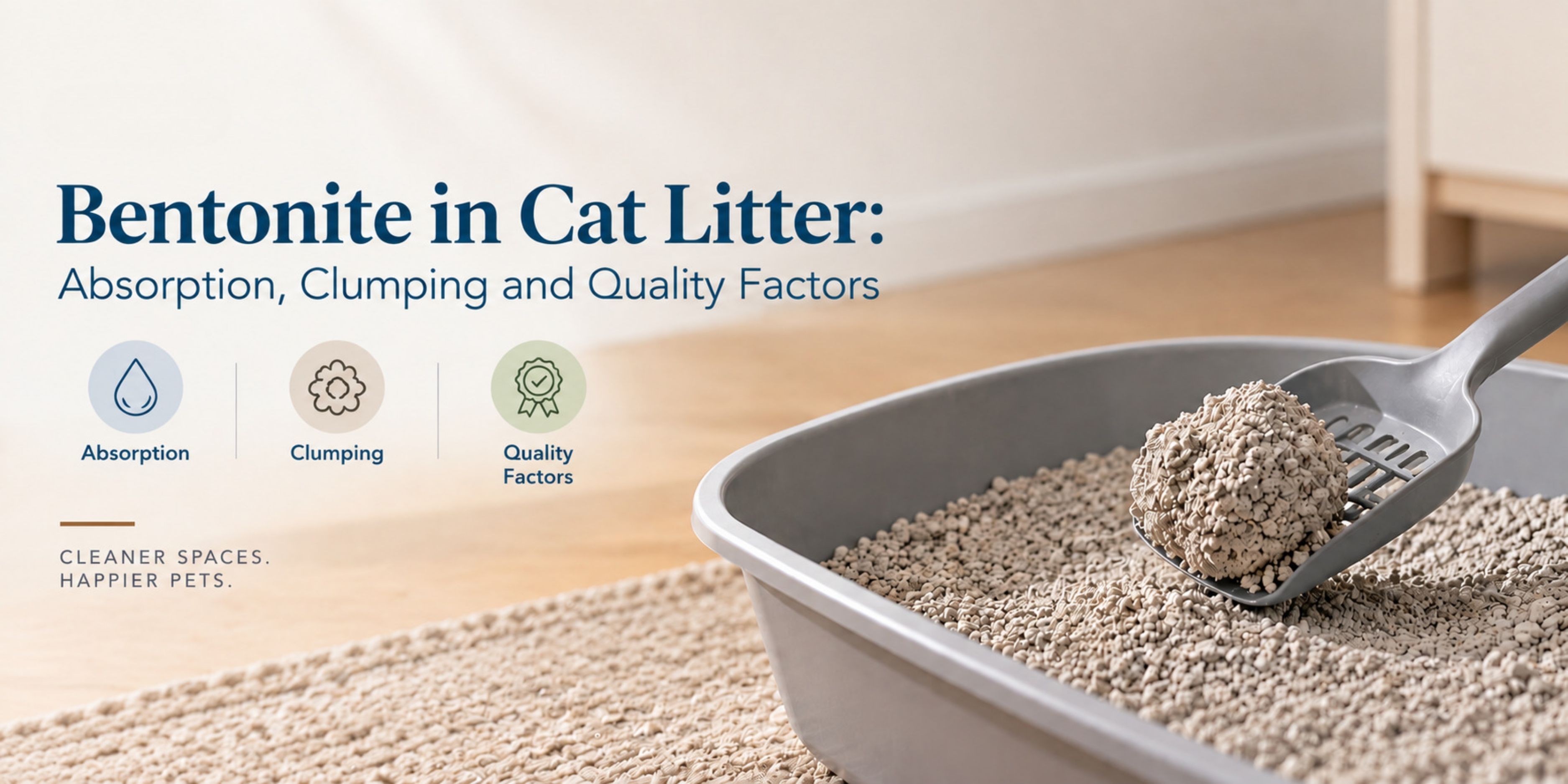
Bentonite in Cat Litter: Absorption, Clumping and Quality Factors
Cat litter might seem like a simple household product, but the science behind it is surprisingly detailed. Among all the raw materials used to make clumping litter, one mineral stands far above the rest in popularity and performance: bentonite clay.
Bentonite in Cat Litter is the reason modern clumping litters can absorb liquid instantly, form solid clumps, and control odor far better than older, non-clumping products.
In this blog, we will explain exactly how bentonite works inside a litter box, what separates a high-quality batch from a poor one, and what factors buyers and manufacturers should check before finalizing a supply source.
Why Bentonite Is Used in Cat Litter
Bentonite is a natural clay formed from the weathering of volcanic ash, and it is composed mainly of a mineral called montmorillonite. This mineral has a unique plate-like, layered structure. When liquid comes into contact with these layers, water molecules move into the gaps between the plates, causing the clay to expand rapidly.
This single property, the ability to swell and lock in moisture, is why Bentonite Cat Litter has become the industry standard across pet care brands worldwide. Unlike plant-based or silica-based alternatives, bentonite offers a rare combination of low cost, strong absorption, and reliable clumping, all from a naturally occurring mineral.
How Absorption Works in Bentonite Cat Litter
Absorption in bentonite happens in two stages, and understanding this helps explain why some litters perform better than others.
Instant Surface Absorption:As soon as liquid touches the granule, the outer surface of the clay begins pulling moisture in through capillary action. This happens within the first few seconds of contact.
Structural Expansion: As water penetrates deeper into the clay's layered structure, the particles swell and interlock with neighboring granules. High-quality sodium-based clay can expand many times its original dry volume during this stage, which is what gives the litter its strong moisture-holding capacity.
Good-quality bentonite for Cat Litter can absorb several times its own weight in liquid. This is significantly higher than traditional clay litters and is one of the biggest reasons pet owners prefer clumping formulas over older, loose granular litters.
The Science Behind Clumping
Absorption alone does not make a good litter. The clumping stage is just as important, because it determines how easily waste can be scooped and removed without leaving a mess behind.
Once the clay has absorbed enough liquid, the swollen particles bond together, forming a tight, solid clump around the moisture. A well-formulated litter will create a clump with a firm outer "skin" within one to three minutes of contact, and it should hold together fully by the time it is scooped, usually around ten minutes later.
Three factors decide how strong this clump will be:
- Granule Size: Finer granules generally absorb faster and clump tighter, but if they are too fine, they can increase dust levels.
- Purity of the Clay: Higher montmorillonite content leads to significantly better clumping strength, while diluted or low-grade clay produces crumbly, weak clumps.
- Litter Bed Depth: Even with excellent raw material, a shallow litter bed will let liquid reach the bottom of the tray before the clump can fully form, resulting in flat, smeared deposits instead of clean, solid clumps.
Sodium Bentonite Cat Litter: Why It Performs Best
Not all bentonite is the same. Clay can be dominated by either sodium or calcium ions, and this difference has a major impact on litter performance. Sodium Bentonite Cat Litter is widely considered the superior choice for clumping products because sodium ions create much stronger electrostatic repulsion between clay layers, allowing far greater swelling compared to calcium-based clay.
While calcium bentonite does absorb moisture, it does not expand nearly as much, which results in looser, weaker clumps that are harder to scoop cleanly. This is why most premium clumping litter brands specifically source sodium-rich bentonite rather than calcium-dominant clay, even though calcium bentonite may be cheaper in some regions.
Odor Control: A Hidden Benefit of Bentonite
Beyond absorption and clumping, bentonite also plays an active role in controlling odor. Cat urine breaks down into ammonia fairly quickly, and bentonite's layered structure allows it to trap and hold odor-causing compounds through natural ion exchange. This means the clay is not simply masking smell with fragrance; it is chemically capturing part of the problem at a mineral level. This is one of the reasons a well-maintained bentonite litter box tends to smell noticeably cleaner than boxes filled with lower-grade alternatives.
Quality Factors Buyers Should Check
For manufacturers and private label brands sourcing raw material, not every batch of bentonite delivers the same performance. Below is a simple comparison of what separates high-quality clay from low-grade material.
| Quality Factor | High-Quality Bentonite | Low-Quality Bentonite |
|---|---|---|
| Montmorillonite Content | High, strong clumping and absorption | Low, weak or crumbling clumps |
| Dust Level | Typically kept at 3 percent or lower | High dust, poor air quality in the home |
| Moisture Content | Controlled and consistent | Inconsistent, affects shelf life |
| Particle Size Distribution | Uniform, screened through multi-stage sieving | Uneven, causing inconsistent clumping |
| Clump Strength | Firm, holds together during scooping | Breaks apart, leaves residue in the tray |
| Color and Odor | Neutral, clean-smelling clay | Off-odor or discoloration, sign of impurities |
Buyers working with Bentonite Cat Litter Manufacturers should always request test data or samples covering these parameters before committing to bulk orders, since even small differences in processing can significantly change final product performance.
What Sets a Reliable Supplier Apart
Sourcing raw bentonite for pet care production is very different from sourcing it for construction or drilling applications. Litter-grade clay needs to meet specific standards for dust control, granule uniformity, and swelling capacity, all while remaining safe for daily contact with pets.
Reliable Bentonite Cat Litter Suppliers typically follow a multi-stage process that includes raw ore crushing, screening, dust removal, and quality testing before the material reaches manufacturing lines. Skipping any of these steps might reduce production cost, but it almost always results in a lower-performing final product, something that pet care brands cannot afford if they want repeat customers.
HTMC Group: Reliable Bentonite Supply for Cat Litter Manufacturing
At HTMC Group, we understand that litter-grade bentonite has to meet a different standard compared to industrial-grade clay. Our processed bentonite is screened and tested for particle uniformity, swelling capacity, and low dust content, making it well-suited for clumping litter production.
Whether you are an established pet care brand or a manufacturer developing a new private label product, our team can supply consistent, quality-tested Bentonite in cat litter-grade material that supports strong absorption and reliable clumping, batch after batch.
Get in Touch with HTMC Group
Looking for a dependable source of high-quality bentonite for your cat litter production line? Our technical team at HTMC Group is ready to help you find the right grade for strong clumping, low dust, and consistent performance.
- Call Us: +91 33 2226 8228, +91 98 1140 9161
- Enquire Now: [email protected]
Reach out today and let HTMC Group be your trusted partner for reliable bentonite supply.
Frequently Asked Questions
Bentonite is used because of its natural ability to absorb large amounts of liquid and form solid, easy-to-remove clumps, making litter box cleaning much simpler.
High-quality bentonite can absorb several times its own weight in liquid, offering much stronger absorption compared to traditional non-clumping clay litters.
Sodium bentonite swells much more than calcium bentonite, which results in tighter, stronger clumps, making it the preferred choice for premium clumping litter products.
Dust levels depend on how the raw clay is processed. Poor screening and inadequate dust removal during manufacturing lead to higher dust content in the final product.
A firm outer layer usually forms within one to three minutes of contact with liquid, while the clump becomes fully solid and ready for scooping within about ten minutes.
Yes, bentonite naturally traps ammonia and other odor-causing compounds through ion exchange, helping keep the litter box smelling cleaner for longer.
Buyers should check montmorillonite content, dust levels, particle size uniformity, and clump strength before finalizing a bulk purchase from any supplier.
Yes, properly processed bentonite cat litter is non-toxic and widely used across the pet care industry, though litter boxes should be cleaned regularly to maintain hygiene.
If the litter bed is too shallow, liquid can reach the bottom of the tray before a proper clump forms, resulting in weak, smeared deposits instead of clean, solid clumps.
Manufacturers should request lab test data or samples for absorption rate, clump strength, and dust content, and work with suppliers who follow strict multi-stage processing standards.
Contact Us

×