What Is Ammonium Bicarbonate? Applications in Food & Industry
What is ammonium bicarbonate, and why is it widely used across food and industrial sectors? Ammonium bicarbonate is an important inorganic compound known for its leavening, buffering, and decomposing properties. It has been used for decades in baking, food processing, agriculture, pharmaceuticals, and chemical manufacturing. Due to its clean decomposition into harmless gases, ammonium bicarbonate remains a preferred choice in many applications where residue-free processing is essential.
This article provides a detailed explanation of what ammonium bicarbonate is, its chemical properties, and its key applications in food and industry, helping businesses and buyers understand its value and uses.
What Is Ammonium Bicarbonate?
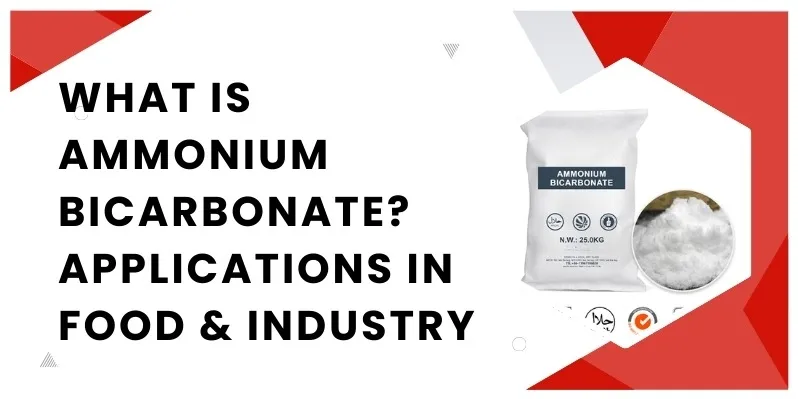
Ammonium bicarbonate is a white crystalline powder with the chemical formula NH₄HCO₃. It is produced by reacting ammonia, carbon dioxide, and water under controlled conditions. When heated, ammonium bicarbonate decomposes easily into ammonia gas, carbon dioxide, and water vapor, leaving no solid residue behind.
This unique property makes it extremely useful in applications such as baking and industrial processing, where clean decomposition is required. Ammonium bicarbonate is also water-soluble and has a mild alkaline nature, making it suitable for buffering and pH control.
Chemical Properties of Ammonium Bicarbonate
Understanding the chemical behavior helps clarify why ammonium bicarbonate is so widely used.
- Appearance: White crystalline powder
- Odor: Slight ammonia smell
- Solubility: Highly soluble in water
- Decomposition temperature: Around 36–60°C
- pH (aqueous solution): Mildly alkaline
Because it decomposes at relatively low temperatures, ammonium bicarbonate is not stable at high heat for long periods, which is why proper storage conditions are important.
Applications of Ammonium Bicarbonate in the Food Industry
1. Leavening Agent in Baking
One of the most common answers to "What is ammonium bicarbonate used for?" is baking. It is widely used as a leavening agent in baked goods such as biscuits, cookies, crackers, and flat bakery items.
When heated during baking, ammonium bicarbonate releases carbon dioxide and ammonia, creating air pockets that give products a light and crispy texture. Since it leaves no residue, it is ideal for thin and dry bakery products.
2. Traditional Baking Ingredient
Ammonium bicarbonate has been used for centuries in traditional baking, long before modern baking powder was developed. It is still preferred for recipes where rapid gas release is required without moisture retention.
3. Dough Conditioning
In food processing, ammonium bicarbonate helps regulate acidity and improve dough structure. It assists in achieving uniform texture and consistent product quality.
Industrial Applications of Ammonium Bicarbonate
1. Fertilizer Industry
In agriculture, ammonium bicarbonate serves as a nitrogen-rich fertilizer. It provides an easily available nitrogen source that supports plant growth. Though it has lower stability compared to other fertilizers, it is still used in controlled agricultural environments.
2. Chemical Manufacturing
Ammonium bicarbonate is an important intermediate in chemical synthesis. It is used in the production of ammonium salts, fire extinguishing compounds, and specialty chemicals.
3. Pharmaceutical Industry
In pharmaceuticals, ammonium bicarbonate is used as a buffering agent and in certain formulations where pH control is required. Its clean decomposition makes it suitable for sensitive processing environments.
4. Textile and Leather Processing
In textile printing and leather treatment, ammonium bicarbonate is used to control pH levels and assist in dye fixation. It improves processing efficiency without leaving harmful residues.
Role of Ammonium Bicarbonate in Environmental Applications
Ammonium bicarbonate is also used in flue gas treatment and pollution control processes. It helps reduce harmful emissions by reacting with acidic gases, making it useful in environmental protection technologies.
Advantages of Using Ammonium Bicarbonate
- Leaves no solid residue after decomposition
- Effective leavening and gas-releasing agent
- Highly soluble and easy to handle
- Cost-effective for industrial use
- Suitable for food-grade and industrial-grade applications
These benefits explain why ammonium bicarbonate remains a preferred compound across multiple sectors.
Storage and Handling Guidelines
Proper storage is essential due to its unstable nature at higher temperatures.
- Store in a cool, dry, and well-ventilated area
- Keep away from heat and direct sunlight
- Seal containers tightly to prevent ammonia loss.
- Avoid long-term exposure to moisture.
Correct handling ensures consistent performance and extended shelf life.
Food Grade vs. Industrial Grade Ammonium Bicarbonate
Food-grade ammonium bicarbonate meets strict purity and safety standards, making it suitable for human consumption. Industrial-grade material may contain higher impurity levels and is used in non-food applications such as fertilizers, chemicals, and textiles. Buyers should always select the appropriate grade based on end use.
Future Demand and Market Importance
With rising demand for baked goods, processed foods, and eco-friendly industrial solutions, ammonium bicarbonate continues to hold strong market relevance. Its versatility, low cost, and safe decomposition support its ongoing use in both traditional and modern applications.
Conclusion
So, What Is Ammonium Bicarbonate? It is a versatile chemical compound with critical roles in food production, agriculture, pharmaceuticals, and industrial processing. Its ability to decompose cleanly into harmless gases makes it especially valuable in baking and sensitive industrial operations. Understanding its properties, applications, and handling requirements helps businesses make informed decisions and maintain product quality.
Get in touch with us!
×