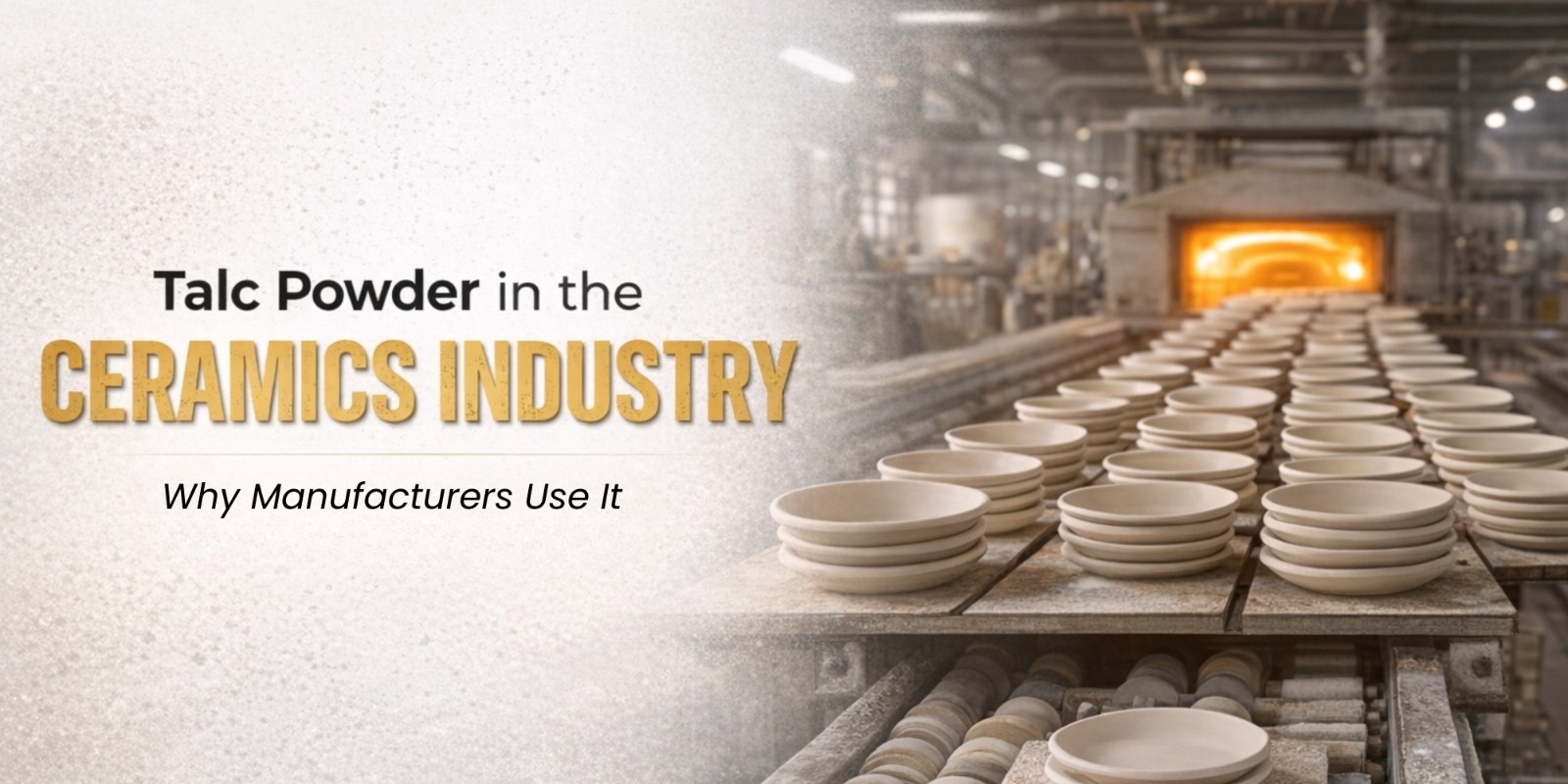
Talc Powder in Ceramics Industry: Why Manufacturers Use It
In the world of industrial manufacturing, minerals form the silent backbone of production. From construction materials to advanced ceramics, the right mineral inputs determine product quality, processing efficiency, and long-term performance. Among these essential minerals, talc stands out as one of the most versatile and widely used raw materials across a broad range of industries.
For ceramic manufacturers in particular, talc powder has become an indispensable ingredient. Whether producing floor tiles, sanitary ware, technical ceramics, or refractory products, industrial buyers and production managers consistently turn to talc minerals in ceramic manufacturing to achieve superior results. This article explores what makes talc so valuable, how it is processed, and why its demand continues to grow across global markets.
What Is Talc? Properties and Characteristics
Talc is a naturally occurring hydrated magnesium silicate mineral with the chemical formula Mg₃Si₄O₁₀(OH)₂. It is the softest mineral on the Mohs hardness scale, rated at just 1, which gives it a characteristic greasy or soapy feel. This softness, combined
with its platy crystal structure, makes talc uniquely easy to grind and disperse into industrial formulations.
Key Physical and Chemical Properties
High whiteness and brightness — ideal for applications requiring clean aesthetics
Excellent chemical inertness — resistant to acids, alkalis, and heat
Low electrical and thermal conductivity
High melting point (approximately 1500°C), making it suitable for high-temperature applications
A hydrophobic surface that repels water while effectively absorbing oils.
Platelet particle shape improves mechanical reinforcement in composite materials.
These properties make talc particularly attractive for ceramic applications where thermal stability, whiteness, and precise melting behavior are critical.
How Talc Is Processed for Industrial Use
The journey from raw talc ore to refined industrial talc powder involves several carefully controlled processing stages. The quality of the final product depends heavily on the consistency and precision of each step.
Mining and Ore Selection
Talc deposits are found in metamorphic rock formations worldwide, with major reserves in India, China, the United States, France, and Finland. High-quality talc ore is selected based on purity, whiteness, and mineralogical composition. Ore with low levels of contaminants such as iron, calcium, or carbonates is prioritized for premium ceramic-grade talc.
Crushing, Grinding and Classification
After mining, the ore undergoes primary crushing followed by fine grinding using mills such as roller mills or ball mills. The ground material is then air-classified to achieve precise particle size distributions. Industrial talc powder for ceramics is typically produced in various grades ranging from coarse powders (D50 ~20–50 microns) to ultrafine powders (D50 ~2–5 microns), depending on the end application.
Quality Control and Certification
Reputable talc manufacturers conduct rigorous quality testing at every stage, including X-ray diffraction (XRD) analysis, chemical assays, brightness measurements, and particle size analysis. Certified grades meeting ISO and industry-specific standards are essential for consistent ceramic production.
Major Industrial Applications of Talc
Talc’s unique combination of properties supports its use across a wide spectrum of industrial sectors. While talc in ceramics is one of its most significant applications, the mineral’s utility extends well beyond.
Ceramics (Primary Focus)
Talc powder uses in ceramics span multiple product categories. In traditional ceramics such as tiles, sanitary ware, and tableware, talc acts as a fluxing agent that lowers the sintering temperature while improving the density and translucency of the final product. In technical or advanced ceramics, talc contributes to precisely controlled thermal expansion coefficients and enhanced dielectric properties.
Paints and Coatings
Talc functions as an extender pigment in paints, improving scrub resistance, anti-sagging behavior, and film opacity. Its platelet structure reinforces the paint film and reduces the overall cost of formulation.
Plastics and Polymers
In polypropylene and other thermoplastics, talc is a high-performance filler that increases stiffness, dimensional stability, and heat deflection temperature. The automotive and packaging industries are leading consumers of talc-filled plastics.
Paper, Chemicals and Agriculture
In the paper industry, talc controls resin and pitch deposits during pulp processing. In agriculture, it is used as a carrier for pesticides and as a dusting agent on seeds. The chemicals sector uses talc as a filler and anti-caking agent in various formulations.
Key Benefits of Talc in Ceramic Manufacturing
The benefits of talc in ceramics are well-documented and continue to drive its adoption among manufacturers worldwide. Here is why ceramic producers choose talc as a core raw material:
1. Improved Firing Efficiency Talc acts as a mineralizer and flux in ceramic bodies, reducing the firing temperature required to achieve full densification. This translates directly into lower kiln energy consumption and faster production cycles—a critical advantage for large-scale tile and sanitary ware manufacturers.
2. Enhanced Thermal Stability Ceramics produced with talc mineral in ceramic manufacturing demonstrate excellent resistance to thermal shock. The controlled conversion of talc to enstatite during firing creates a stable microstructure that withstands rapid temperature changes.
3. Superior Whiteness and Aesthetics High-purity industrial talc powder for ceramics contributes to a bright, clean white body color, which is especially important for wall tiles, porcelain tableware, and sanitary products where surface aesthetics are a primary selling point.
4. Low Shrinkage and Dimensional Accuracy Talc helps reduce overall shrinkage during the drying and firing stages, improving the dimensional precision of the finished ceramic product. For precision technical ceramics used in electronics or engineering components, this benefit is particularly significant.
5. Better Plasticity and Green Strength When incorporated into ceramic bodies during mixing and shaping, talc’s platy particles improve plasticity, making the green (unfired) ware easier to form and handle without cracking. This reduces defect rates and material waste in the production process.
Market Demand and Industry Trends
The global talc market has demonstrated consistent growth and is expected to continue expanding over the coming years, driven by rising demand from several high-growth end-use sectors.
Growing Ceramic Industry in Asia-Pacific
Asia-Pacific, particularly India, China, and Southeast Asia, dominates global ceramic tile and sanitaryware production. As urbanization accelerates across these regions, construction activity is driving unprecedented demand for talc in ceramics. India alone has emerged as both one of the world’s largest producers and consumers of ceramic-grade talc.
Rising Demand for Technical Ceramics
Advanced ceramics for electronics, aerospace, and biomedical applications represent a rapidly growing niche. These applications demand high-purity, ultrafine talc with tightly controlled particle size and chemistry, creating premium market opportunities for specialized talc suppliers.
Sustainability and Energy Efficiency Trends
As ceramic manufacturers face increasing pressure to reduce energy consumption and carbon emissions, talc’s role as a firing aid becomes even more strategically important. Its ability to lower kiln temperatures directly reduces fuel costs and greenhouse gas emissions, aligning with global sustainability targets and green manufacturing initiatives.
Choosing the Right Talc Supplier: Quality That Matters
The performance advantages of talc in ceramics are only fully realized when manufacturers source from reliable, quality-focused suppliers. Inconsistent raw material quality — whether in particle size distribution, whiteness, moisture content, or chemical purity — can introduce variability into the ceramic production process, leading to increased rejection rates, kiln inefficiencies, and product failures.
Industrial buyers and procurement managers should prioritize suppliers who offer certified talc grades backed by consistent laboratory testing, traceability from mine to finished powder, and the capacity to fulfill large-volume orders on reliable schedules. A trusted talc partner is not just a material vendor—they are a critical link in your quality supply chain.
Whether you are a tile manufacturer seeking cost-effective firing solutions, a technical ceramics producer demanding ultrahigh purity, or a purchasing manager looking to secure a consistent supply of industrial talc powder for ceramics, partnering with a reputable mineral processing company ensures that your production targets and quality standards are consistently met.
In an industry where raw material quality directly determines finished product excellence, talc mineral in ceramic manufacturing is too important to leave to chance. Choose your supplier wisely — and let the natural power of talc elevate your ceramics to the next level.
Get in touch with us!
×