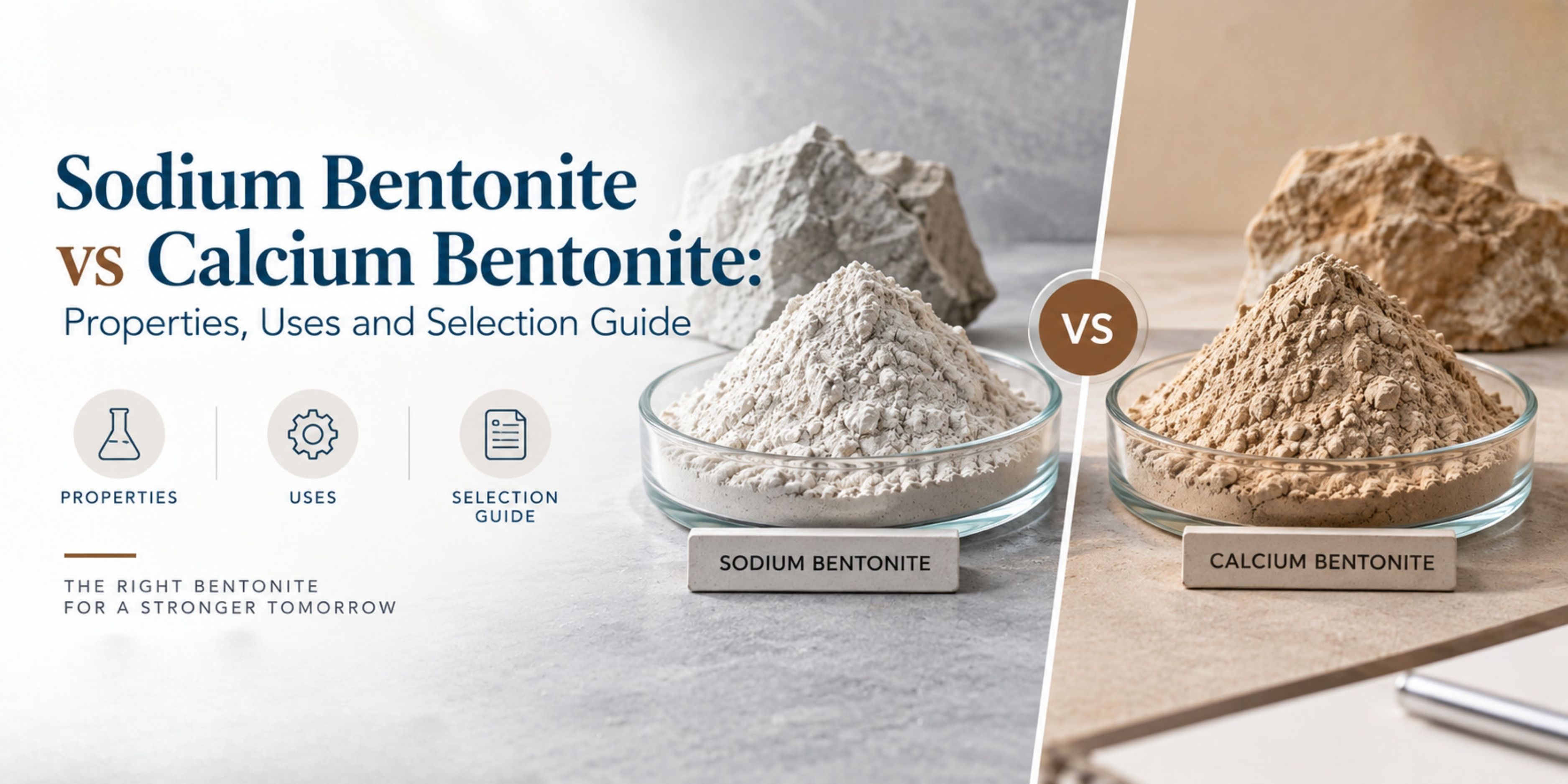
Sodium Bentonite vs Calcium Bentonite: Properties, Uses and Selection Guide
Bentonite is one of the most versatile industrial minerals available today. It is a naturally occurring clay, formed mainly from the weathering of volcanic ash, and is dominated by a mineral called montmorillonite. But not all bentonite behaves the same way. Depending on which ion, sodium or calcium, dominates its structure, the clay's swelling power, absorption behavior, and end use change completely.
This is exactly why the Sodium Bentonite vs Calcium Bentonite comparison matters so much for industries ranging from oil drilling and foundry casting to civil engineering and cosmetics. Choosing the wrong type can lead to poor mold quality, weak sealing performance or product failure. In this guide, we will break down both types in detail, compare their properties side by side, and help you decide which one is right for your application.
What Is Bentonite and Why Does the Type of Ion Matter?
Bentonite clay has a layered silicate structure with a cation sandwiched between its layers. This cation is usually sodium (Na+) or calcium (Ca2+), and it is this single difference that separates the two commercial classes of bentonite. When water enters the clay structure, the type of ion present determines how much the clay swells, how it disperses, and how strongly it bonds with other materials.
In simple terms, Sodium Bentonite Properties are built around high swelling and dispersion, while Calcium Bentonite Properties are built around stability and strong adsorption without excessive expansion.
Sodium Bentonite: Key Properties
Sodium bentonite is often referred to as "swelling bentonite" because of its dramatic reaction with water. When hydrated, sodium ions create strong electrostatic repulsion between the clay layers, causing the material to expand significantly.
Key Sodium Bentonite Properties include:
- Swells 12 to 20 times its original dry volume when mixed with water
- Forms a thick, gel-like, thixotropic suspension
- Very low permeability once hydrated, making it ideal for watertight seals
- High plasticity and strong dry bonding strength
- Remains stable at higher temperatures compared to calcium bentonite
- Excellent viscosity-building and suspension properties
This swelling behavior is the reason sodium bentonite is the preferred choice wherever a strong, flexible, self-sealing barrier is needed.
Calcium Bentonite: Key Properties
Calcium bentonite, sometimes called "non-swelling bentonite" or historically known as Fuller's earth, behaves very differently in water. Because calcium ions create stronger interlayer bonding, the clay structure resists expansion.
Key Calcium Bentonite Properties include:
- Swells only 2 to 3 times its dry volume, much less than sodium bentonite
- Strong adsorptive capacity, meaning it binds well with oils, toxins, and impurities on its surface
- More stable structure with less clumping during processing
- Naturally higher in calcium content, often light in color
- Commonly available in regions where sodium-rich deposits are limited
Because it does not swell as aggressively, calcium bentonite is generally chosen for applications where controlled adsorption matters more than gel formation.
Sodium Bentonite vs Calcium Bentonite: Side-by-Side Comparison
| Property | Sodium Bentonite | Calcium Bentonite |
|---|---|---|
| Dominant Ion | Sodium (Na+) | Calcium (Ca2+) |
| Swelling Capacity | High, 12 to 20 times dry volume | Low, 2 to 3 times dry volume |
| Water Absorption | Very high, gel-forming | Moderate, surface adsorption |
| Permeability After Hydration | Very low, watertight | Comparatively higher |
| Viscosity Building | Strong, thixotropic gel | Limited gel formation |
| Thermal Stability | More stable at high heat | Less stable at high heat |
| Common Name | Swelling bentonite | Fuller's earth / non-swelling bentonite |
| Main Industries | Drilling, foundry, civil engineering | Cosmetics, animal feed, adsorption-based uses |
This table makes the practical difference clear. If your process depends on expansion, gel strength, and sealing, sodium bentonite is the answer. If your process depends on binding and adsorption without excessive swelling, calcium bentonite fits better.
Sodium Bentonite Uses Across Industries
Because of its strong swelling and sealing behavior, Sodium Bentonite Uses span across some of the heaviest industrial sectors:
- Oil and Gas Drilling: Used as a key component in drilling mud, sodium bentonite stabilizes boreholes, suspends drill cuttings, lubricates the drill bit, and controls fluid loss under pressure.
- Foundry and Metal Casting: As a binder in green sand molds, sodium bentonite provides excellent mold strength, flowability, and thermal stability, reducing casting defects during metal pouring.
- Civil Engineering and Waterproofing: Sodium bentonite is used in landfill liners, pond and canal linings, slurry walls, and basement waterproofing because of its extremely low permeability once hydrated.
- Iron Ore Pelletizing: It acts as a binding agent that gives iron ore pellets the strength needed to withstand handling and transportation before smelting.
- Cat Litter and Absorbent Products: Its rapid clumping ability when it contacts liquid makes it the preferred clay for scoopable cat litter.
Calcium Bentonite Uses Across Industries
While sodium bentonite dominates heavy industrial sealing and drilling applications, Calcium Bentonite Uses are more focused on adsorption-driven processes:
- Cosmetics and Skincare: Calcium bentonite is widely used in facial masks and skincare formulations because of its ability to adsorb excess oil and impurities from the skin without excessive expansion.
- Animal Feed Additives: It is used as a mycotoxin binder and pelletizing aid in livestock feed, helping improve digestion and feed quality.
- Foundry Applications: In some regions, particularly where sodium-rich deposits are limited, calcium bentonite is also used in foundry sand, sometimes after being chemically activated to improve its bonding behavior.
- Oil and Fat Refining: Its natural adsorptive property makes it useful in bleaching and purifying edible oils by removing color bodies and impurities.
- Detox and Wellness Products: Calcium bentonite is a common ingredient in clay-based detox products, valued for its surface adsorption of toxins.
Can Calcium Bentonite Be Converted to Sodium Bentonite?
Yes, and this is an important point for industrial buyers. Calcium bentonite can be treated with sodium carbonate, commonly known as soda ash, through a process called sodium activation. This exchanges calcium ions for sodium ions and gives the clay swelling properties similar to natural sodium bentonite. Activated sodium bentonite is often used in regions where naturally occurring sodium-rich deposits are limited, allowing manufacturers to still meet drilling or sealing specifications.
How to Choose Between Sodium and Calcium Bentonite
When deciding which type fits your application, consider the following factors:
- Do you need sealing or waterproofing? Choose sodium bentonite for its low permeability and strong gel-forming behavior.
- Do you need adsorption without excessive swelling? Choose calcium bentonite, especially for cosmetic, feed, or refining applications.
- Is your process temperature-sensitive? Sodium bentonite generally performs better under higher thermal stress, making it more suitable for foundry and drilling operations.
- Is cost and availability a concern? In some regions, calcium bentonite is more locally available and can be sodium-activated to meet specific performance requirements at a lower cost than importing natural sodium bentonite.
Working with a supplier who understands both the mineralogy and the application requirements ensures that you get consistent performance, batch after batch.
HTMC Group: Trusted Supplier of Sodium and Calcium Bentonite
At HTMC Group, we supply both Sodium Bentonite Uses grade and Calcium Bentonite Uses grade materials, processed and tested to match the specific demands of drilling, foundry, civil engineering, feed, and industrial adsorption applications. Whether you need high swelling capacity for sealing projects or strong adsorptive performance for refining and feed formulations, our technical team can guide you to the right grade.
We understand that no two industries use bentonite the same way, which is why we focus on consistent particle size, moisture content, and swelling index across every batch we deliver.
Get in Touch with HTMC Group
Looking for reliable, high-quality bentonite for your industrial process? Our team at HTMC Group is ready to help you choose between Sodium Bentonite Properties and Calcium Bentonite Properties based on your exact application needs.
- Call Us: +91 33 2226 8228, +91 98 1140 9161
- Enquire Now: [email protected]
Reach out today and let HTMC Group support your bentonite sourcing with quality you can depend on.
Frequently Asked Questions (FAQs)
The main difference lies in the dominant exchangeable ion. Sodium bentonite swells significantly in water, while calcium bentonite swells much less but has strong adsorptive properties.
Sodium bentonite is the preferred choice for drilling mud because of its high swelling capacity, viscosity-building, and ability to stabilize boreholes.
Yes, calcium bentonite is widely used in facial masks and skincare formulations because it gently adsorbs oil and impurities from the skin.
Yes, through a process called sodium activation, where sodium carbonate is added to calcium bentonite to exchange calcium ions for sodium ions, giving it swelling properties similar to natural sodium bentonite.
Sodium bentonite is generally preferred for foundry molds due to its higher green strength and thermal stability, though activated calcium bentonite is also used in some regions.
Sodium ions create stronger electrostatic repulsion between clay layers, allowing more water to enter and causing greater expansion compared to the tighter interlayer bonding in calcium bentonite.
Calcium bentonite is often referred to as Fuller's earth or non-swelling bentonite in commercial and industrial trade.
Yes, sodium bentonite's very low permeability once hydrated makes it an excellent material for landfill liners, pond linings, and other environmental sealing applications.
Sodium bentonite generally shows better thermal stability at higher temperatures compared to calcium bentonite, making it more suitable for foundry and drilling environments.
HTMC Group supplies both sodium and calcium bentonite grades, processed to meet specific industrial requirements, including drilling, foundry, sealing, and adsorption-based applications.
Contact Us

×