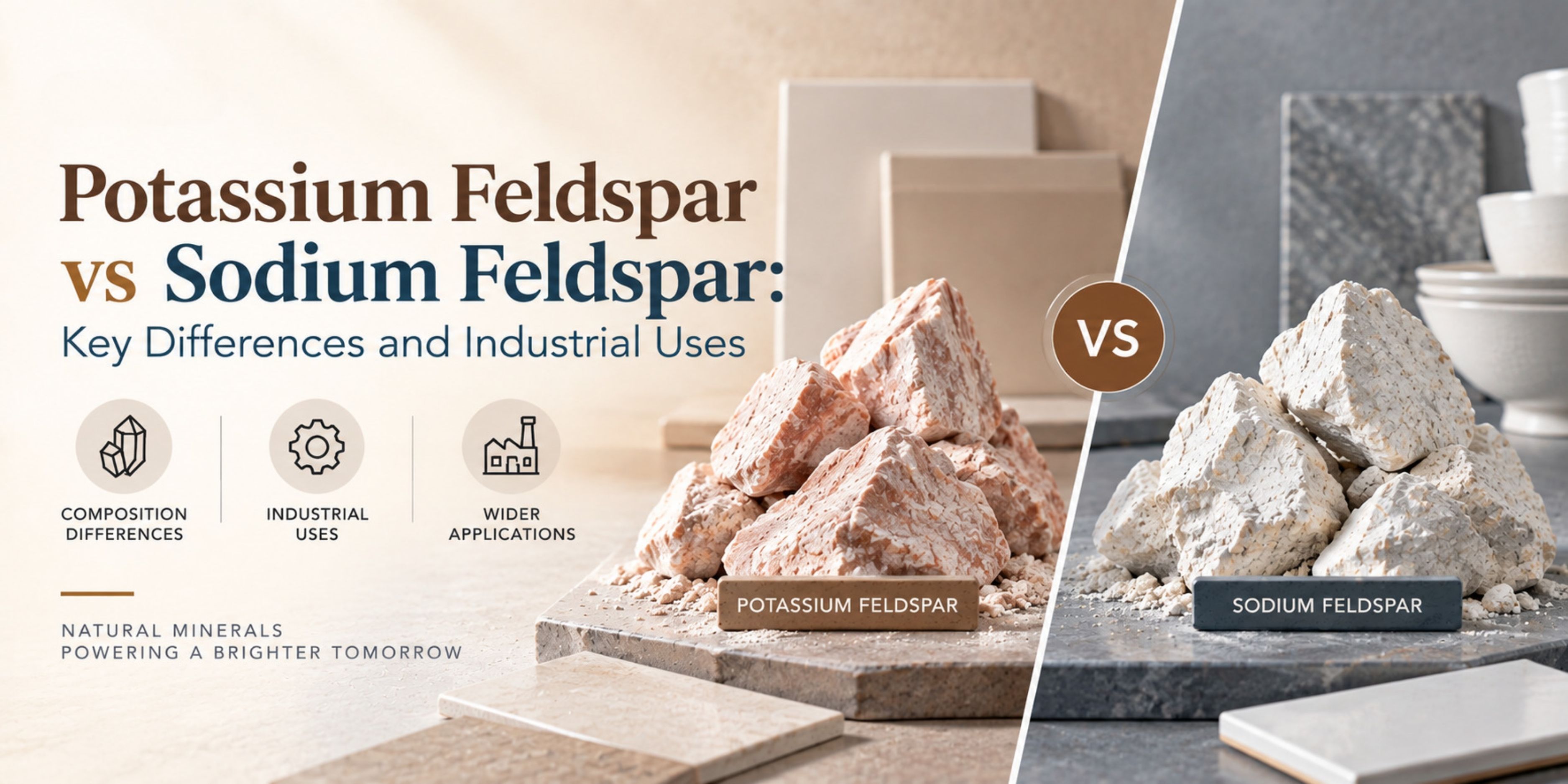
Potassium Feldspar vs Sodium Feldspar: Key Differences and Industrial Uses
Feldspar is one of the most important raw materials used in the glass and ceramics industries, acting as a natural flux that lowers melting temperatures and improves the strength of the finished product. But when it comes to choosing the right type for a formulation, manufacturers are almost always deciding between two main varieties. The Potassium Feldspar vs Sodium Feldspar question comes up constantly in ceramic bodies, glazes, glass batches, and even sanitaryware production, because each type behaves differently once it enters the kiln or furnace.
In this blog, we will explain the core differences between these two minerals, break down their individual properties, and help you understand which one fits better depending on whether you are working with glass, ceramics, or glaze formulations.
What Is Feldspar and Why Does the Alkali Content Matter?
Feldspar is a group of aluminosilicate minerals that make up a large portion of the earth's crust. In industrial use, feldspar is mainly valued for the alkali metal oxides it carries, either potassium oxide (K2O) or sodium oxide (Na2O). These oxides act as fluxes, meaning they help lower the temperature at which silica and other raw materials melt together to form glass or a vitrified ceramic body.
The type of alkali present determines almost everything about how the feldspar will behave during firing, which is why the Potassium Feldspar vs Sodium Feldspar Difference is such a critical consideration for formulators rather than just a matter of preference.
Potassium Feldspar Properties
Potassium feldspar, also known as potash feldspar or orthoclase, is rich in potassium oxide. Its behavior in a kiln or furnace is quite distinct from its sodium counterpart.
Key Potassium Feldspar Properties include:
- Higher melting point, typically around 1200 degrees Celsius
- Produces a more viscous melt once vitrification begins
- Wider firing range, giving more tolerance during production
- Can form a crystalline phase called leucite, which contributes to opacity in some glazes
- Generally less pure and slightly less white compared to sodium feldspar
- Provides better dimensional stability during firing due to its higher viscosity
This higher viscosity is actually an advantage in many applications, since it helps the fired product hold its shape and prevents excessive slumping or deformation at high temperatures.
Sodium Feldspar Properties
Sodium feldspar, also known as soda feldspar or albite, is dominated by sodium oxide instead of potassium. Its melting behavior is quite different from potash feldspar.
Key Sodium Feldspar Properties include:
- Lower melting point compared to potassium feldspar
- Produces a less viscous, more fluid melt once it begins to flow
- Generally purer and whiter, making it preferred for glass and light-colored ceramics
- Slightly soluble, which can occasionally cause minor plasticity issues in clay bodies
- Promotes brightness and color clarity in finished glass and glaze surfaces
Because sodium feldspar flows more easily once melted, it is often chosen when a smoother, glassier surface finish is required.
Potassium Feldspar vs Sodium Feldspar: Side-by-Side Comparison
| Property | Potassium Feldspar | Sodium Feldspar |
|---|---|---|
| Dominant Oxide | Potassium oxide (K2O) | Sodium oxide (Na2O) |
| Melting Point | Higher, around 1200°C | Lower than potassium feldspar |
| Melt Viscosity | More viscous, thicker flow | Less viscous, more fluid flow |
| Firing Range | Wider, more forgiving | Narrower, requires more control |
| Purity and Whiteness | Slightly lower | Generally higher |
| Common Mineral Name | Orthoclase, microcline | Albite |
| Best Suited For | Ceramic clay bodies, sanitaryware | Glass, glazes, enamels |
| Dimensional Stability | Higher, holds shape well | Lower, more prone to deformation |
This comparison shows why the two minerals are rarely interchangeable without adjusting the rest of the formulation.
Potassium Feldspar or Sodium Feldspar for Ceramics?
When it comes to ceramic clay bodies, the choice between Potassium Feldspar or Sodium Feldspar for Ceramics usually leans toward potassium feldspar. This is because potash feldspar's higher viscosity and wider firing range make it easier to control during vitrification, reducing the risk of warping or slumping in the kiln.
Sodium feldspar, on the other hand, is more commonly used in glazes rather than clay bodies. Its lower melting point and fluid melt behavior help create smooth, glossy glaze surfaces, but its slight solubility can cause workability issues if used heavily inside a raw clay body, sometimes leading to short plasticity or cracking during drying.
That said, many industrial formulations use a blend of both, adjusting the ratio to balance melting behavior with structural stability, depending on the target firing temperature and desired finish.
Potassium Feldspar or Sodium Feldspar for Glass?
In the glass industry, the answer shifts noticeably. Potassium Feldspar or Sodium Feldspar for Glass production almost always favors sodium feldspar. Its lower melting point reduces energy consumption during glass production, and its higher purity supports the clarity and brightness that glass manufacturers demand.
Sodium feldspar also improves the mechanical strength and chemical durability of finished glass while helping keep production temperatures manageable, which is a major factor for large-scale glass manufacturing where energy costs make up a significant part of overall production expense.
Potassium feldspar can still be used in specialty glass formulations where higher viscosity or specific optical properties are required, but for standard container and flat glass production, sodium feldspar remains the preferred raw material worldwide.
Why Blending Both Feldspars Is Common Practice
Many manufacturers do not rely on a single feldspar type alone. Instead, they blend potassium and sodium feldspar in carefully calculated ratios to get the best of both properties: controlled viscosity from the potassium content and improved flow and brightness from the sodium content. This blending approach allows formulators to fine-tune firing behavior, surface finish, and production cost simultaneously, rather than compromising on one property to gain another.
Choosing the Right Feldspar for Your Application
Before finalizing a feldspar source, manufacturers should consider a few key questions:
- What is your target firing temperature? Higher firing ranges generally favor potassium feldspar due to its viscosity and stability.
- Do you need maximum brightness and clarity? Sodium feldspar's higher purity makes it the better option for glass and light-colored glazes.
- Is dimensional stability during firing a concern? Potassium feldspar's thicker melt helps parts hold their shape better under heat.
- Are you working with a blended formulation? If so, understanding the exact potassium-to-sodium ratio in your feldspar supply becomes critical for consistent results batch after batch.
HTMC Group: Reliable Feldspar Supply for Glass and Ceramics
At HTMC Group, we supply both potassium and sodium feldspar, processed and graded to meet the specific requirements of glass manufacturers, ceramic producers, and glaze formulators. Whether your process demands the higher viscosity and stability of potash feldspar or the purity and low melting point of soda feldspar, our team can help you source consistent, quality-tested material suited to your exact application.
We work closely with our clients to understand their firing temperature range, target finish, and production goals, ensuring that every batch of feldspar we supply performs reliably from one production run to the next.
Get in Touch with HTMC Group
Need help choosing the right feldspar for your glass, ceramic, or glaze production line? Our technical team at HTMC Group is ready to guide you through the selection process based on your exact formulation needs.
- Call Us: +91 33 2226 8228, +91 98 1140 9161
- Enquire Now: [email protected]
Reach out today and let HTMC Group support your feldspar sourcing with quality you can rely on.
Frequently Asked Questions (FAQs)
Potassium feldspar has a higher melting point and produces a more viscous melt, while sodium feldspar melts at a lower temperature and flows more easily once molten.
Sodium feldspar is generally preferred for glass production because of its lower melting point, higher purity, and ability to improve brightness and clarity in the finished glass.
Potassium feldspar's higher viscosity and wider firing range make it easier to control during vitrification, reducing the risk of warping or deformation in the kiln.
Yes, many manufacturers blend both types to balance melting behavior, viscosity, and surface finish according to their specific production requirements.
Sodium feldspar is slightly soluble, which can sometimes cause short plasticity or minor workability issues if used in large quantities within a raw clay body.
Sodium feldspar is generally purer and whiter compared to potassium feldspar, making it a common choice for light-colored ceramics and glass.
Feldspar acts as a natural flux, lowering the melting temperature of silica-based materials and helping form a strong, vitrified structure in the finished product.
Pricing varies by region and deposit quality, but potassium feldspar is sometimes considered a premium option due to its stability and performance in high-temperature ceramic applications.
Higher viscosity, as seen in potassium feldspar, helps the product maintain its shape during firing, while lower viscosity, as in sodium feldspar, allows for smoother, more even glaze coverage.
HTMC Group supplies both potassium and sodium feldspar grades, processed to meet the specific requirements of glass, ceramics, and glaze manufacturing industries.
Contact Us

×