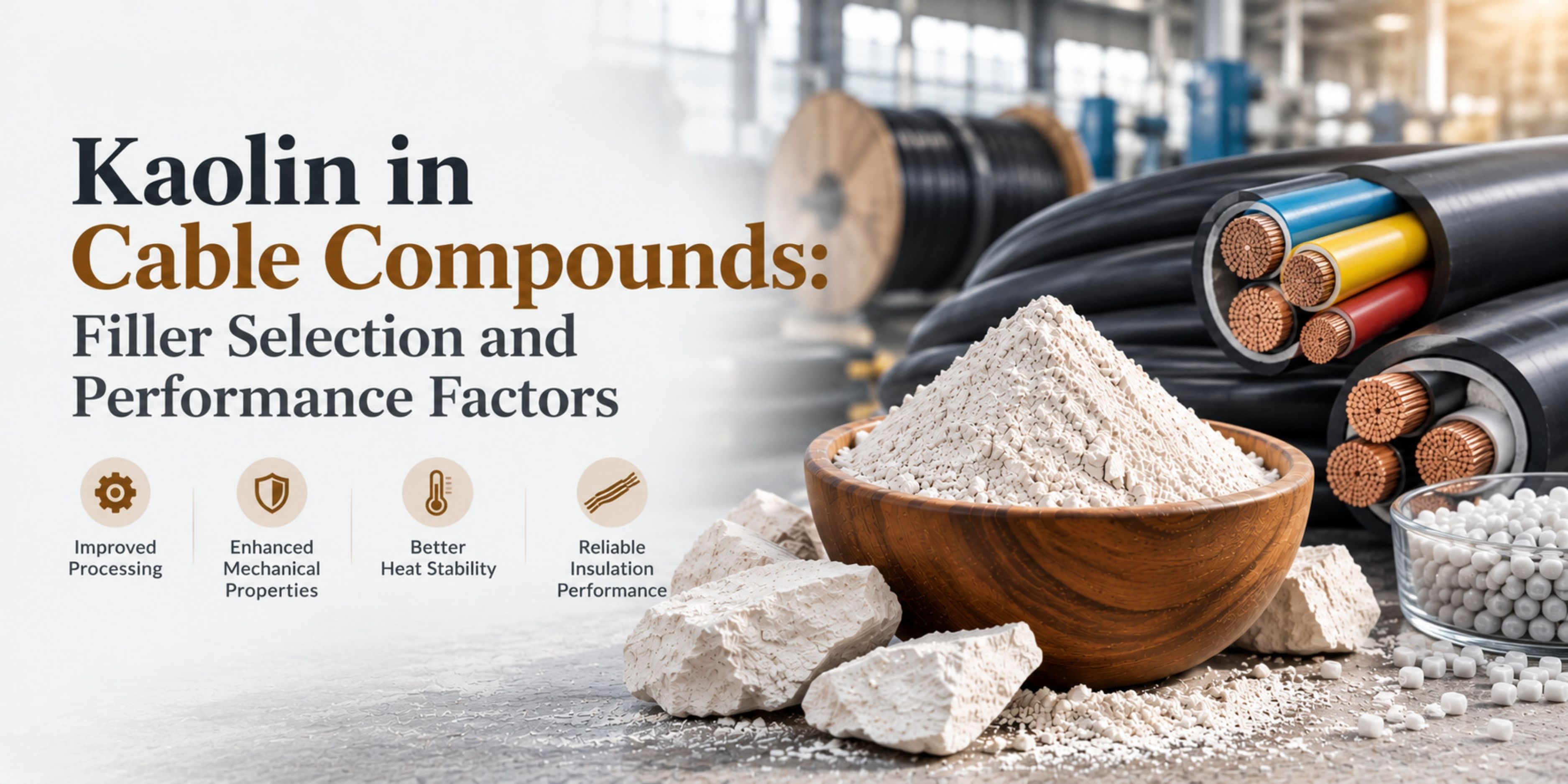
Kaolin in Cable Compounds: Filler Selection and Performance Factors
Cable manufacturing is a highly technical field where even a small variation in compound formulation can affect insulation quality, mechanical performance, service life, and overall safety. Every component used in a cable compound must therefore be selected carefully to achieve the required balance of electrical insulation, flexibility, strength, heat resistance, processing efficiency, and cost. Among the different mineral fillers used in the wire and cable industry, kaolin in cable compounds has remained a preferred choice for decades because of its useful insulation characteristics, fine particle structure, processing behaviour, and cost efficiency.
Kaolin, also known as China Clay, can contribute to the performance and processing characteristics of various cable and wire compounds when the appropriate grade is selected. Its chemical stability, insulating nature, particle size, purity, and moisture characteristics can influence how the material behaves during mixing, extrusion, and subsequent processing. For manufacturers producing power cables, electrical wires, communication cables, and other insulated products, maintaining consistent filler quality is essential for achieving uniform compound performance from batch to batch.
The selection of kaolin becomes particularly important when manufacturers need to balance electrical properties with mechanical strength and production costs. Factors such as particle size, moisture content, pH, purity, dispersion, whiteness and surface characteristics can all affect the suitability of a particular kaolin grade for a cable formulation. A poorly selected or inconsistently processed filler may create challenges during compounding or extrusion, while a properly matched grade can support smoother processing and consistent product quality.
In this blog, we will explore what kaolin is, why it is used in cable and wire compounds, how mineral filler selection can influence electrical and mechanical performance, and which technical factors cable manufacturers should evaluate before choosing a kaolin grade. We will also look at the key considerations involved in achieving consistent quality, reliable processing, and long-term performance in cable manufacturing.
What is Kaolin?
Kaolin, also known as China Clay, is a naturally occurring hydrated aluminium silicate mineral. It is valued across industries for its fine particle size, chemical inertness, and natural whiteness. In the cable industry specifically, kaolin's low conductivity and stable dielectric behaviour make it one of the most trusted mineral fillers for insulation and jacketing compounds.
Kaolin used in cable compounds is generally processed into either a hydrous or calcined form, and is often surface-treated with silane coupling agents to improve its compatibility with polymer systems such as PVC, PE, XLPE, and EPDM.
Why Kaolin is Used in Cable Compounds
Cable compounders rely on kaolin for a specific set of performance benefits that directly affect the safety and reliability of the finished cable.
| Benefit | What It Does |
|---|---|
| Electrical Insulation | Increases volume resistivity and supports dielectric stability |
| Moisture Resistance | Reduces water absorption and helps prevent insulation breakdown |
| Smooth Surface Finish | Improves the surface quality and dimensional control of extruded cable |
| Processing Aid | Improves dispersion and extrusion behaviour in polymer compounds |
| Cost Efficiency | Works as an economical filler compared to specialty additives |
| Flame Retardant Support | Works alongside flame retardants to maintain dielectric properties |
| Acid Scavenging | Calcined kaolin can help neutralise acidic by-products during ageing |
Kaolin is not just a bulking filler in cable compounds. Its layered, plate-like structure and chemical inertness make it particularly effective at resisting the migration of free ions, which is one of the biggest threats to long-term insulation resistance in cables.
Hydrous Kaolin vs Calcined Kaolin for Cables
| Parameter | Hydrous Kaolin | Calcined Kaolin |
|---|---|---|
| Processing | Natural, water-washed form | Heat-treated to remove structural water |
| Moisture Content | Higher, around 12 to 16% | Very low, generally below 0.5% |
| Electrical Insulation | Good | Excellent, higher volume resistivity |
| Colour Consistency | Moderate | High, more uniform white colour |
| Thermal Stability | Standard | Higher, suited for higher operating temperatures |
| Common Cable Use | General-purpose PVC cables | XLPE, medium and high voltage cables, premium insulation |
Calcined kaolin is generally preferred in cable applications where insulation resistance and long-term dielectric stability matter most, since the calcination process removes structural moisture and improves its resistance to electrical breakdown. Hydrous kaolin remains a cost-effective option for general-purpose, lower-voltage cable insulation.
Surface-Treated Kaolin for Cable Applications
A significant share of cable-grade kaolin used today is surface-treated with silane coupling agents. This treatment improves the compatibility between the mineral filler and the polymer matrix, which has a direct effect on cable performance.
Benefits of Silane-Treated Kaolin in Cable Compounds:
- Improves dispersion of the filler within the polymer, reducing agglomeration
- Enhances bonding between the kaolin particles and the polymer chains
- Improves mechanical properties such as tensile strength and elongation
- Increases volume resistivity under both wet and dry electrical conditions
- Reduces moisture pickup, which supports long-term insulation performance
Silane-treated calcined kaolin is especially common in medium- and high-voltage PVC and XLPE cable insulation, where consistent dielectric performance over the cable's service life is critical.
Technical Specifications of Cable Grade Kaolin
Cable manufacturers evaluate kaolin against a strict set of technical parameters, since even small variations can affect insulation resistance and long-term reliability.
| Property | Typical Range |
|---|---|
| Particle Size (D50) | 0.5 to 3 microns for insulation grade kaolin |
| Whiteness/Brightness | 85 to 92% |
| Moisture Content | Below 0.5% for calcined grades |
| Volume Resistivity | High, grade and treatment dependent |
| pH (10% suspension) | 4.5 to 7.5 |
| Oil Absorption | 30 to 50 g per 100 g |
| Bulk Density | 0.3 to 0.6 g/cm³ |
| Residue on 325 Mesh | Very low, typically below 0.05% |
A low residue on mesh screening is particularly important for cable applications, since coarse particles or grit can create weak points in the insulation layer and increase the risk of electrical breakdown.
Kaolin in Different Cable Insulation Types
| Cable Insulation Type | Role of Kaolin |
|---|---|
| PVC Insulated Cables | General-purpose filler, improves cost efficiency and processability |
| XLPE Cables | Calcined and silane-treated kaolin used for high dielectric strength |
| EPDM Rubber Cables | Kaolin improves insulation resistance and mechanical strength |
| Mineral Insulated Metal Sheathed Cables | Kaolin blended with magnesium oxide to reduce moisture-related resistivity loss |
| Flame Retardant Cables | Kaolin combined with ATH or MDH to maintain dielectric performance |
| Low Voltage Power Cables | Improves electrical safety margin at a lower overall cost |
Medium and high voltage cables generally demand higher purity, finer particle size, and surface-treated kaolin grades, while low voltage and general-purpose cables can often use standard calcined or hydrous kaolin.
Recommended Loading in Cable Compounds
Kaolin loading in cable compounds varies depending on the insulation type, voltage rating, and the specific performance target of the formulation.
| Application | Typical Kaolin Loading |
|---|---|
| PVC insulation compounds | 5 to 15 phr, often blended with calcium carbonate |
| XLPE and medium voltage insulation | 3 to 10 phr, mainly silane-treated calcined kaolin |
| EPDM rubber cable insulation | 20 to 60 phr |
| Mineral insulated metal sheathed cables | 3 to 20% by dry weight, blended with magnesium oxide |
| Flame retardant cable jacketing | Variable, used alongside flame retardant fillers |
Higher kaolin loadings generally increase stiffness and can improve dielectric strength up to a certain point, but excessive loading may affect flexibility and processing behaviour. Trial formulations are always recommended before finalising the loading level for a specific cable design.
Kaolin vs Other Cable Fillers
| Parameter | Kaolin | Calcium Carbonate | Mica | ATH/MDH |
|---|---|---|---|---|
| Insulation Performance | High | Moderate | Good, especially for dielectric formation | Moderate, mainly used for flame retardancy |
| Cost | Low | Very low | Moderate to high | Moderate |
| Flame Retardant Support | Indirect, works alongside FR additives | Limited | Good char formation | Primary flame retardant filler |
| Surface Finish | Smooth | Moderate | Can be less smooth | Moderate |
| Common Cable Use | PVC, XLPE, EPDM insulation | Low-cost PVC blends | Flame retardant polyolefin cables | Halogen-free flame retardant cables |
In many cable formulations, kaolin is used alongside these other fillers rather than as a complete replacement. For example, kaolin is often blended with calcium carbonate for cost engineering in PVC cables, or combined with ATH and MDH in halogen-free flame retardant cable jacketing to help maintain dielectric properties.
How Kaolin Is Added During Cable Compounding
Kaolin is generally introduced during the compounding stage before extrusion, following a defined sequence to ensure good dispersion and consistent insulation quality.
- Base Polymer Selection: The base resin, such as PVC, PE, or EPDM, is selected according to the cable's voltage rating and application.
- Pre-drying of Kaolin: Especially for hydrous grades, kaolin is dried to control moisture before mixing, since excess moisture can affect dielectric properties.
- Filler Addition: Kaolin is added along with other fillers, stabilisers, and flame retardants during the mixing stage, using internal mixers or twin-screw extruders.
- Coupling Agent Treatment: If silane-treated kaolin is used, this treatment is generally applied during the filler manufacturing stage before it reaches the compounder.
- Homogenisation: The compound is mixed thoroughly to achieve even dispersion of kaolin particles throughout the polymer matrix.
- Extrusion Over Conductor: The finished compound is extruded as an insulation or jacketing layer directly over the cable conductor.
- Curing or Crosslinking: For crosslinked systems such as XLPE, the insulation undergoes a curing step to achieve its final thermal and electrical properties.
Consistent dispersion at this stage is critical. Poorly dispersed kaolin can create localised weak points in the insulation, which may reduce dielectric strength and increase the risk of premature cable failure.
How to Select the Right Cable Grade Kaolin
Selecting the correct kaolin grade for a cable application depends on several technical and application-specific factors.
- Match the Voltage Rating: Higher voltage cables generally require finer particle size, higher purity, and silane-treated calcined kaolin.
- Check Moisture Content: Low moisture is critical for maintaining dielectric strength, especially in calcined grades.
- Evaluate Particle Size and Residue: Look for low residue on mesh screening to avoid weak points in the insulation layer.
- Consider Surface Treatment: Silane-treated kaolin improves dispersion and long-term insulation resistance, especially in demanding applications.
- Assess Compatibility with Base Polymer: Confirm that the kaolin grade performs well with your specific polymer system, whether PVC, XLPE, or EPDM.
- Run Insulation Resistance Trials: Always test volume resistivity and dielectric strength on trial batches before committing to full-scale production.
Why Choose the Right Kaolin Supplier
The electrical performance of a cable compound depends heavily on the purity, particle size consistency, and moisture control of the kaolin used. Even small batch-to-batch variations can affect insulation resistance, which makes supplier reliability especially important in the cable industry, where safety margins matter.
At HTMC Group, we process and supply high-quality Kaolin and Calcined Kaolin suited for PVC, XLPE, and EPDM cable insulation compounds. With decades of mining and processing experience, in-house quality labs and a strong global supply network, we help cable manufacturers get consistent, application-specific kaolin grades that support reliable long-term insulation performance.
Conclusion
Kaolin remains one of the most reliable and cost-effective fillers in the wire and cable industry. From improving dielectric strength and volume resistivity to supporting smooth extrusion and dimensional stability, kaolin in cable compounds continues to play a central role in insulation performance. Choosing between hydrous and calcined kaolin, evaluating surface treatment, and matching the grade to your specific voltage rating and polymer system are all essential steps in filler selection. With the right supplier and the right technical specifications, kaolin can significantly improve both the safety and the service life of cable products.
ConclusionGet in Touch with HTMC Group
Looking for reliable kaolin in cable-grade insulation filler for your next production run? HTMC Group supplies hydrous and calcined kaolin tailored for PVC, XLPE, and EPDM cable compounds.
Get in touch with our team today for technical data sheets, sample requests, or bulk pricing.
Call Us: +91 33 2226 8228, +91 98 1140 9161
Enquire Now: [email protected]
Frequently Asked Questions
Kaolin is used in cable compounds because of its excellent electrical insulation properties, moisture resistance, and ability to improve dispersion and surface finish in the final extruded product.
Hydrous kaolin is the natural, unprocessed form with higher moisture content, while calcined kaolin is heat-treated to remove structural water, resulting in higher volume resistivity and better dielectric stability.
Silane treatment improves the bonding between kaolin particles and the polymer matrix, which enhances dispersion, mechanical strength, and long-term insulation resistance.
Kaolin is commonly used in PVC-insulated cables, XLPE cables, EPDM rubber cable insulation, and mineral-insulated metal-sheathed cables.
Kaolin does not act as a primary flame retardant, but it is often combined with flame retardants like ATH and MDH to help maintain dielectric properties in flame-retardant cable jacketing.
Cable-grade kaolin generally requires a fine particle size, typically in the range of 0.5 to 3 microns, along with very low residue on mesh screening to avoid weak points in the insulation.
Higher moisture content can reduce volume resistivity and negatively affect dielectric strength, which is why calcined kaolin with very low moisture is preferred for demanding insulation applications.
Yes, kaolin is often blended with calcium carbonate in PVC cable formulations to balance electrical performance with overall material cost.
Loading varies by application, ranging from around 5 to 15 phr in PVC insulation to 20 to 60 phr in EPDM rubber cable insulation, depending on the desired properties.
The right grade depends on your voltage rating, base polymer, required dielectric performance, and whether surface treatment is needed. Working with an experienced mineral supplier like HTMC Group helps ensure a grade tailored to your specific cable formulation.
Contact Us
Get in touch with us!
×