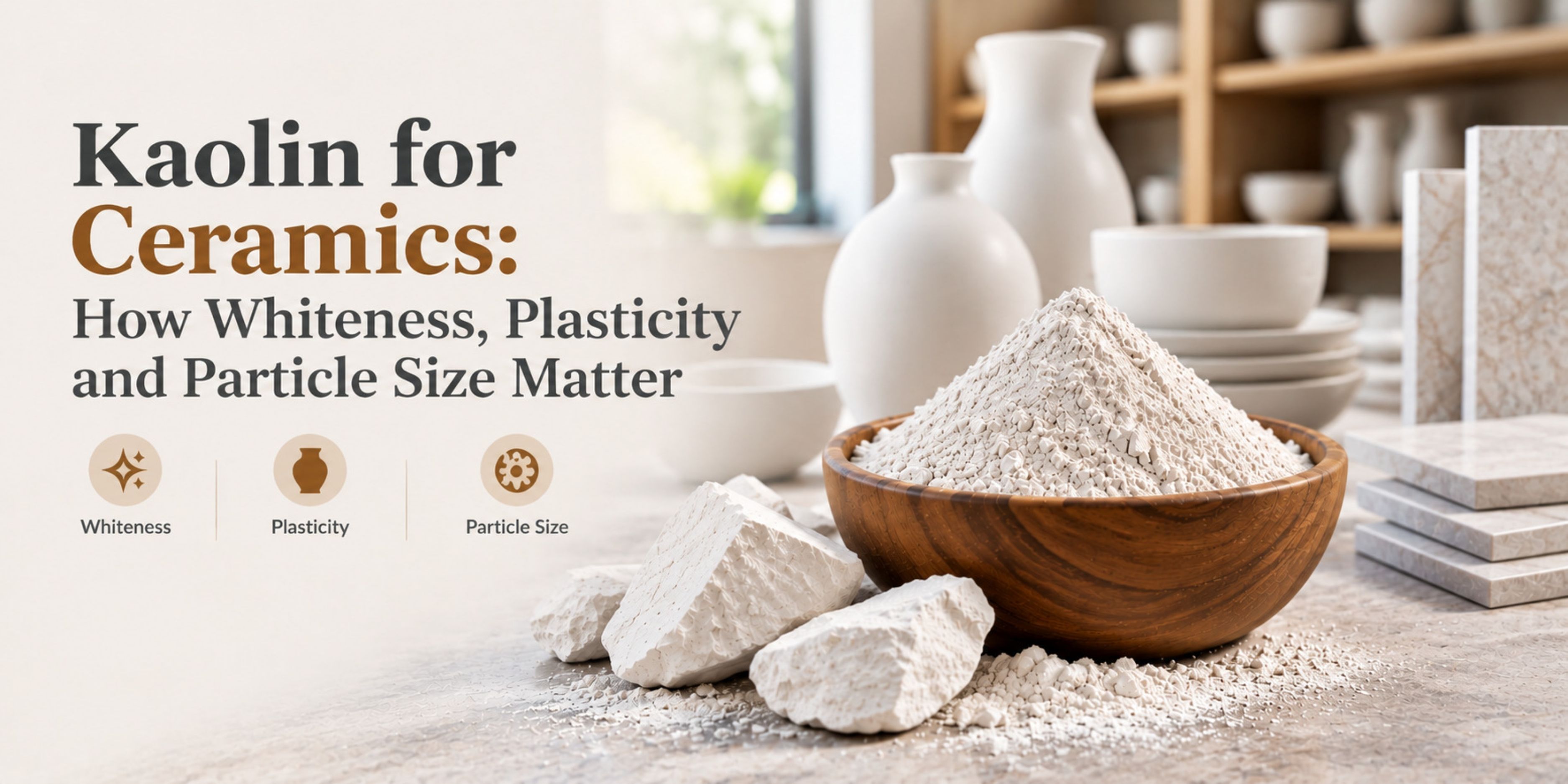
Kaolin for Ceramics: How Whiteness, Plasticity and Particle Size Matter
Ceramics is one of the oldest manufacturing industries in the world, yet producing high-quality ceramic products still depends on precise material selection and careful control of every stage of the manufacturing process. From delicate porcelain teacups and fine tableware to durable ceramic tiles, sanitaryware, electrical insulators, and advanced ceramic products, the final quality depends heavily on the characteristics of the raw materials used. Among these materials, kaolin for ceramics plays a particularly important role because of its natural whiteness, fine particle structure, plasticity, and contribution to the strength and stability of ceramic bodies.
Kaolin, or china clay, is recognized as an important component in the production of porcelain, tableware, sanitary appliances, tiles, and other ceramic products. Its characteristics can play a vital role in determining the ease of workability during processing, firing behavior, color, dimensional accuracy, and marketable appearance of the ceramics. However, it should also be noted that kaolin grades vary in their performance. Some of the factors, such as whiteness, plasticity, grain size, mineral purity, moisture content, and firing properties, can greatly influence the production process and the final quality of the ceramic products.
That is why the choice of kaolin should not be based simply on its whiteness when it comes to the ceramic producer. The grade must comply with the particular needs of the ceramic body, method of manufacture, firing temperature, and the needed traits of the ceramic.
This blog aims to review kaolin and its role in the process of ceramic production as well as to provide information about the factors that influence the performance of kaolin, such as whiteness, plasticity, grain size and others.
What is Kaolin?
Kaolin, also known as China Clay, is a naturally occurring aluminosilicate mineral formed from the weathering of feldspar-bearing rocks. It gets its name from Kao-ling, the region in China where it was first mined centuries ago. Kaolin is prized for its fine particle size, natural whiteness, and chemical inertness, which is why it remains central to porcelain and whiteware manufacturing even today.
Unlike many other clays, kaolin contains very low levels of iron oxide and titanium oxide, the two impurities most responsible for discolouration during firing. This purity is what allows kaolin bodies to fire into a bright white, dense ceramic material.
Why Kaolin is Essential in Ceramics
Ceramic manufacturers rely on kaolin for several core properties that directly affect the quality of the finished product.
| Property | Why It Matters |
|---|---|
| Whiteness | Determines the visual brightness of the fired ceramic body |
| Plasticity | Allows the clay body to be shaped, moulded, or cast |
| Particle Size | Controls drying rate, shrinkage, and fired strength |
| Chemical Purity | Low iron and titanium content prevents discolouration |
| Refractoriness | Helps the body withstand high firing temperatures without deforming |
| Rheology | Affects flow behaviour in slips and glazes used for casting |
Kaolin is typically combined with feldspar, quartz, and ball clay in a ceramic body. Feldspar acts as a flux that helps vitrification, quartz adds mechanical strength, and ball clay contributes additional plasticity, while kaolin provides the whiteness and structural stability that hold the whole composition together.
Whiteness and Brightness in Kaolin
Whiteness is one of the most important selection criteria when choosing kaolin for ceramics, especially for tableware, sanitaryware, and premium porcelain products. The whiteness of kaolin is directly linked to its purity. Iron oxide and titanium oxide are the two impurities that cause yellowish or grey tones during firing, so ceramic manufacturers look for kaolin with the lowest possible levels of these elements.
Brightness is usually measured using standardised reflectance methods such as ISO 2470, which give a numerical brightness value that manufacturers use to compare different kaolin sources. High-purity kaolin with low iron and titania content is essential for applications like bone china, premium tiles, and sanitaryware, where a pristine white finish is a key selling point.
Plasticity of Kaolin
Plasticity refers to the ability of a clay body to be shaped and moulded while wet, and to hold that shape once it dries. Kaolin naturally has a lower plasticity compared to other clays like ball clay or bentonite. This is why pure kaolin bodies are often difficult to wedge, roll, or throw on a wheel without falling apart.
To improve workability, ceramic manufacturers commonly blend kaolin with more plastic materials such as ball clay or bentonite. This blending achieves two goals at once. It improves the plasticity needed for shaping, and it also creates a better cross-section of particle sizes in the body, which improves drying behaviour and reduces the risk of cracking.
For casting applications, where the clay is poured as a liquid slip into a mould, kaolin's naturally lower plasticity is actually an advantage. Casting bodies need to be short, meaning they should not be overly plastic, so that the slip flows well and releases cleanly from the mould.
Particle Size and Its Role in Ceramic Bodies
Particle size is one of the most technically significant properties of kaolin in ceramics, and it influences almost every stage of processing, from mixing to firing.
| Effect of Particle Size | Result |
|---|---|
| Finer particles | Higher plasticity, higher green density, better strength |
| Coarser particles | Faster water permeability, quicker casting and drying rates |
| Very fine particles | Higher drying shrinkage, higher risk of cracking if not controlled |
| Blended particle sizes | Better packing, improved drying, reduced defects |
Because kaolinite particles are generally larger than ball clay or bentonite particles, blending kaolin with these finer plastic clays produces a wider spread of particle sizes in the final body. This blend improves both the working properties of the wet clay and the drying behaviour of the finished piece.
Particle size also affects how quickly water moves through the clay body. Coarser kaolin allows water to pass through more easily, which speeds up casting rates in slip bodies and drying rates across the board. Finer kaolin, on the other hand, is generally chosen when higher plasticity and higher fired density are the priority, such as in premium porcelain and bone china.
Kaolin in Different Ceramic Products
Different ceramic products use kaolin in different proportions and demand different grades, depending on the required whiteness, strength, and firing behaviour.
| Ceramic Product | Typical Kaolin Content | Key Requirement |
|---|---|---|
| Porcelain | Roughly one-third of the body, combined with feldspar and quartz | High whiteness, high firing temperature stability |
| Bone China | Around 25% of the body, combined with bone ash and feldspar | Very low iron and titanium content, fine particle size |
| Sanitaryware | Moderate kaolin content, blended with ball clay | Good casting behaviour, high fired whiteness |
| Ceramic Tiles | Lower kaolin ratio compared to porcelain | Cost efficiency, moderate firing temperature |
| Tableware and Whiteware | Kaolin mixed with silica, feldspar, and ball clay | Balance of plasticity, whiteness, and strength |
| Glazes | Small percentage used as suspension aid | Prevents settling of glaze particles |
Porcelain is typically fired between 1200°C and 1400°C, while ceramic tiles are generally fired at lower temperatures. Bone china requires very tight control over kaolin purity, since even small amounts of iron can visibly affect the ivory white finish that defines the product.
Technical Specifications of Ceramic Grade Kaolin
Ceramic manufacturers evaluate kaolin against a defined set of specifications before it is approved for use in a production body.
| Property | Typical Range |
|---|---|
| Particle Size (D50) | 0.5 to 10 microns, depending on grade |
| Brightness (ISO) | 80 to 92% |
| Iron Oxide (Fe2O3) | Below 1%, lower for premium whiteware |
| Titanium Dioxide (TiO2) | Below 0.5% for high translucency applications |
| Moisture Content | 12 to 16% for hydrous kaolin |
| pH (10% suspension) | 4.5 to 7.5 |
| Plasticity Index | Varies by grade, tested using standard plasticity methods |
| Loss on Ignition | 12 to 15% at high temperature |
These parameters are checked because even small variations in iron content or particle size distribution can change the whiteness, shrinkage, and strength of the finished ceramic piece.
Kaolin vs Ball Clay
Ceramic bodies almost always combine kaolin with ball clay, since the two materials complement each other's strengths.
| Parameter | Kaolin | Ball Clay |
|---|---|---|
| Particle Size | Coarser | Finer |
| Plasticity | Lower | Higher |
| Whiteness | Higher, fires white | Lower, can fire slightly off white or grey |
| Iron Content | Low | Comparatively higher |
| Role in Body | Provides whiteness and structural stability | Provides plasticity and workability |
| Best Suited For | Porcelain, bone china, premium whiteware | General ceramic bodies needing high plasticity |
This is exactly why kaolin is rarely used alone in a plastic forming body. It is blended with ball clay to balance whiteness with the plasticity required for shaping, throwing, or extrusion.
How Kaolin Is Used During Ceramic Processing
Kaolin passes through several processing stages before it becomes part of a finished ceramic product.
- Batching: Kaolin is weighed and combined with feldspar, quartz, and ball clay according to the body's formulation.
- Blunging and Mixing: The materials are mixed with water to form a slip or plastic mass, ensuring even dispersion of kaolin particles.
- Shaping: Depending on the product, the body is shaped by casting into a mould, throwing, pressing, or extrusion.
- Drying: The shaped ware is dried carefully to avoid cracking, with particle size and plasticity levels affecting the drying rate.
- Bisque Firing: The dried ware is first fired at a lower temperature to achieve initial hardness.
- Glazing: A glaze layer is applied, in which kaolin also plays a role by helping keep the glaze particles in suspension.
- Glost Firing: The ware undergoes a final high-temperature firing, where kaolin converts partly into mullite crystals, giving the body its strength, whiteness, and, in the case of porcelain, translucency.
How to Select the Right Ceramic Grade Kaolin
- Check Whiteness Requirements: For bone china and premium tableware, choose kaolin with the lowest possible iron and titanium content.
- Match Particle Size to Process: Finer particle size for plastic forming and higher green strength, coarser particle size for faster casting and drying.
- Balance with Ball Clay: Decide the correct kaolin-to-ball-clay ratio based on the plasticity needed for your shaping method.
- Verify Firing Behaviour: Confirm the kaolin's performance at your specific firing temperature range to avoid warping, sagging, or poor vitrification.
- Test Rheology for Slips and Glazes: If the kaolin will be used in casting slips or glazes, check its flow behaviour and suspension properties.
- Run Trial Batches: Always test a new kaolin source in a small trial batch before full scale production, since natural variation between deposits can affect results.
Why Choose HTMC Group as a Kaolin Supplier
The performance of kaolin in ceramics depends heavily on its purity, particle size consistency, and mineralogical stability from batch to batch. Even a small variation in iron content or particle size distribution can shift the whiteness or shrinkage behaviour of a ceramic body, which makes supplier reliability critical.
At HTMC Group, we process and supply high-purity Kaolin and Calcined Kaolin suited for porcelain, tableware, sanitaryware, tiles, and other ceramic applications. With decades of mining and processing experience, in-house quality labs and a strong global supply network, we help ceramic manufacturers get consistent, application-specific kaolin grades batch after batch.
Conclusion
Kaolin remains the foundation of modern ceramic manufacturing, and its three defining properties, whiteness, plasticity, and particle size, directly shape the quality of the finished product. Kaolin for ceramics is not a one-size-fits-all material; the right grade depends on whether you are producing porcelain, bone china, tiles, sanitaryware, or general tableware. By understanding how these properties interact and selecting a supplier who can guarantee consistent quality, ceramic manufacturers can achieve the whiteness, strength, and workability their products demand.
Get in Touch with HTMC Group
Looking for high-purity kaolin for ceramics to improve whiteness, plasticity, and firing performance in your production? HTMC Group supplies kaolin and calcined kaolin tailored for porcelain, tableware, sanitaryware, and tiles.
Get in touch with our team today for technical data sheets, sample requests, or bulk pricing.
Call Us: +91 33 2226 8228, +91 98 1140 9161
Enquire Now: [email protected]
Frequently Asked Questions
Kaolin is used in ceramics because of its natural whiteness, fine particle size, and chemical purity, which give the fired body strength, brightness, and dimensional stability.
Yes, the whiteness of a fired ceramic body is largely determined by the iron and titanium oxide content of the kaolin used, since these impurities cause yellowish or grey discolouration.
Kaolin has a relatively coarse particle structure compared to ball clay and bentonite, which limits its plasticity. This is why it is usually blended with more plastic clays for shaping applications.
Finer kaolin particles generally improve plasticity, green strength, and fired density, while coarser particles allow faster water permeability, speeding up casting and drying rates.
Kaolin is coarser, whiter, and lower in plasticity, while ball clay is finer, more plastic, but generally less white. The two are usually blended together to balance whiteness with workability.
Yes, kaolin is a core ingredient in both. Porcelain typically uses kaolin with feldspar and quartz, while bone china combines kaolin with bone ash and feldspar for a lighter, translucent finish.
Porcelain is generally fired between 1200°C and 1400°C, while bone china is fired at slightly lower temperatures, typically around 1200°C to 1280°C, depending on the formulation.
Yes, small amounts of kaolin are used in glaze formulations to keep other glaze particles, such as silica and feldspar, from settling out of suspension.
Iron oxide and titanium dioxide are the main impurities that affect kaolin quality, since they reduce whiteness and can cause discolouration during firing.
The right grade depends on your product type, required whiteness, particle size needs, and firing temperature. Working with an experienced mineral supplier like HTMC Group helps ensure consistent, application-specific kaolin quality for your ceramic body.
Contact Us
Get in touch with us!
×