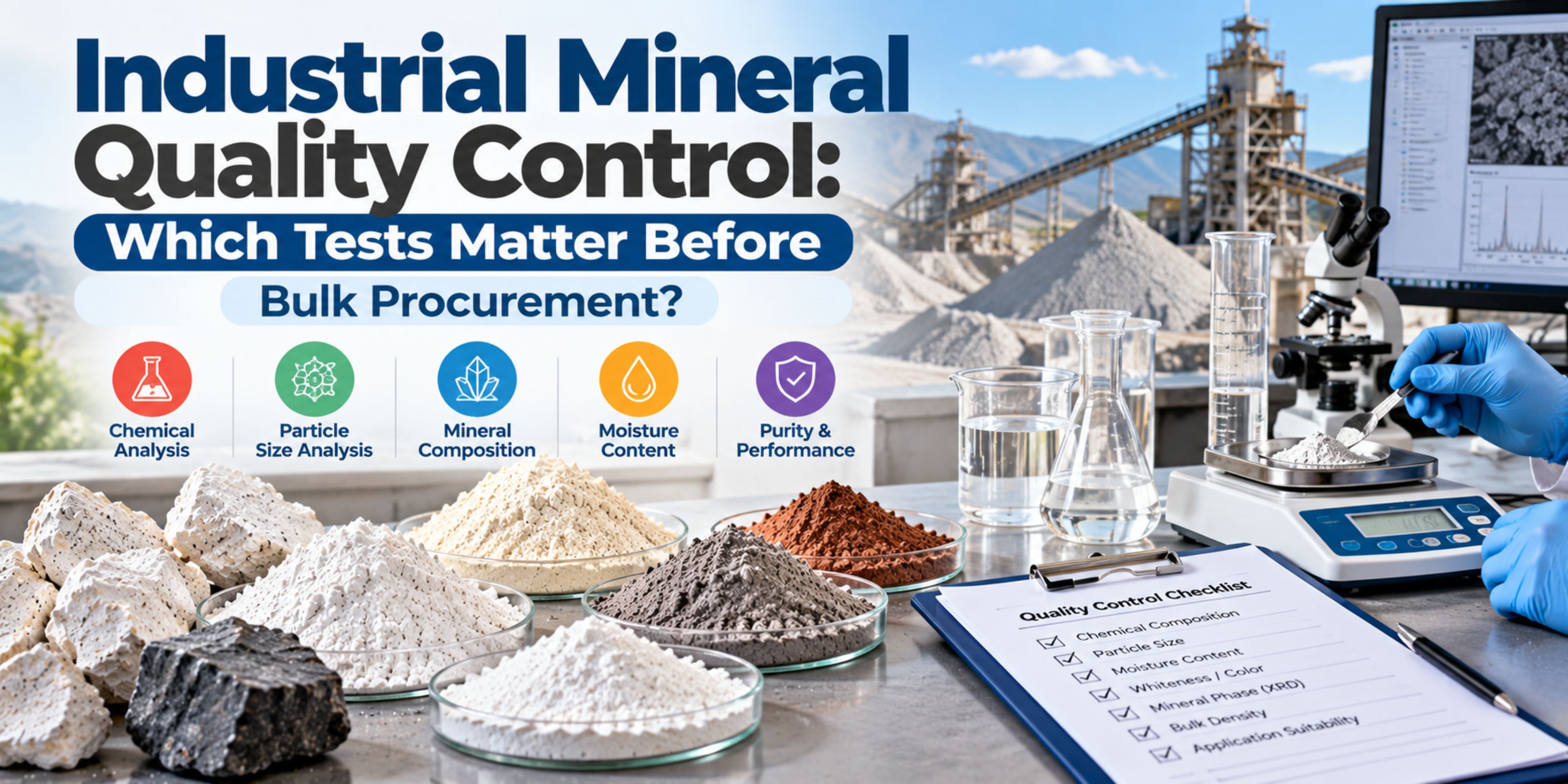
Industrial Mineral Quality Control: Tests Before Bulk Buying
A bulk order of minerals is a big commitment. You may be buying 25, 100 or 1,000 tons in one go. If the material does not match your needs, the problem is not small. It can mean rejected batches, blocked production lines, unhappy customers and wasted freight.
The good news is that most of these problems can be avoided. A smart buyer checks the right things before placing the order. In this guide, HTMC Group explains in simple words how industrial mineral quality control works, which tests really matter, how to read a COA, and how to build a safe buying process.
Why Quality Control Matters Before You Buy in Bulk
Minerals are natural materials. Two lots of the same product can look the same and still behave very differently. A small change in moisture, particle size or iron content can change how the mineral works in paint, plastics, ceramics, paper, food, pharma, steel or agriculture.
Quality checks before purchase help you to:
- Avoid production stoppages and rejected batches
- Match the mineral to your exact application
- Compare suppliers on facts, not on price alone
- Protect your own product quality and brand name
- Reduce disputes about quality after delivery
Think of testing as a cheap insurance policy. The cost of a few lab tests is tiny compared with the cost of one bad truckload.
Step 1: Start With Identity and Traceability
Before any technical test, confirm that the paperwork matches the material. Check these simple points:
- Product name and grade match your purchase specification
- Batch or lot number on the bag matches the COA
- Date of manufacture and date of testing are clear
- Supplier name and plant location are mentioned
A COA (Certificate of Analysis) is a report of test results for one specific batch. If the batch number is missing or does not match, the COA has little value.
Step 2: Sampling Must Be Done Right
Many quality problems start before the test even begins. A bad sample gives a bad result, even in the best lab.
A mineral lot can vary from top to bottom of a pile or from one bag to another. So the sample must represent the whole lot. Good practice includes:
- Taking small portions from many bags or many points in the lot
- Mixing them well and reducing the sample size properly
- Sealing and labelling the sample, with batch number and date
- Keeping a retained sample with both buyer and seller for future checks
If both sides agree on how to sample, later arguments become much easier to settle.
Step 3: Chemical Composition Tests
Chemistry tells you what the mineral is made of and how pure it is. This is the heart of industrial mineral quality control for most buyers.
- Main oxide or element content. For example, CaCO3 in calcium carbonate, MgO and CaO in dolomite, SiO2 in quartz, Al2O3 in kaolin, MgO and SiO2 in talc.
- Impurities. Iron (Fe2O3), silica, alumina and similar elements can affect colour, reactivity or performance. Even a small rise in iron can spoil the whiteness of a white mineral.
- Loss on ignition (LOI). This shows how much weight the mineral loses when heated. It tells you about carbonates, bound water and organic matter. It is very useful for dolomite, limestone, clay and bentonite.
- Heavy metals and harmful elements. For food, pharma, cosmetic and feed grades, limits for lead, arsenic, cadmium and mercury are important.
Common methods are XRF (X-ray fluorescence), ICP, AAS and classic wet chemistry. XRF is fast and popular for routine checks. For good accuracy, the sample should be ground to a fine, even powder, because coarse grains can give misleading results.
Step 4: Particle Size Distribution
Particle size is one of the most important physical tests. It controls how the mineral behaves in your process and in your final product.
Ask for these values:
- Mesh or sieve residue, for example, the percentage left on a 325 mesh sieve
- D50 (median size), which shows the typical particle size
- D97 or D90 (top size), which shows how coarse the largest particles are
Why does it matter? In paint, coarse particles can cause specks and poor finish. In plastics, they can weaken film or fibre. In ceramics and glass, size changes melting and packing. In sinter and steel use, lump size decides feeding and reaction speed. Always ask which method was used, such as sieve, laser diffraction or sedimentation, because the numbers from different methods are not always the same.
Step 5: Moisture Content
Moisture looks like a small detail but it creates real cost. You pay freight for water, not minerals. Wet powder clumps, blocks feeders and changes dosing. Many industrial applications need a low moisture level, often around 1 to 2 percent or even lower, depending on the product and use.
Ask for the moisture value at the time of packing and also check the packing quality. A bag that was dry at the plant can still pick up moisture in a humid port or warehouse.
Step 6: Optical Tests for White Minerals
If you buy kaolin, talc, calcium carbonate, calcined clay or similar white minerals, colour tests matter.
- Brightness or whiteness. Usually shown as a percentage value measured on a pressed powder sample.
- Colour values (L, a, b). These show how white, yellow or grey the powder looks.
- Yellowness. Small yellow tones may not be easy to see by eye but can show up in the final product.
Always compare colour on the same instrument and method, since different methods give different numbers.
Step 7: Application Specific Tests
General chemistry and size are not enough for every use. Many minerals need tests linked to how you will use them. Here are some examples.
| Mineral | Useful application tests |
|---|---|
| Kaolin and calcined kaolin | Brightness, particle size, oil absorption, abrasion, viscosity |
| Talc | Whiteness, particle size, oil absorption, absence of asbestos for sensitive uses |
| Calcium carbonate | CaCO3 content, whiteness, top cut size, oil absorption, moisture |
| Bentonite | Swell index, montmorillonite content, moisture, pH, methylene blue value |
| Bleaching clay | Bleaching activity, free acidity, moisture, filtration behaviour |
| Dolomite | CaO and MgO, LOI, silica, size range, reactivity for burnt grades |
| Mica | Particle size, aspect ratio, colour, moisture |
Step 8: Physical Property Tests
These tests help with handling, storage and processing:
- Bulk density and tapped density. They affect packing, silo capacity and freight volume.
- Oil absorption. This shows how much oil or resin the powder takes in. It matters for paints, inks, plastics and adhesives.
- pH. A water slurry pH check helps in formulations where acidity or alkalinity matters.
- Specific gravity. Helps with dosing and recipe calculation.
- Hardness and abrasion. Hard particles can wear screens, blades and spray tips.
Step 9: Mineralogy
Chemistry alone may not tell the whole story. Two materials may have the same chemical analysis but a different mineral structure. XRD (X-ray diffraction) identifies which mineral phases are present. This is very useful for products like talc, bentonite and kaolin, where mixed phases can change performance. For some grades, you may also need confirmation that harmful phases, such as free crystalline silica or asbestos, are absent or within limits.
Step 10: Compliance and Safety Documents
Depending on your industry, you may need extra paperwork:
- Safety data sheet (SDS)
- Statement of heavy metal limits
- Food or pharma related certifications and declarations
- Microbial test reports for food, feed or cosmetic grades
- Certificate of origin and export papers
Do not wait until the end to ask for these. Missing documents can stop a shipment at the port.
How to Read a COA Properly
A COA is useful only if you read it with care. Use this quick method:
- Check that the batch number, product name and date are correct.
- Compare each result against your written specification.
- Look at the test method. A different method can give a different number.
- Check whether limits are given as minimum, maximum or range.
- Look for missing tests that matter for your use.
- Compare COAs from several batches. Stable numbers show a stable process.
If something looks odd, ask questions early.
Build a Simple Pre-Procurement Process
Here is a practical path that works for most buyers.
- Write your specification. List the parameters, limits and test methods that matter for your use.
- Request a sample with TDS and COA. The TDS (technical data sheet) shows typical properties. The COA shows batch results.
- Test the sample in your own lab or a third party lab. Do not rely only on paper.
- Run a plant or formulation trial. Real use is the final judge.
- Approve a golden sample. Keep a reference sample that the supplier must match.
- Fix the quality terms in the contract. Include limits, test methods, sampling methods and what happens if a lot fails.
- Test the first bulk shipment carefully. Many buyers also use independent inspection at loading.
- Keep retained samples. They help to settle any future dispute with proof.
Common Mistakes Buyers Make
- Judging only by price. A cheaper lot with weak quality often costs more in the end.
- Accepting a COA without checking the batch number.
- Ignoring moisture and packing. These are common sources of loss.
- Testing only chemistry. Size, colour and application tests matter just as much.
- Skipping trials. Lab data helps, but plant behaviour confirms.
- No written specification. Without it, there is nothing to hold the supplier to.
Why Work With HTMC Group
HTMC Group (HiTech Minerals and Chemicals Group) is an Indian industrial minerals manufacturer and supplier with over 40 years of experience and customers in more than 30 countries. The group works with mineral reserves, processing units and in house labs, and supplies minerals such as talc, kaolin, calcined kaolin, calcium carbonate, dolomite, bentonite, bleaching clay and more.
For buyers who care about industrial mineral quality control, the useful points are:
- In house labs for routine quality checks
- Made to order production to match your specification
- Planned bulk supply and logistics
- Documents on request, including TDS and COA
- Certified processing for sensitive industries such as food and pharma
Final Thoughts
Good buying is not about luck. It is about asking for the right information and checking it. Start with a clear specification, ask for a COA and TDS, test a sample, run a trial and fix the terms in the contract. A strong industrial mineral quality control routine protects your production, your customers and your budget.
HTMC Group is ready to support your next bulk order with samples and technical documents. Request Sample + TDS/COA for this application and buy with confidence.
Get in Touch with HTMC Group
- Call Us: +91 33 2226 8228, +91 98 1140 9161
- Enquire Now: [email protected]
Frequently Asked Questions (FAQs)
It is the set of checks, tests and documents used to make sure a mineral matches the required specification. It covers sampling, chemistry, particle size, moisture, colour and application tests.
The core tests are chemical composition, loss on ignition, particle size distribution, moisture and, for white minerals, brightness. Add application specific tests for your use.
A COA is a Certificate of Analysis. It lists test results for one batch. It proves that the lot was tested and gives data to compare with your specification.
A TDS shows typical properties and ranges of a product. A COA shows actual results of a particular batch.
A COA is a good start, but it is wise to test a sample in your own or a third party lab, especially for a new supplier or a new grade.
It controls how a mineral behaves in processing and in the final product. It affects finish, strength, flow, reaction speed and cost.
It depends on the mineral and use. Many industrial powders aim for around 1 to 2 percent or lower. Always set a limit in your specification.
Differences in sampling, sample preparation, method and instrument can change results. Agree on the method and keep a retained sample for cross checks.
Yes. A small plant or formulation trial shows how the mineral truly performs and avoids costly surprises.
Contact HTMC Group through htmcgroup.com or the phone numbers above. Share your application and specification, and request a sample with TDS and COA.
Contact Us

×