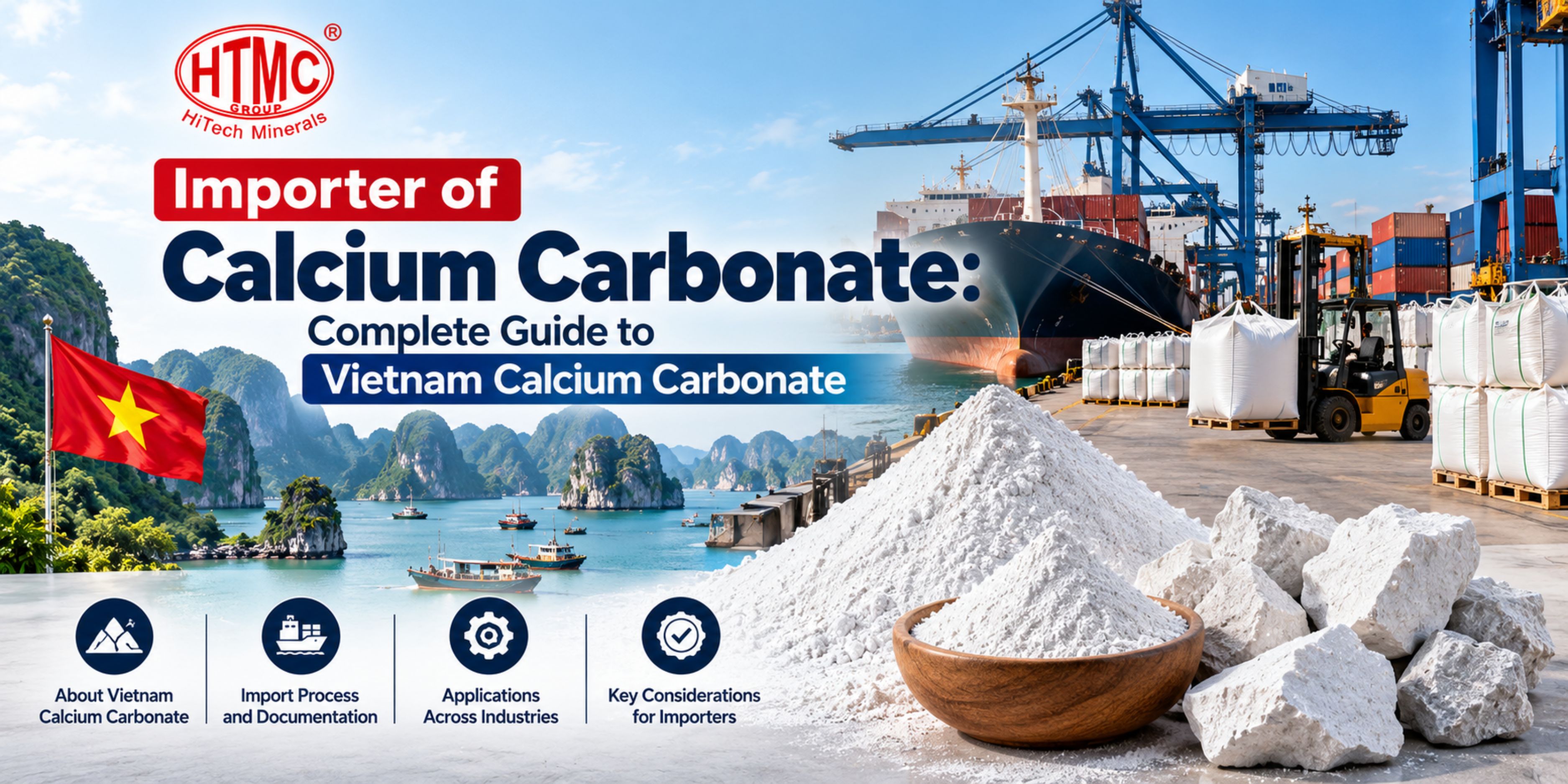
Calcium carbonate (CaCO₃) is one of the most versatile and widely consumed industrial minerals on the planet. You will find it in the plastic pipe carrying water to your home, the paint on your walls, the paper you write on, the toothpaste you use every morning, and even the supplements on a pharmacy shelf. Because it touches so many industries, demand for it is steady and global.
For an importer of calcium carbonate, this creates both an opportunity and a challenge. The opportunity is a large, consistent market. The challenge is that calcium carbonate is not one single product. Whiteness, purity, particle size, coating, moisture and origin can all differ, and a small difference in specification can decide whether your customer's production line runs smoothly or stops.
In recent years, Importer of Calcium Carbonate has gained strong attention from buyers across Asia, the Middle East, Africa and beyond. In this detailed guide, we cover why importers look at Vietnam, how to understand the different grades, which quality parameters matter, how the import process works, what risks to plan for, and how to choose a supplier you can rely on for the long term.
Why Calcium Carbonate Is Such an Important Industrial Mineral
Before looking at sourcing, it helps to understand why calcium carbonate is in such steady demand. It performs several jobs at once:
- As a functional filler: It reduces the cost of the final product while improving stiffness, opacity and surface finish.
- As a whitening and brightening agent: High-whiteness grades improve the look of paints, paper, plastics and cosmetics.
- As a source of calcium: In food, feed and pharmaceutical products, it is a trusted calcium source and also acts as an antacid and a carrier.
- As a processing aid: It helps with flow, dispersion and consistency in manufacturing.
This wide range of uses means an importer rarely serves just one type of customer. Understanding each industry's needs is the first step to supplying the right grade.
Major Applications of Calcium Carbonate
1. Plastics and PVC
Calcium carbonate is one of the most common fillers in plastic compounding. It is used in PVC pipes, window profiles, cables, films, masterbatches and injection-moulded products. Coated grades blend better with the polymer, which improves strength and reduces processing problems.
2. Paints and Coatings
In both decorative and industrial paints, calcium carbonate improves opacity, brightness, gloss control and durability. It also lets manufacturers use less costly pigment while keeping quality high.
3. Paper and Packaging
Paper mills use calcium carbonate to improve brightness, smoothness and printability, and to reduce production costs.
4. Rubber and Adhesives
As a reinforcing and bulking filler, it helps control viscosity and improves the feel and finish of adhesives, sealants and rubber goods.
5. Construction Materials
It is used in putty, tile adhesives, grouts, cement-based products and flooring compounds.
6. Food and Pharmaceuticals
Food-grade and pharma-grade calcium carbonate, usually in the precipitated form, is used in calcium supplements, antacid tablets, fortified foods, confectionery and dental care products. These applications need strict purity and certification.
7. Animal Feed and Agriculture
It is a key calcium source for poultry and livestock feed, and is also used for soil conditioning.
8. Personal Care and Cosmetics
Toothpaste, powders and creams use fine, high-purity calcium carbonate for gentle abrasion, bulk and opacity.
Why Importers Look at Vietnam Calcium Carbonate
Vietnam has substantial limestone and marble resources and a well-developed processing industry that supplies calcium carbonate to many international markets. Importers are generally attracted by a few key factors:
- Raw material availability: Large natural deposits support steady, long-term production of ground calcium carbonate.
- High-whiteness marble-based grades: Marble-derived calcium carbonate is popular where brightness is critical, such as paints, plastics, paper and cosmetics.
- Range of particle sizes: Processors offer coarse to ultra-fine grades, covering different applications.
- Coated and uncoated options: Many producers offer stearic acid-coated grades for plastics and rubber.
- Convenient export logistics: Access to ports makes shipping to nearby Asian markets and farther destinations straightforward.
- Competitive pricing: Buyers often find attractive pricing for standard industrial GCC grades.
However, a good price on paper does not guarantee good business. A smart importer looks beyond the quotation at consistency, documentation, and after-sales support.
Understanding the Types: GCC vs PCC in Detail
Before you send an enquiry, be clear about which type you need. The two are very different in how they are made and where they are best used.
Ground Calcium Carbonate (GCC)
How it is made: Natural limestone, marble or calcite is crushed, ground and classified into specific particle sizes. Some grades are then surface-treated with a coating agent.
Key characteristics:
- Cost-effective and widely available
- Irregular particle shape
- Whiteness depends heavily on the raw material (marble usually gives higher whiteness)
- Available in a wide range of mesh and micron sizes
Best suited for: Plastics, PVC, paints, adhesives, sealants, rubber, construction chemicals and general industrial uses.
Precipitated Calcium Carbonate (PCC)
How it is made: Through a controlled chemical process in which calcium carbonate is precipitated from a solution, allowing very precise control over particle size and shape.
Key characteristics:
- Very high purity and uniformity
- Controlled, consistent particle shape and size
- Excellent brightness and smoothness
- Available in food, pharma and cosmetic grades
Best suited for: Food, pharmaceuticals, toothpaste, cosmetics, high-quality paper, premium coatings, specialty plastics and inks.
Quick Comparison
| Feature | GCC | PCC |
|---|---|---|
| Source | Natural limestone / marble | Chemically precipitated |
| Purity | Good, depends on raw material | Very high, controlled |
| Particle shape | Irregular | Uniform, engineered |
| Cost | Generally lower | Generally higher |
| Typical use | Plastics, paints, construction | Food, pharma, cosmetics, premium paper |
Importer tip: If your customers are in food, pharma or personal care, always confirm whether the supplier can provide PCC with the right certifications. Standard industrial GCC will not meet those needs.
Key Quality Parameters Every Importer Must Check
Quality is where most import problems begin. Always get these parameters in writing, and verify them with batch-wise test reports.
1. CaCO₃ Content (Purity)
This shows how much of the material is actually calcium carbonate. Higher purity usually means better whiteness and performance, especially for sensitive applications.
2. Whiteness and Brightness
Check the whiteness/brightness value agreed in your specification. This is especially important for paints, plastics and paper, where even a small variation shows up in the finished product.
3. Particle Size Distribution
Particle size affects dispersion, viscosity, opacity, surface finish and mechanical strength. Confirm the mesh or micron size, and values such as D50 and D97, against your requirements.
4. Moisture Content
Excess moisture causes lumping, poor flow and processing issues, particularly in plastics. Confirm the maximum moisture level and ensure suitable packaging.
5. Oil Absorption
For paints, adhesives and sealants, oil absorption directly influences formulation and cost.
6. Acid-Insoluble Matter and Impurities
Lower levels indicate a cleaner, higher-quality material.
7. Heavy Metals
For food, pharma, cosmetics and feed applications, limits for lead, arsenic, cadmium and mercury must be tested and documented.
8. Surface Coating
Stearic acid-coated calcium carbonate improves compatibility with polymers. Confirm the coating percentage and consistency if you need coated grades.
9. Bulk Density and Packing
Bulk density affects how much material fits per container, and therefore your freight cost per tonne.
Certifications and Documents to Ask For
A professional supplier should provide documentation without hesitation. As an importer, ask for:
- Certificate of Analysis (COA) for every batch
- Technical Data Sheet (TDS) with typical specifications
- Material Safety Data Sheet (MSDS/SDS)
- Certificate of Origin
- Commercial invoice and packing list
- Bill of Lading / Air Waybill
- Quality and safety certifications relevant to your industry, such as ISO, BRC, EXCiPACT, Halal, Kosher, FDA registration, or US-DMF where applicable
Missing or inconsistent documents are an early warning sign. Reliable suppliers keep their paperwork organised and up to date.
How the Import Process Works: Step by Step
Understanding the full process helps you avoid delays and surprises.
- Step 1: Define your requirement. Fix the grade (GCC or PCC), particle size, whiteness, coating, packing and monthly or annual quantity.
- Step 2: Shortlist suppliers. Compare manufacturers and verified exporters, not just traders.
- Step 3: Request samples and test them. Always test samples in your own application or through a third-party lab before placing a bulk order.
- Step 4: Negotiate commercial terms. Agree on price, payment terms, Incoterms (such as FOB, CIF or CFR), lead time and packaging.
- Step 5: Place a trial order. Start with a smaller shipment to check consistency and service.
- Step 6: Arrange shipping and insurance. Confirm container loading, moisture protection, and transit insurance.
- Step 7: Customs clearance. Prepare all documents in advance. Classification codes can vary depending on the grade and processing, so confirm the correct code with your customs broker to avoid duties or clearance problems.
- Step 8: Inspect on arrival. Check the shipment against the COA and your specifications before using it.
- Step 9: Build the relationship. Once quality is proven, move to regular supply contracts with agreed specifications.
Common Challenges in Importing Calcium Carbonate
Even experienced importers face a few recurring problems. Knowing them in advance helps you plan better.
- Batch-to-batch variation: Differences in whiteness, fineness or moisture between shipments.
- Long lead times and shipping delays: Port congestion, freight changes and seasonal disruption.
- Documentation gaps: Missing COA, MSDS or origin papers that hold up clearance.
- Packaging damage: Torn or moisture-affected bags during transit.
- Single-source dependency: Relying on one supplier or one country is risky if there is any disruption.
- Trader versus manufacturer confusion: Traders often cannot customise or control quality at the source.
- Currency and freight fluctuations: These can affect landed cost between quotation and delivery.
How to Reduce Risk: A Dual-Sourcing Approach
Many successful importers do not depend on a single country. Instead, they build a dual-sourcing strategy, using Vietnam as one source and another country, such as India, as a second source. The benefits are clear:
- Supply security: If one source faces delays, the other keeps your customers supplied.
- Better negotiation position: Having alternatives helps you keep pricing fair.
- Wider grade availability: Different sources may excel in different grades.
- Quality benchmarking: You can compare suppliers on real performance.
India offers a wide range of calcium carbonate grades, strong industrial processing capacity, and flexibility for customised, made-to-order production, which makes it a practical partner in a dual-sourcing plan.
How HTMC Group Supports Calcium Carbonate Importers
HTMC Group (HiTech Minerals and Chemicals Group) is a mine owner and manufacturer, not just a trader. The group supplies both Ground Calcium Carbonate (GCC) and Precipitated Calcium Carbonate (PCC) to a wide range of industries, including food, pharma, cosmetics, paints and coatings, plastics, rubber, adhesives, feed and agriculture.
Here is what importers value most:
- Controlled source: With its own and leased mineral reserves, HTMC can maintain consistent quality and supply in bulk without depending on outside feedstock.
- 40+ years of experience: Decades of work in industrial minerals mean deep technical knowledge and reliable processes.
- Certified manufacturing: ISO, BRC and EXCiPACT certified plants, including dedicated units for food and pharma requirements.
- In-house quality labs: Testing, validation and application support help ensure every shipment meets the agreed specification.
- Made-to-order production: A large part of production is tailored to the customer's end-product needs, which helps your own customers get the exact grade they want.
- Strategic PCC plants: PCC plants located in both North and South India support dependable bulk supply.
- Warehousing and logistics strength: Strategically located warehouses and well-planned logistics support just-in-time delivery and reduce lead-time uncertainty.
- Global supply experience: HTMC already serves customers across multiple countries and continents, so export documentation and international standards are a familiar process.
Whether you need GCC for plastics, paints and construction applications, or PCC for food, pharma and personal care, working with a single manufacturer who controls production can simplify your supply chain and reduce risk.
Supplier Selection Checklist
Use this checklist when evaluating any calcium carbonate supplier, whether in Vietnam, India or elsewhere.
| Check | Question to Ask |
|---|---|
| Source | Does the supplier own the mine or processing plant? |
| Quality | Is a batch-wise COA provided with every shipment? |
| Grades | Are GCC, PCC and coated/uncoated options available? |
| Compliance | Are ISO, BRC, Halal, Kosher or FDA documents available? |
| Customisation | Can particle size, whiteness and coating be tailored? |
| Samples | Are samples available before a bulk order? |
| Packaging | Are bag size, liners and palletisation suitable for export? |
| Logistics | What are lead times, loading capacity and shipping options? |
| Support | Is technical support available for your application? |
| Track record | Does the supplier have experience exporting to your region? |
Tips for Building a Long-Term Supply Relationship
- Share clear specifications. The more precise you are, the fewer surprises you will face.
- Test before you commit. A small trial order tells you more than any brochure.
- Communicate forecasts. Sharing expected demand helps the supplier plan production and stock.
- Keep a safety stock. A buffer protects you from shipping delays.
- Review quality regularly. Compare incoming batches with the approved sample.
- Prefer partnerships over one-time deals. Consistent suppliers often respond faster when you need changes.
Final Thoughts
For an importer of calcium carbonate, the best purchasing decision is never based on price alone. It balances quality, consistency, documentation, logistics and supply security. Vietnam calcium carbonate is a strong and popular option for many applications, especially where good whiteness and competitive pricing are priorities. Pairing it with a trusted, certified manufacturer as a second source gives your business flexibility and peace of mind.
Looking for a reliable calcium carbonate supplier?
Contact HTMC Group with your required grade, particle size, packing and quantity. Our team will share specifications, samples and a competitive quote.
Phone: +91 98114 09161 | Website: htmcgroup.com
Frequently Asked Questions
It is mainly used as a filler and functional additive in plastics, paints, paper, rubber, adhesives and construction materials, and in some cases in feed and personal care products.
GCC is made by grinding natural limestone or marble. PCC is produced through a chemical precipitation process, giving higher purity and a uniform particle size and shape.
PCC is generally preferred because of its purity and consistency, provided it is supplied with the required food or pharma certifications.
A COA, MSDS, TDS, certificate of origin, invoice, packing list, and the quality or food-safety certifications relevant to your industry.
Request a sample, test it in your own application or at a third-party lab, and compare the results with the supplier's COA and your required specification.
Yes. Many importers use a dual-sourcing model to reduce supply risk, compare quality and keep pricing competitive.
Coated grades have a surface treatment, usually stearic acid, that improves compatibility with plastics and rubber. Uncoated grades suit paints, construction products and many other uses.
Yes, HTMC supplies Ground Calcium Carbonate and Precipitated Calcium Carbonate for a wide range of industries.
Yes. A large share of HTMC's production is made to order, tailored to the customer's specification and end application.
Contact Us

×