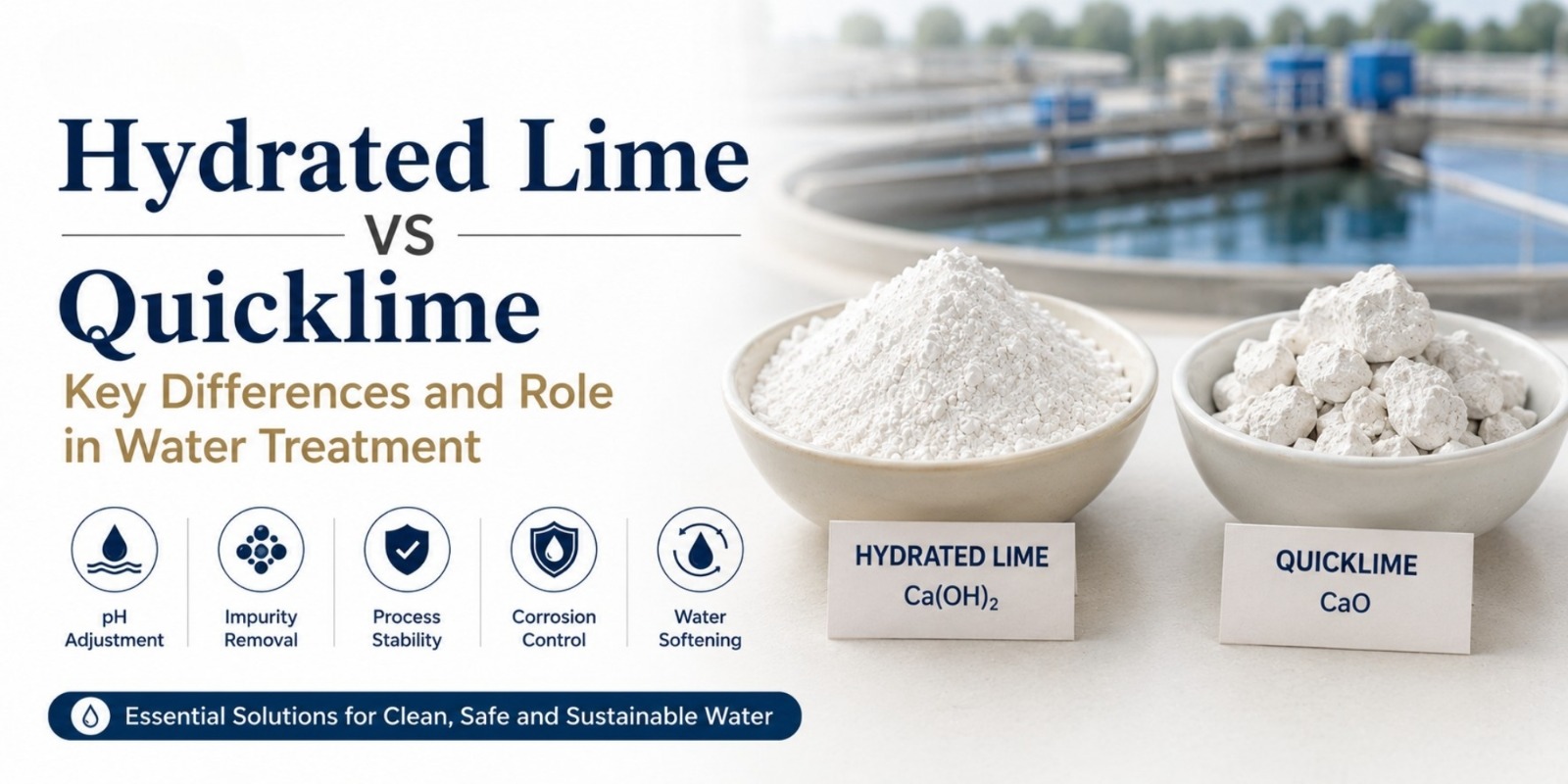
Hydrated Lime vs Quicklime: Key Differences and Role in Water Treatment
When someone in the water treatment or construction industry mentions lime, they are usually referring to one of two things: hydrated lime or quicklime. These two forms of lime are related, come from the same raw material, and are often confused with each other. But they are chemically different, behave very differently in industrial processes, and are not always interchangeable.
Understanding the difference between them goes beyond a technical detail. It is a practical necessity for anyone sourcing lime for water treatment, agriculture, construction, or industrial manufacturing. Choosing the wrong type can lead to poor results, higher costs, safety risks, and wasted material.
In this blog, we will explain what hydrated lime and quicklime are, how they compare across key properties, and why hydrated lime for water treatment has become the preferred choice in municipal and industrial water management around the world.
What is Quicklime?
Quicklime, also known as calcium oxide (CaO), is produced by heating limestone (calcium carbonate) in a kiln at extremely high temperatures, typically above 900 degrees Celsius. During this process, called calcination, the heat drives off carbon dioxide from the limestone and leaves behind calcium oxide.
The result is a dense, highly reactive substance that appears as a white or off-white granular material. Quicklime has a density of approximately 65 lb per cubic foot, which makes it heavier and more compact than hydrated lime. It is one of the most reactive calcium compounds available and generates significant heat when it comes into contact with water.
What is Hydrated Lime?
Hydrated lime, also known as calcium hydroxide (Ca(OH)2), is produced by adding a controlled amount of water to quicklime in a process called slaking. The water chemically combines with the calcium oxide to produce calcium hydroxide, which is a dry, bright white powder with a much finer and lighter texture than quicklime.
Hydrated lime has a density of approximately 35 lb per cubic foot, which is roughly half the density of quicklime. It is less reactive than quicklime, which makes it significantly safer and easier to handle. Unlike quicklime, hydrated lime does not generate dangerous heat when mixed with water. It can be dissolved in water to form a lime slurry or lime milk, which is commonly used in water treatment, soil stabilisation, and construction applications.
Hydrated Lime vs Quicklime: A Direct Comparison
The debate around hydrated lime vs quicklime comes down to several factors: chemical composition, reactivity, handling safety, storage, density, cost efficiency, and suitability for specific applications. Here is a clear breakdown of how they compare:
Chemical Formula: Quicklime is calcium oxide (CaO). Hydrated lime is calcium hydroxide (Ca(OH)2). The addition of water during slaking is what converts one into the other.
Reactivity: Quicklime is highly reactive. It reacts vigorously with water, generating significant heat. Hydrated lime is less reactive because it has already been slaked. Its reaction with water is controlled and does not produce dangerous heat.
Appearance and Texture: Quicklime typically appears as a denser, coarser, granular material that may look dull white or slightly grey. Hydrated lime is a fine, bright white, fluffy powder with a lighter and more uniform texture.
Handling Safety: Quicklime requires strict safety precautions due to its exothermic reaction with water. Contact with moisture, including sweat and humidity, can cause skin and eye irritation. On-site slaking requires specialist equipment. Hydrated lime is much safer to handle and does not require slaking equipment, making it the practical choice for most industrial applications.
Density and Storage: Quicklime is denser, which means it takes up less space in storage and is less expensive to transport per unit volume. This can be an advantage for operations consuming very large volumes of lime. However, it requires a lime slaker on-site to convert it before use.
Cost Considerations: Quicklime is generally less expensive per tonne and more cost-efficient at very high volumes because its greater density reduces storage and transportation costs. However, the capital investment required for slaking equipment offsets this advantage for smaller operations. Hydrated lime costs slightly more per tonne but requires no additional processing equipment, which makes it the more economical choice for most water treatment plants and medium-scale industrial applications.
Best Applications: In hydrated lime vs quicklime terms, quicklime is preferred for high-temperature industrial processes such as steel production, glass manufacturing, and soil stabilisation where fast, vigorous reactions are needed. Hydrated lime is preferred for water treatment, agriculture, construction mortars, flue gas treatment, and any application where controlled, safe handling is a priority.
Hydrated Lime for Water Treatment: Why It Is the Standard Choice
Of all the industrial applications of hydrated lime, hydrated lime for water treatment is arguably the most critical and the most widespread. Lime in various forms has been used in water treatment for well over a century, and hydrated lime remains the standard alkaline reagent in both drinking water purification and industrial wastewater management.
Here is a detailed look at exactly what hydrated lime does in water treatment systems and why it is so effective:
1. pH Adjustment and Acid Neutralisation
The most fundamental role of hydrated lime for water treatment is pH adjustment. Water that is too acidic is corrosive. It attacks metal pipes, concrete infrastructure, and water storage tanks, leaching harmful metals like lead and copper into the water supply. Acidic water is also unsuitable for many industrial processes and poses health risks when consumed.
When hydrated lime is added to acidic water, it dissolves and releases hydroxide ions (OH-). These ions react with the hydrogen ions present in the acidic water, neutralising the acidity and raising the pH to a safe and stable level. A pH between 7.0 and 8.5 is the target range for drinking water, and hydrated lime is one of the most cost-effective and reliable ways to achieve this.
2. Water Softening
Hard water is water that contains high levels of dissolved calcium and magnesium minerals. These minerals are not harmful to health in moderate amounts, but they cause significant problems in water distribution and industrial systems. They form hard mineral deposits called scale inside pipes, boilers, heat exchangers, and cooling towers. Scale reduces flow rates, reduces heat transfer efficiency, and increases energy consumption and maintenance costs.
3. Heavy Metal Removal
One of the most important public health functions of hydrated lime for water treatment is the removal of dissolved heavy metals from water. Heavy metals such as lead, arsenic, cadmium, chromium, and mercury can be present in groundwater, industrial effluents, and water contaminated by mining or industrial activity. Many of these metals are toxic at even very low concentrations and must be removed before water can be safely consumed or discharged.
Hydrated lime removes heavy metals by raising the pH of the water to a level at which the metals precipitate out of solution as insoluble hydroxide compounds. Different metals precipitate at different pH levels, and hydrated lime allows operators to target specific metals by controlling the pH during treatment. The precipitated solids are then removed through settling and filtration. This approach is widely used in the treatment of industrial wastewater from mining, electroplating, metal processing, and manufacturing facilities.
4. Flocculation and Clarification
Raw water drawn from rivers, lakes, and reservoirs often contains suspended particles including silt, clay, organic matter, algae, and colloidal material that makes the water turbid and cloudy. These particles are too fine to settle on their own within a practical timeframe.
Hydrated lime promotes flocculation, a process where fine suspended particles clump together into larger aggregates called flocs. The alkaline environment created by hydrated lime causes the surface charge on fine particles to change, allowing them to attract and bind to each other. These larger floc particles then settle out of the water more quickly through gravity or can be removed by filtration. This significantly improves water clarity and removes organic matter and bacteria along with the settled solids.
5. Disinfection Support
While hydrated lime is not a primary disinfectant in the same way that chlorine or UV treatment is, it supports disinfection by creating an alkaline environment that is hostile to many bacteria and pathogens. When the pH of water is raised to above 10.5 for a sustained period, many common waterborne bacteria and viruses are destroyed or inactivated. This is sometimes used in the pre-treatment of wastewater and sludge before further processing.
Hydrated lime is also used to stabilise and condition sludge generated during water treatment. Adding lime to sludge raises its pH, which reduces odour, inactivates pathogens, and makes the sludge easier to handle, dewater, and dispose of safely.
6. Phosphorus Removal
In wastewater treatment, excess phosphorus is a major cause of water pollution. When phosphorus-rich wastewater is discharged into lakes and rivers, it promotes the rapid growth of algae in a process called eutrophication. This depletes oxygen in the water and devastates aquatic ecosystems. Hydrated lime is widely used in tertiary wastewater treatment to remove dissolved phosphorus by converting it into calcium phosphate. This compound forms solid particles that settle at the bottom, making them easy to separate from the treated water. This is a cost-effective and well-established method for meeting phosphorus discharge limits set by environmental regulators.
Other Important Uses of Hydrated Lime
Beyond water treatment, hydrated lime is used across a wide range of other industries.
In construction, it is used as a component in mortars, plasters, and render where it improves workability, flexibility, and durability. Lime mortars are breathable and self-healing, which makes them particularly valued in the restoration of historic buildings.
In agriculture, hydrated lime is applied to acidic soils to raise pH and improve growing conditions for crops. It also adds calcium to the soil, which is an essential plant nutrient, and improves soil structure in heavy clay soils.
In flue gas treatment, hydrated lime is injected into exhaust gas streams to neutralise harmful gases including sulphur dioxide, hydrogen chloride, and nitrogen oxides before they are released into the atmosphere. This application is used in coal-fired power stations, cement plants, waste incinerators, and glass manufacturing facilities.
In the food industry, food-grade hydrated lime is used in the processing of sugar, the nixtamalisation of corn for tortilla production, and as a firming agent in certain food products.
Choosing Between Hydrated Lime and Quicklime for Your Application
The decision in the hydrated lime vs quicklime comparison comes down to your specific application, the volume of lime required, and your operational setup.
If your process requires very large volumes of lime and you have the capital and space for slaking equipment, quicklime may offer a cost advantage due to its lower transport cost per unit of active calcium content. This is common in large-scale industrial operations such as steel manufacturing or major construction projects.
For water treatment, agriculture, construction, and most environmental applications, hydrated lime is the clear practical choice. It is safer to handle, does not require slaking equipment, produces consistent and predictable results, and is available in grades that meet the quality and purity standards required for regulated applications.
Conclusion
Both hydrated lime and quicklime are important industrial materials that trace their origins to the same raw material but serve different purposes because of their different chemical properties. Understanding hydrated lime vs quicklime is essential for making the right sourcing decisions for your industry.
For water treatment specifically, hydrated lime for water treatment has proven itself across more than a century of use as one of the most effective, affordable, and versatile chemicals available. Its ability to adjust pH, soften water, remove heavy metals, support flocculation, and assist in disinfection makes it an indispensable part of modern water management in both municipal and industrial settings.
Frequently Asked Questions
The main difference is chemical composition and reactivity. Quicklime is calcium oxide (CaO), produced by heating limestone at very high temperatures. It is highly reactive and generates intense heat when mixed with water. Hydrated lime is calcium hydroxide (Ca(OH)2), produced by adding water to quicklime in a controlled process. It is less reactive, safer to handle, and does not require slaking before use. In the hydrated lime vs quicklime comparison, the right choice depends on your specific application and operational requirements.
Hydrated lime for water treatment is preferred because it is safer to handle, does not generate dangerous heat when dissolved in water, and does not require on-site slaking equipment. It dissolves more readily into a lime slurry or lime milk that can be accurately dosed into water treatment systems. Its controlled reactivity also makes it easier to achieve precise pH targets without overshooting, which is critical in both drinking water and wastewater treatment.
Quicklime can technically be used in water treatment, but it must first be slaked on-site to convert it into hydrated lime before it is added to the water. This requires specialist slaking equipment and strict safety controls to manage the heat generated during slaking. For most water treatment facilities, particularly small and medium-sized plants, using pre-hydrated lime is the more practical choice because it offers easier handling, improved safety, and greater cost efficiency.
Hydrated lime for water treatment is effective at removing a wide range of contaminants. These include dissolved heavy metals such as lead, arsenic, cadmium, and chromium, which precipitate out of solution when the pH is raised. It also removes hardness minerals like calcium and magnesium through lime softening, reduces suspended solids and turbidity through flocculation, removes excess phosphorus from wastewater, and creates conditions that support the inactivation of some bacteria and pathogens.
Yes. Hydrated lime is approved for use in drinking water treatment in most countries and is used by municipal water authorities around the world. When dosed correctly, it raises the pH of water to safe and acceptable levels without leaving harmful residues. The calcium it adds is not only harmless but is a beneficial mineral for human health. It is important to source hydrated lime from a reliable supplier who can provide documentation of purity and compliance with water treatment quality standards.
Get in touch with us!
×