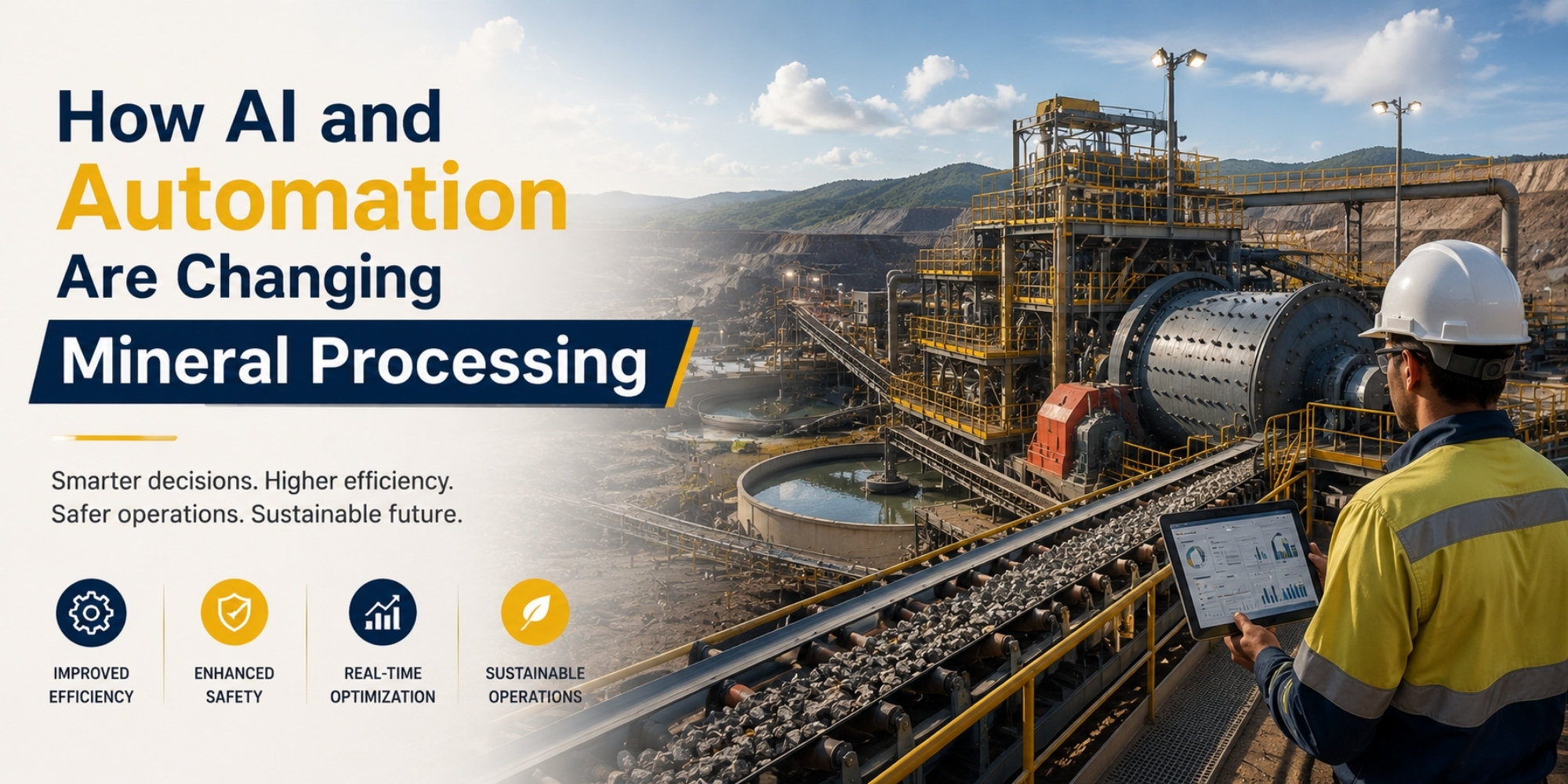
How AI and Automation Are Changing Mineral Processing
The mineral processing industry has always been about precision. From crushing and grinding to flotation and separation, every step demands accuracy, consistency, and speed. For decades, these processes relied heavily on human expertise, manual adjustments, and experience-based decision-making. But that is changing fast. Today, a new generation of technology is taking over the shop floor, and it is reshaping the entire value chain from ore body to finished product.
At the center of this shift is artificial intelligence in mining. Paired with automation, sensor technology, real-time data analytics, and machine learning, AI is helping mineral processors do more with less while pushing quality and recovery rates to levels that were simply not possible before.
Why the Mineral Processing Sector Needed a Technology Upgrade
Mining and mineral processing have always faced a difficult set of pressures. Ore grades are declining globally, meaning companies must process more material to extract the same volume of valuable minerals. At the same time, energy costs are rising, environmental regulations are tightening, and labor shortages are hitting operations across the board.
Traditional methods were designed for a different time. Manual sampling, periodic lab testing, and operator intuition worked well enough when ore bodies were rich and demand was steady. Today, those approaches simply cannot keep pace with the complexity and scale of modern mineral processing operations. This is precisely where AI in mining industry applications is delivering measurable results.
According to recent industry estimates, the global smart mining market is projected at over USD 15 billion in 2025 and is expected to nearly double by 2032. That kind of growth reflects genuine operational need, not just hype.
Key Areas Where AI and Automation Are Making an Impact
1. Real-Time Process Optimization
One of the most significant applications of AI in mineral processing is real-time optimization of grinding circuits, flotation cells, and thickeners. Traditional control systems respond to changes reactively. AI systems, by contrast, can anticipate changes by continuously analyzing sensor data, feed
characteristics, and historical performance patterns.
For example, AI-powered flotation control systems monitor froth characteristics using computer vision and automatically adjust reagent dosing, airflow, and pulp levels. The result is higher mineral recovery, lower reagent consumption, and more consistent product quality without constant operator intervention.
2. Predictive Maintenance
Equipment downtime is one of the most expensive problems in any processing plant. Unplanned shutdowns can result in losses of hundreds of thousands of dollars per day. AI-powered predictive maintenance significantly reduces this risk.
By continuously monitoring vibration data, temperature, acoustic signals, and motor performance, AI systems can detect early signs of bearing failure, wear, or misalignment weeks before they lead to a breakdown. Maintenance teams are then alerted to take action during planned shutdowns rather than scrambling in response to an emergency.
This is a core component of what industry experts now call "Digital Mining Solutions"—integrated platforms that combine IoT sensors, edge computing, and AI analytics to give plant managers a complete, real-time picture of asset health across their entire operation.
3. Ore Sorting and Feed Characterization
Knowing what is in your feed before it enters the processing circuit is enormously valuable. Sensor-based ore sorting technologies, combined with machine learning models, can now classify ore types, estimate grades, and even identify deleterious elements in real time using X-ray transmission, laser-induced breakdown spectroscopy, and hyperspectral imaging.
This means low-grade or barren material can be rejected before it even enters the plant, dramatically reducing energy consumption, reagent use, and wear on equipment. For operations processing large tonnages of variable ore, the savings can be enormous.
4. Autonomous and Remote Operations
Automation has already transformed surface mining haulage, with autonomous truck fleets now operating at major mines run by companies like Rio Tinto, BHP, and Fortescue. The same principles are now moving into processing plants through autonomous sampling systems, robotic laboratory analysis, and remote operating centers that allow a small team of specialists to monitor and control multiple plants from a single location.
This shift is a defining feature of digital transformation in mining. Plants that once required large on-site workforces can now be managed with leaner teams, improved safety outcomes, and greater operational consistency.
5. Digital Twins and Simulation
A digital twin is a virtual representation of a physical asset or process. In mineral processing, digital twins allow engineers to model the entire plant from the crusher to the tailings facility and run simulations to test different operating scenarios before implementing changes in the real world.
This capability is particularly powerful during commissioning, ramp-up, or when major process changes are being considered. Rather than learning through costly trial and error, plant operators can test changes virtually, identify bottlenecks, and optimize performance in a risk-free environment.
Industry 4.0 and the Future of Mineral Processing
Industry 4.0 in mining refers to the integration of digital technologies such as the Internet of Things, cloud computing, advanced robotics, artificial intelligence, and big data analytics into mining and mineral processing operations. It is not a single technology but a convergence of many, all working together to create smarter, more connected, and more responsive operations.
For mineral processors in India and globally, this represents both a challenge and an opportunity. The challenge is that the investment required to adopt these technologies is significant, and the skills needed to operate and maintain them are not always readily available. The opportunity is that companies that move early will gain a substantial competitive advantage in terms of cost, quality, and sustainability.
India, as one of the world's leading producers and processors of industrial minerals, is well-positioned to benefit from this transition. Companies that supply minerals to global industries such as pharmaceuticals, ceramics, paints, plastics, and food are increasingly being asked to demonstrate consistent quality and traceability. AI-driven quality control systems can help meet these demands with a level of precision and documentation that manual methods simply cannot match.
What This Means for Mineral Processors and Suppliers
The adoption of AI and automation in mineral processing is not about replacing skilled workers. It is about giving those workers better tools, better information, and more time to focus on high-value problem-solving rather than routine monitoring and manual adjustments.
For mineral processors and suppliers, the practical takeaways are straightforward. Investing in sensor-based quality control, data-driven process optimization, and predictive maintenance can significantly improve product consistency and reduce operational costs. These are not distant future technologies. They are available today and already delivering results in operations around the world.
At HTMC Group, we understand the demands of modern mineral processing. As one of India's most diversified mineral processing companies, we are committed to staying at the forefront of quality, consistency, and sustainable operations, leveraging the best available technologies to serve our global customers with the reliability they depend on.
Conclusion:
The mineral processing industry is undergoing a genuine transformation. Driven by declining ore grades, rising operational costs, and increasing quality demands, the shift toward AI and automation is accelerating. From real-time process control to predictive maintenance and digital twins, these technologies are delivering measurable improvements in recovery, efficiency, and safety.
For companies operating in the mineral sector, the question is no longer whether to adopt these technologies but how quickly and how strategically to do so. Those who move thoughtfully and decisively will be the ones setting the benchmark for mineral processing in the decade ahead.
Frequently Asked Questions
AI improves mineral recovery by enabling real-time optimization of processes like flotation and grinding. Machine learning models analyze continuous sensor data to adjust operating parameters automatically, maintaining optimal conditions even as feed characteristics change. This reduces variability and consistently pushes recovery toward the upper end of what the process is capable of achieving.
Digital mining solutions are integrated technology platforms that combine IoT sensors, edge computing, AI-based analytics, and cloud connectivity to monitor and optimize mining and processing operations in real time. They typically cover equipment health monitoring, process performance tracking, energy management, and production reporting through a unified interface accessible from any location.
Industry 4.0 in mining technologies helps reduce energy consumption by optimizing the speed and load of high-energy equipment like SAG mills, ball mills, and crushers based on real-time feed conditions. AI-driven energy management systems can also schedule high-energy operations during off-peak tariff periods and identify inefficiencies in compressed air, water pumping, and ventilation systems.
Digital transformation in mining improves safety by reducing the need for personnel to work in hazardous environments. Autonomous equipment, remote monitoring, and AI-powered hazard detection systems reduce human exposure to risks associated with moving machinery, high-energy environments, and unstable ground conditions. Real-time monitoring also allows faster response to equipment anomalies before they become safety incidents.
Yes, increasingly so. While large-scale implementations require significant investment, many AI tools are now available as software subscriptions or modular add-ons to existing control systems, making them accessible to smaller processors. Predictive maintenance alone typically delivers a return on investment within 12 to 18 months through avoided downtime and extended equipment life. The key is starting with high-impact, lower-cost applications and scaling from there.
Get in touch with us!
×