HEDP Chemical Properties, Formula and Industrial Specifications
The Role of HEDP in Modern Industrial Chemistry
In today's highly competitive industrial landscape, the demand for high-performance chemical additives has never been greater. From large-scale water treatment facilities and steel manufacturing plants to oil refineries and cooling tower operations, the need for reliable, efficient, and technically sound chemical compounds is fundamental to maintaining productivity and protecting infrastructure.
Among the most widely used specialty phosphonate chemicals in the global industry is HEDP—1-Hydroxyethylidene-1,1-Diphosphonic Acid. This organophosphonic acid has earned its place as a critical industrial input across dozens of sectors due to its exceptional scale-inhibiting, corrosion-inhibiting, and chelating capabilities. Whether you are an industrial buyer evaluating sourcing options, a manufacturer optimizing your production process, or a supplier seeking detailed technical data, understanding HEDP's chemical properties, its molecular structure, and its industrial specifications is essential.
This article provides a thorough technical and commercial overview of HEDP—covering its chemical formula, CAS number, molecular weight, structure, key properties, manufacturing process, industrial applications, and current market dynamics.
What Is HEDP? Definition, Formula and Basic Properties
Chemical Identity and HEDP Chemical Formula
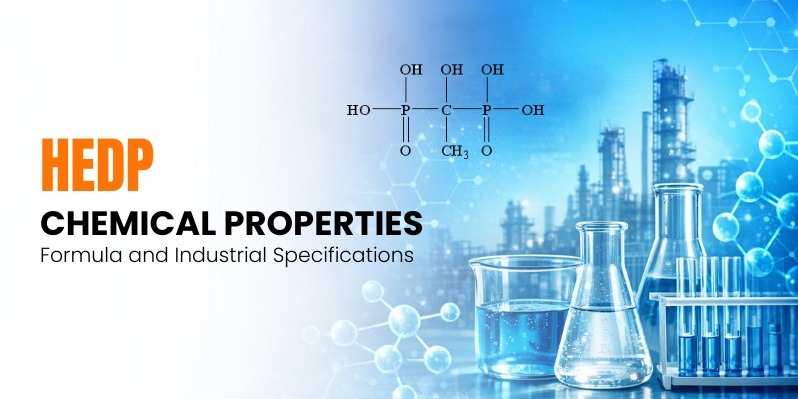
HEDP, or 1-Hydroxyethylidene-1,1-Diphosphonic Acid, belongs to the organophosphonate family of compounds. Its HEDP chemical formula is C₂H₈O₇P₂, representing a compact yet chemically active molecule with two phosphonate groups and one hydroxyl group attached to a central carbon backbone.
The HEDP CAS number is 2809-21-4, which serves as its unique international identifier across regulatory databases, safety datasheets (SDS), customs documentation, and procurement systems. Industrial buyers and procurement specialists commonly use the HEDP CAS number when verifying product identity and compliance with international chemical standards.
HEDP Molecular Weight and Physical Characteristics
The HEDP molecular weight is 206.03 g/mol. In its standard commercial form, HEDP is available as a colorless to pale-yellow aqueous solution, typically at 50%, 60%, or 90%, and in solid (crystalline) form at a minimum purity of 98% for specialized industrial applications.
Key physical and chemical properties include:
Appearance: Colorless to pale yellow transparent liquid (aqueous solution) or white crystalline powder (solid form).
Density: Approximately 1.43–1.45 g/cm³ (for 50% aqueous solution)
pH (1% solution): 1.8–2.2 — strongly acidic
Boiling Point: 100°C (decomposes before boiling in concentrated form)
Solubility: Fully miscible with water; compatible with most inorganic salts
Stability: Excellent thermal and hydrolytic stability up to 200°C
HEDP Structure
The HEDP structure is characterized by a geminal diphosphonate configuration—two phosphonic acid groups (-PO₃H₂) bonded to the same carbon atom (C₁), with a methyl group and a hydroxyl group also attached. This unique HEDP structure enables strong coordination with metal ions such as calcium, magnesium, iron, zinc, and copper, making it highly effective as a scale and corrosion inhibitor. The hydroxyl group further enhances the molecule's ability to interact with mineral surfaces, while the dual phosphonate groups provide exceptional chelation capacity.
Manufacturing and Processing of HEDP
Industrial Synthesis Route
HEDP is commercially produced through the reaction of acetic acid (or acetic anhydride) with phosphorous acid (H₃PO₃) in the presence of phosphorus trichloride (PCl₃) as a catalyst. The reaction proceeds under controlled temperature and pressure conditions to yield a highly pure diphosphonic acid product.
The manufacturing process typically follows these stages:
Raw material preparation and quality verification of acetic acid and phosphorous acid
Controlled addition of PCl₃ under inert atmosphere conditions
Temperature-regulated reaction at 60–90°C with continuous agitation.
Hydrolysis and neutralization of the intermediate product
Concentration and purification to achieve target HEDP content
Quality assurance testing: HEDP assay, pH, density, iron content, chloride content
Reputable manufacturers implement rigorous process controls at every stage to meet ISO, GB, and international industry standards. Final products are verified against certified reference standards to ensure batch-to-batch consistency — a critical factor for industrial buyers requiring stable performance in continuous processes.
Major Industrial Applications of HEDP
Water Treatment
The largest global application of HEDP is in industrial water treatment — including cooling water systems, boiler water treatment, reverse osmosis (RO) membrane protection, and circulating water management. HEDP's outstanding scale-inhibiting and corrosion-inhibiting properties make it highly effective at preventing calcium carbonate, calcium sulfate, and barium sulfate scale deposition on heat exchanger surfaces and pipelines. It is commonly formulated with other scale inhibitors such as ATMP, PBTCA, and polyacrylates to create balanced treatment programs.
Oilfield Chemistry
In oil and gas production, HEDP is used as a scale inhibitor in downhole applications, pipelines, and surface processing equipment. Its compatibility with high-salinity environments and elevated temperatures makes it particularly suited for offshore and onshore production systems where mineral scale buildup poses significant operational risks and maintenance costs.
Metal Surface Treatment and Steel Industry
HEDP functions as an effective metal cleaning and pre-treatment agent in the steel and metal finishing industries. It removes iron oxides, rust, and mill scale from steel surfaces while passivating the surface to slow re-oxidation. It is also incorporated into phosphating baths and electroplating processes to improve coating adhesion and surface quality.
Textile and Dyeing Industry
In textile processing, HEDP is used as a chelating agent to deactivate hardness ions (calcium and magnesium) that interfere with dye uptake and fabric quality. It prevents the precipitation of insoluble metal salts during bleaching, dyeing, and finishing processes, improving color fastness and uniformity.
Detergents, Cleaning Agents, and Daily Chemicals
HEDP is incorporated into industrial and consumer cleaning formulations, including laundry detergents, dishwashing compounds, and industrial cleaners, as a builder and scale inhibitor. It replaces traditional phosphates in environmentally sensitive formulations while maintaining equivalent or superior performance in hard water conditions.
Concrete and Construction Chemicals
In the construction chemicals sector, HEDP finds application as a set retarder and workability enhancer in cement and concrete formulations. It controls the hydration rate of calcium aluminates and silicates, extending workability time without compromising final compressive strength—a valuable property in hot-climate concreting and large-pour applications.
Agriculture and Micronutrient Fertilizers
HEDP is used in chelated micronutrient fertilizer formulations to stabilize iron, manganese, zinc, and copper in liquid fertilizer solutions. It prevents precipitation of these micronutrients at high pH, ensuring their bioavailability for plant uptake in drip irrigation and foliar spray applications.
Key Benefits and Advantages of HEDP in Industrial Production
Industrial operators and formulators choose HEDP for a comprehensive set of performance and commercial advantages:
Superior Scale Inhibition: Effective against calcium carbonate, calcium sulfate, and barium sulfate scale at dosages as low as 1–10 mg/L.
Excellent Corrosion Inhibition: Forms a protective film on metal surfaces, reducing corrosion rates significantly in both carbon steel and mild steel systems
Thermal Stability: Maintains activity at temperatures up to 200°C, outperforming many conventional phosphate-based inhibitors.
Broad pH Tolerance: Effective across a wide pH range (2–12), enabling use in both acidic cleaning and alkaline treatment environments.
Good Compatibility: Compatible with chlorine disinfectants, oxidizing biocides, and other scale/corrosion inhibitor components
Low Toxicity Profile: Acceptable aquatic toxicity and biodegradation characteristics compared to phosphate alternatives under appropriate regulatory frameworks
Chelation Efficiency: : Strong affinity for iron, zinc, copper, and calcium ions, preventing interference from hardness minerals in complex industrial formulations.
Market Demand, Trends and Industrial Outlook for HEDP
The global HEDP market has demonstrated consistent demand growth, driven primarily by increasing industrialization in emerging economies, tightening water treatment regulations in developed markets, and expanding applications in oilfield chemistry and specialty formulations.
Key market trends shaping the HEDP industry include the following:
Growing Water Scarcity Concerns: : Industrial facilities are under increasing pressure to recycle and treat water more efficiently, driving demand for high-performance scale and corrosion inhibitors such as HEDP.
Phosphate Replacement Initiatives: Environmental regulations restricting inorganic phosphate use in detergents and cleaning agents are accelerating the adoption of HEDP-based alternatives in formulation chemistry.
Expansion of Oil and Gas Operations: Rising oilfield activity in the Middle East, North America, and Southeast Asia is generating sustained demand for HEDP-based scale inhibitor programs.
Specialty Agriculture Growth: The rapid expansion of precision agriculture and fertigation systems is creating new application segments for HEDP in chelated micronutrient products.
Asia-Pacific Production Hub: China remains the world's dominant producer and exporter of HEDP, with ongoing capacity expansions and quality improvements by leading manufacturers serving international markets.
Industrial buyers should note that HEDP pricing is influenced by raw material costs (particularly phosphoric acid and acetic acid), energy costs, and logistics. Establishing long-term supply agreements with reliable manufacturers helps mitigate price volatility and ensures uninterrupted production continuity.
Choosing the Right HEDP Manufacturer and Supplier
For industrial buyers, manufacturers, and formulators, the quality and consistency of HEDP supply directly impact operational performance, compliance, and production economics. When evaluating HEDP suppliers, key selection criteria should include:
Technical documentation: Verified HEDP CAS number (2809-21-4), full SDS, certificate of analysis (COA), and independent third-party test reports
Manufacturing standards: ISO 9001 certification, compliance with GB and international chemical manufacturing standards
Product range: Availability of both standard aqueous solutions (50% and 60%) and high-purity solid grades (98%+) to match your specific application requirements
Batch consistency: Demonstrated track record of consistent HEDP assay, molecular weight compliance, and low impurity levels across production batches
Supply chain reliability: : Adequate production capacity, warehousing infrastructure, and global logistics capability to support consistent delivery schedules
Technical support: Application engineering expertise to assist with formulation development, dosage optimization, and regulatory compliance
In an industry where chemical performance directly translates to operational uptime, equipment longevity, and regulatory compliance, the importance of sourcing HEDP from a reputable and technically capable manufacturer cannot be overstated. Whether your requirement is for bulk industrial supply, specialty formulation-grade product, or custom purity specifications, partnering with an established HEDP producer ensures you receive a product that consistently meets the technical demands of your application.
As global industries continue to evolve toward greater efficiency, sustainability, and performance optimization, HEDP will remain a cornerstone chemical compound in water treatment, metal processing, oilfield operations, and specialty chemistry. Investing in a reliable supply relationship today is a strategic decision that delivers measurable long-term value.
×