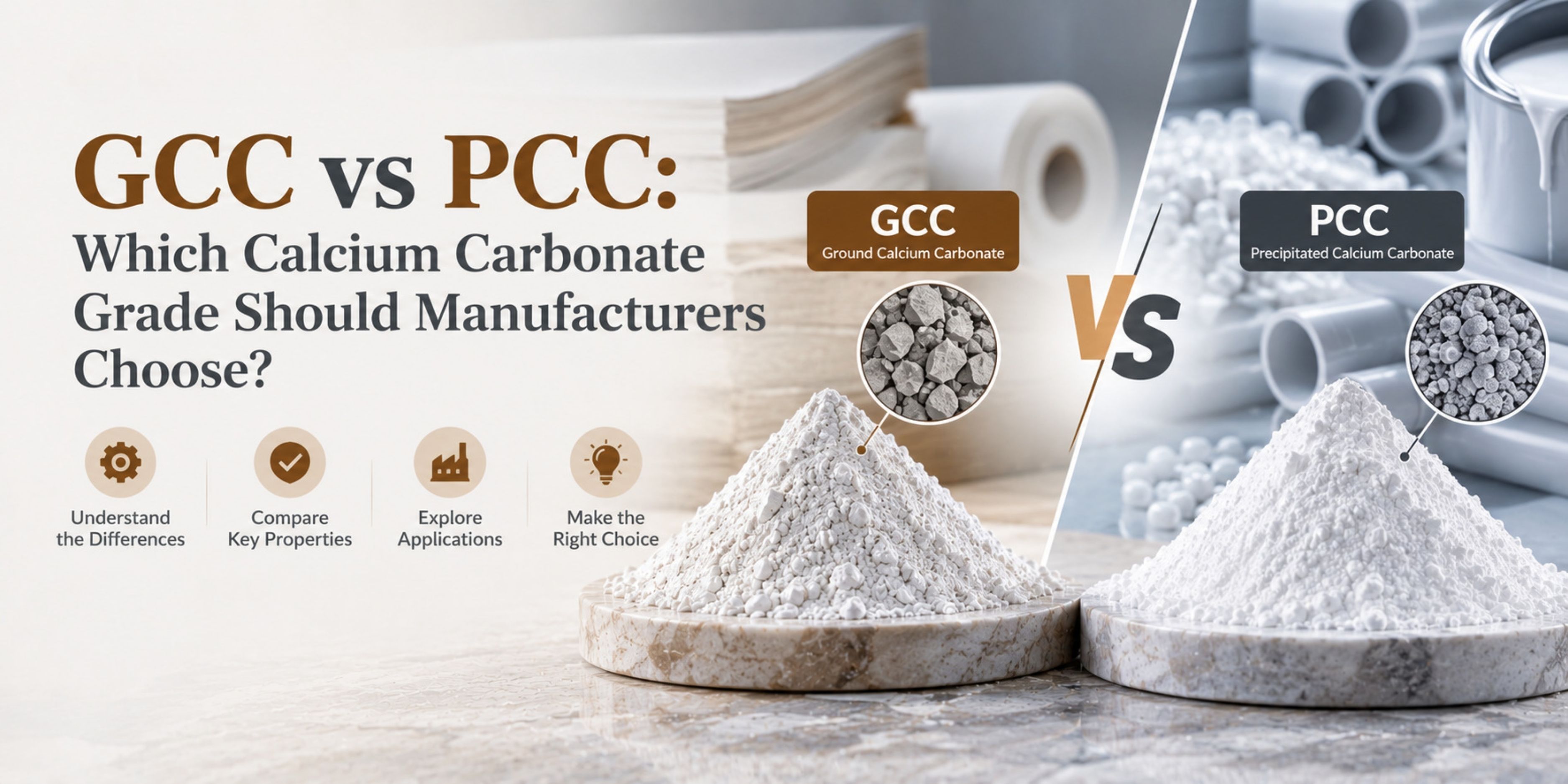
GCC vs PCC: Which Calcium Carbonate Grade Should Manufacturers Choose?
Calcium carbonate is one of the most widely used industrial minerals, playing an important role in the manufacturing of products ranging from paper, paints, coatings, plastics, and rubber to adhesives, sealants, construction materials, and pharmaceuticals. Its versatility, availability, and ability to modify important product properties make it a popular choice for manufacturers across numerous industries. However, not all calcium carbonate is the same. Differences in particle size, morphology, surface area, purity, and manufacturing method can significantly influence how calcium carbonate performs in a specific formulation.
When manufacturers evaluate different calcium carbonate grades, one of the most common questions that comes up is GCC vs PCC. Ground Calcium Carbonate (GCC) and Precipitated Calcium Carbonate (PCC) have the same basic chemical formula, CaCO₃, but they are produced through completely different processes. GCC is obtained by mining and mechanically grinding naturally occurring calcium carbonate minerals such as limestone, marble, or chalk, while PCC is manufactured through a controlled chemical precipitation process. These differences give each material distinct physical characteristics and performance advantages.
The choice between GCC and PCC therefore depends on much more than price alone. Factors such as particle size, particle shape, brightness, purity, surface area, dispersion, oil absorption, and application requirements can determine which grade is more suitable for a particular manufacturing process. While GCC may be preferred for applications where cost efficiency and high-volume filler loading are important, PCC can offer more controlled particle characteristics for applications requiring specific functional performance.
This blog breaks down the real differences between Ground Calcium Carbonate and Precipitated Calcium Carbonate, including their manufacturing processes, physical properties, advantages, limitations, and common industrial applications. By understanding how GCC and PCC differ, manufacturers can make a more informed, application-specific decision instead of choosing a calcium carbonate grade based only on assumptions or price.
What is GCC (Ground Calcium Carbonate)?
Ground Calcium Carbonate is a naturally occurring mineral produced by mechanically crushing and grinding high-purity limestone, marble, or chalk. No chemical reaction is involved in this process. The raw ore is simply mined, crushed, and then ground down to the required particle size through grinding mills, followed by classification or screening.
Because GCC retains its natural mineral structure, its particle shape is generally irregular or blocky, and its properties depend heavily on the quality of the original limestone deposit. GCC is widely used as a cost-effective, high-volume filler across industries such as paper, plastics, paints, rubber, and construction.
What is PCC (Precipitated Calcium Carbonate)?
Precipitated Calcium Carbonate, unlike GCC, is a synthetically manufactured material. The process begins with calcining limestone at around 1000°C to produce quicklime. The quicklime is then slaked with water to form a milk of lime slurry, which is reacted with carbon dioxide in a controlled carbonation step. This reaction precipitates ultra-pure calcium carbonate crystals, which are then filtered and dried into a fine powder.
Because PCC is engineered rather than mined, manufacturers can precisely control its particle size, shape, and surface chemistry during production. PCC crystals can be formed in different habits, such as scalenohedral, rhombohedral, or aragonite needle shapes, depending on the reaction conditions, giving formulators far more control over their performance in a specific application.
GCC vs PCC: Manufacturing Process
| Step | GCC | PCC |
|---|---|---|
| Raw Material | Natural limestone, marble, or chalk | Limestone, chemically transformed |
| Process Type | Mechanical grinding and classification | Calcination, slaking, and carbonation |
| Chemical Change | None | Full chemical transformation |
| Control Over Particle Shape | Limited, depends on natural ore | High, engineered during precipitation |
| Energy Requirement | Lower | Higher, due to multi-step chemical processing |
This difference in manufacturing is the root cause of nearly every property difference between the two materials. GCC is essentially "what nature provides, refined," while PCC is "built to a specification."
GCC vs PCC: Key Property Differences
| Property | GCC | PCC |
|---|---|---|
| Purity | 97 to 99% CaCO3, depending on ore quality | Generally above 98%, often higher purity |
| Brightness | 85 to 93% ISO | 92 to 98% ISO, consistently higher |
| Particle Shape | Irregular, blocky, natural | Engineered, uniform crystal habits |
| Particle Size Range | Typically coarser, mesh-based grading | Sub-micron to a few microns, tightly controlled |
| Surface Area | Lower | Higher, due to fine-engineered particles |
| Oil Absorption | Lower | Higher |
| Consistency | Varies with ore source and batch | Highly consistent, batch to batch |
PCC's finer, more uniform particle size and higher surface area allow it to function as more than a simple bulking filler. In many formulations, PCC behaves as a functional additive that actively improves mechanical or optical properties, while GCC is generally used as a volume extender.
GCC vs PCC: Cost Comparison
Cost is often the deciding factor for manufacturers working with large-volume, price-sensitive applications.
| Factor | GCC | PCC |
|---|---|---|
| Production Cost | Lower, mechanical process only | Higher, multi-step chemical process |
| Typical Price Difference | 40 to 70% less expensive than equivalent PCC grades | Priced at a premium due to processing and purity |
| Best Fit for Budget | High-volume, cost-sensitive formulations | Applications where performance justifies the added cost |
For most bulk industrial applications, GCC delivers a strong balance of performance and cost. PCC is generally reserved for applications where its finer particle size, higher purity, or specific crystal shape provides a functional benefit that GCC cannot match.
Industry-Wise Recommendation
| Industry | Recommended Grade | Reason |
|---|---|---|
| Paper (Filler and Coating) | Both used, PCC preferred for coating | PCC offers better brightness and smoothness for coated paper |
| Plastics | GCC for general filling, PCC for functional grades | GCC reduces cost, PCC improves specific mechanical or optical properties |
| Paints and Coatings | Both used depending on grade | GCC for bulk extension, PCC for opacity and rheology control |
| Rubber | GCC most common | Cost-effective volume filler, works well as an extender |
| Adhesives and Sealants | GCC is widely used and can form up to 80% of the formulation | Controls rheology at a low cost |
| Pharmaceuticals and Food | PCC preferred | High purity and consistency required for ingestible products |
| Construction and Cement | GCC | Purity requirements are lower; cost efficiency matters most |
When Should You Choose GCC?
GCC is generally the right choice when:
- Your application requires a high-volume, cost-effective filler rather than a functional additive
- Purity and particle size control are important but not at the extreme, sub-micron level
- You are working in industries like construction, rubber, general plastics, or bulk paper filling
- You want a naturally sourced material with minimal processing and a lower environmental footprint
- Budget efficiency is a higher priority than achieving the absolute finest particle size
When Should You Choose PCC?
PCC becomes the better choice when:
- Your formulation needs a very fine, tightly controlled particle size, often in the sub-micron range
- You require high, consistent brightness for premium paper coating, paints, or cosmetic applications
- You need a specific crystal shape or surface chemistry to achieve a functional effect, such as improved reinforcement or reactivity
- Your industry demands pharmaceutical or food-grade purity
- You are formulating high-performance plastics, rubber, or coatings where PCC's engineered properties directly improve product performance
Common Mistakes Manufacturers Make While Choosing
- Assuming PCC is always better: PCC is not universally superior. For many bulk applications, GCC performs just as well at a much lower cost.
- Ignoring particle size requirements: Choosing a coarse GCC grade for an application that actually needs fine, controlled particle size can hurt product performance.
- Overlooking brightness needs: Applications like premium coated paper or cosmetics often require the higher brightness that only PCC can consistently deliver.
- Not testing before scaling up: Every formulation reacts differently to filler type. Small trial batches should always be run before committing to a full production run.
- Focusing only on price: The cheaper option is not always the most cost-effective once processing efficiency and final product quality are factored in.
Why Choose HTMC Group for GCC or PCC Supplier
Whether you choose GCC or PCC, the consistency and quality of the supplier matter just as much as the grade itself. Variation in purity, particle size distribution, or brightness from batch to batch can create real problems in downstream processing, from inconsistent product quality to increased rejection rates.
At HTMC Group, we manufacture and supply both Ground Calcium Carbonate (GCC) and Precipitated Calcium Carbonate (PCC), processed under strict quality control to meet the specific technical requirements of the paper, plastics, paints, rubber, and construction industries. With decades of mining and processing experience, in-house quality labs, and a strong global supply network, we help manufacturers select and receive the right calcium carbonate grade, batch after batch.
Conclusion
The GCC vs PCC decision ultimately comes down to matching the grade to your application's actual technical requirements, not simply choosing the material with the best reputation on paper. GCC offers a cost-effective, naturally sourced solution for high-volume applications, while PCC delivers engineered purity, brightness, and particle control for more demanding formulations. Manufacturers who understand these fundamental differences and who work with a supplier capable of delivering consistent quality are best positioned to choose the grade that genuinely improves their product performance and cost efficiency.
Get in Touch with HTMC Group
Still deciding between GCC vs PCC for your formulation? HTMC Group manufactures and supplies both Ground Calcium Carbonate and Precipitated Calcium Carbonate, tailored to your industry's specific purity, brightness, and particle size requirements. Get in touch with our team today for technical data sheets, sample requests, or bulk pricing.
Call Us: +91 33 2226 8228, +91 98 1140 9161
Enquire Now: [email protected]
Frequently Asked Questions
GCC is a naturally mined mineral that is mechanically ground, while PCC is synthetically produced through a chemical process involving calcination, slaking, and carbonation.
Generally, yes, PCC tends to offer higher purity and brightness since it is chemically manufactured and free from many of the natural impurities found in mined limestone.
GCC is typically 40 to 70% less expensive than equivalent PCC grades, since it requires only mechanical processing rather than a multi-step chemical process.
In many bulk applications such as rubber, plastics, and general paper filling, high-purity GCC can substitute for PCC. However, PCC remains necessary where sub-micron particle size or engineered crystal shape is required.
Industries requiring very fine particle size, high brightness, or pharmaceutical-grade purity, such as premium paper coating, food, and pharmaceuticals, generally prefer PCC.
Yes, GCC particle size depends on grinding and is generally coarser, while PCC particle size can be precisely engineered, often down to the sub-micron range.
GCC is more commonly used in rubber as a cost-effective extender filler, though PCC may be used in specific formulations requiring finer particle control.
Yes, since PCC involves a more complex manufacturing process, it generally costs more, which directly affects the overall raw material cost of the final product.
Yes, some formulations blend GCC and PCC to balance cost efficiency with the specific functional benefits that PCC provides.
The decision should be based on your required particle size, brightness, purity level, and budget. Running trial batches and consulting an experienced mineral supplier like HTMC Group can help identify the most suitable grade for your specific application.
Contact Us
Get in touch with us!
×