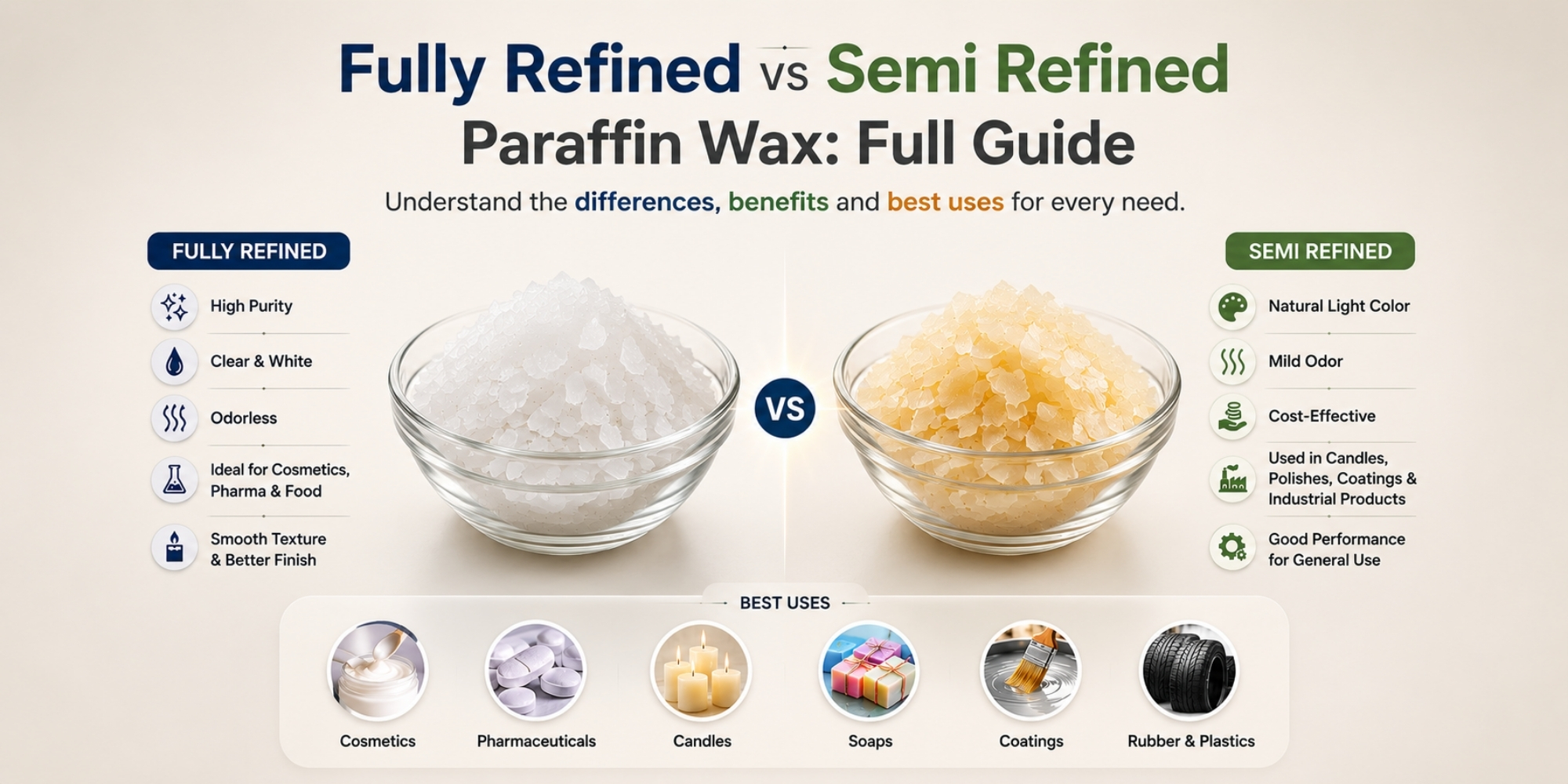
Fully Refined vs Semi Refined Paraffin Wax: Full Guide
Paraffin wax is one of the most widely used materials across dozens of industries worldwide. From candles and cosmetics to food packaging, rubber manufacturing, and pharmaceuticals, its versatility is unmatched. But here is something most buyers and manufacturers overlook: not all paraffin wax is the same.
When you walk into the paraffin wax market, the two most important grades you will encounter are fully refined paraffin wax and semi-refined paraffin wax. They may look similar on the surface, but they have very different chemical compositions, physical properties, performance levels, and ideal applications.
Choosing the wrong grade can cost your business money, hurt product quality, or even create compliance issues in regulated industries. This guide breaks down everything you need to know so you can make an informed, confident decision.
What Is Paraffin Wax and How Is It Produced?
Before comparing the two grades, it helps to understand where paraffin wax comes from and how the refining process works.
The unique structure of mica allows light to bounce off its surface, creating depth, sparkle, and shine. This characteristic makes it highly valuable for products that require visual appeal and decorative finishes.
Paraffin wax is a petroleum-derived solid wax made up primarily of saturated hydrocarbons. It is extracted from crude oil through a multi-stage refining process that typically involves distillation, dewaxing, deoiling, and in some cases hydrotreating and clay filtration. The result is a white or off-white solid material that is odorless, tasteless, and chemically stable at room temperature.
The degree to which this refining process is carried out determines whether the final product is classified as fully refined or semi-refined paraffin wax. The more thoroughly the wax is processed, the purer it becomes, with lower oil content, better color, and a more neutral odor.
What Is Fully Refined Paraffin Wax?
Fully refined paraffin wax is the highest purity grade of paraffin wax available in the commercial market. It is produced through an intensive refining sequence that includes deep deoiling, hydrotreating, and clay filtration to strip away residual oil, aromatic compounds, sulfur traces, and other impurities.
The result is a wax that is crystal white, completely odorless and tasteless, very hard in texture, and chemically consistent from batch to batch.
Key Technical Specifications:
- Oil content: Less than 0.5%
- Color: Pure white to translucent
- Odor: Completely odorless
- Melting point: Typically ranges from 52°C to 62°C (125°F to 144°F) depending on grade
- Texture: Hard, crystalline, and brittle
- Regulatory status: Meets FDA, EU, and food-grade standards in appropriate formulations
Because of its extremely low oil content and high purity, fully refined paraffin wax delivers predictable, consistent thermal behavior. This makes it the preferred choice in any application where precision, cleanliness, and regulatory compliance matter.
What Is Semi Refined Paraffin Wax?
Semi-refined paraffin wax undergoes a less intensive version of the same refining process. The deoiling step is not pushed to the same endpoint, which means a higher level of residual oil remains in the final product.
This grade still goes through dewaxing, solvent extraction, and filtration, but because the process stops earlier, the wax retains some of the characteristics of the raw material. It is slightly softer, may have a faint petroleum odor, and its color can appear slightly off-white or mildly yellow depending on the source crude and the degree of processing.
Key Technical Specifications:
- Oil content: Typically between 0.5% and 7% (varies by grade and supplier)
- Color: Off-white to slightly yellow
- Odor: Mild petroleum smell, varies by grade
- Melting point: Can range from 46°C to 66°C, depending on formulation
- Texture: Softer and slightly more flexible than fully refined
- Cost: Generally lower than fully refined wax
Semi-refined paraffin wax is not inferior in all applications. In many industrial applications, its slightly higher oil content provides performance benefits, including improved flexibility, better fragrance absorption in candles, and enhanced processability in rubber manufacturing.
Fully Refined vs Semi Refined Paraffin Wax: Head-to-Head Comparison
Understanding the differences between these two grades requires looking at each key property side by side.
1. Oil Content
This is the single most important differentiator between the two grades. Fully refined paraffin wax contains less than 0.5% oil, while semi-refined grades can contain anywhere from 0.5% to 7%, depending on the supplier and grade specification. Oil content directly affects hardness, odor, color, and regulatory suitability. Lower oil content means a harder, cleaner, more stable wax. Higher oil content makes the wax softer and more flexible, but less suitable for sensitive applications.
2. Purity and Color
Fully refined wax appears bright white to translucent and looks completely clean. Semi-refined wax may appear slightly off-white or have a pale yellow tint because trace impurities from the crude oil source are not fully removed during the less intensive refining process. In applications where appearance matters, such as premium cosmetics, pharmaceutical-adjacent products, and food-safe packaging, the white clarity of fully refined wax is important and often required.
3. Odor Profile
Fully refined paraffin wax is entirely odorless. Semi-refined wax retains a faint petroleum-like smell, which is noticeable to varying degrees depending on the grade and oil content. For candles, perfumed products, food contact materials, or cosmetics, any background odor in the wax can interfere with the intended fragrance or create a negative sensory experience.
4. Hardness and Texture
Because fully refined wax has so little residual oil, it is significantly harder and more brittle at room temperature. It has a crystalline, almost chalky texture when broken. Semi-refined wax, with its higher oil content, is softer, slightly more pliable, and easier to work with in certain processing conditions such as molding or blending.
5. Melting Point Consistency
Fully refined grades generally offer tighter melting point ranges and more predictable thermal behavior. This matters greatly in industries with narrow processing windows, such as pharmaceutical tablet coating or precision food packaging. Semi-refined grades can exhibit slightly more variability in melting behavior, which is usually acceptable in general industrial applications.
6. Regulatory Compliance
This is where the distinction becomes critical for certain industries. Fully refined paraffin wax is the grade most commonly formulated and documented to meet FDA food contact regulations, European food safety standards, and pharmaceutical-grade requirements. Semi-refined wax does not typically qualify for direct food contact or pharmaceutical use because of its higher residual oil content and the presence of trace impurities that do not meet the necessary purity thresholds.
7. Cost
Semi-refined paraffin wax is more affordable than fully refined wax because it requires less intensive processing. For high-volume industrial applications where purity is not critical, this lower cost makes semi-refined wax the economically smart choice. For regulated or premium applications, the additional cost of fully refined wax is justified by the performance and compliance benefits it provides.
Applications of Fully Refined Paraffin Wax
Fully refined paraffin wax is the go-to grade whenever product safety, purity, and quality standards are non-negotiable.
Cosmetics and Skin Care
In the beauty and personal care industry, fully refined wax is used in lip balms, moisturizing creams, lotions, ointments, and paraffin spa treatments for hands and feet. Its odorless nature and pure white color make it compatible with sensitive formulations. It functions as an occlusive emollient, locking in moisture and creating a smooth skin feel.
Food Packaging and Food-Grade Applications
Fully refined paraffin wax meets food safety standards and is approved for use in food contact applications. It is used to coat paper cups, cardboard packaging, cheese rinds, fresh produce, and confectionery items like chocolate. It extends shelf life by forming a moisture-resistant barrier without affecting taste or smell.
Pharmaceuticals
In pharmaceutical manufacturing, fully refined wax is used as a coating agent for tablets, a base for ointments, and a component in suppositories. The purity and inertness of fully refined grades are essential in this context because any impurity could compromise drug safety or efficacy.
Premium Candle Making
High-end scented candles, container candles, and decorative candles are often made with fully refined paraffin wax because of its clean burn, excellent fragrance retention, and bright white appearance. The wax does not interfere with the added fragrance oils and produces minimal soot when burned correctly.
Electrical Insulation
Fully refined paraffin wax is used in certain electrical components as an insulating material. Its chemical stability, low conductivity, and consistent melting point make it reliable for this application.
Crayons and Art Supplies
The clean, pure, and non-toxic nature of fully refined wax makes it the standard ingredient in crayons, colored pencils, and art wax products, especially those intended for children.
Applications of Semi Refined Paraffin Wax
Semi-refined paraffin wax holds its own in a wide range of industrial and commercial applications where absolute purity is not required, but performance and cost-efficiency are priorities.
Candle Manufacturing
Semi-refined wax is widely used in the production of standard candles, taper candles, emergency candles, pillar candles, and outdoor torches. The higher oil content can actually improve fragrance retention in some formulations, and the lower cost makes it ideal for large-scale candle production where budget matters.
Rubber and Tire Industry
In rubber compounding, semi-refined paraffin wax serves as a processing aid and lubricant. It improves the flow of rubber compounds during mixing, acts as a release agent in molds, and enhances the surface properties of finished rubber products. The flexibility added by its higher oil content is a functional benefit in this context.
Packaging and Waterproofing
Semi-refined wax is used to coat paper, cardboard, and corrugated packaging materials to improve moisture resistance, durability, and strength. It is also used in waterproofing applications for textiles, building materials, and industrial coatings.
Adhesives and Sealants
The wax serves as a component in hot-melt adhesives and industrial sealants. Its lower melting point and workable texture make it easy to blend into adhesive formulations that need to bond at moderate temperatures.
Polishes and Surface Treatments
Floor wax, shoe polish, car polish, and furniture polish products often use semi-refined paraffin wax as a base or filler ingredient. The slight oil content contributes a natural sheen and helps the polish spread evenly across surfaces.
Textile Industry
In textile manufacturing, semi-refined wax acts as a lubricant in the spinning and weaving processes. It reduces friction on fibers, improves the softness of fabrics, and provides a protective coating that increases durability.
Fireworks and Matches
The fireworks and matches industry uses semi-refined paraffin wax as a binder and combustion aid. Its lower cost and workable texture make it a practical choice for these high-volume applications.
How to Choose Between Fully Refined and Semi Refined Paraffin Wax
Making the right choice comes down to a clear assessment of four factors.
1. What Is the End Use?
If the wax will come into contact with human skin, food, or medicine, or if it will be used in a visible, premium product, fully refined is the correct choice. If the application is industrial, structural, or functional where sensory properties and purity compliance are secondary, semi-refined offers excellent value.
2. Are There Regulatory Requirements?
If your application must comply with FDA food safety standards, EU cosmetic regulations, or pharmaceutical GMP requirements, you need fully refined wax. Semi-refined grades typically do not meet these standards and can create compliance problems in regulated markets.
3. What Is Your Budget?
For high-volume applications such as industrial rubber processing, packaging coatings, or standard candle manufacturing, the cost difference between the two grades adds up significantly at scale. Semi-refined wax can reduce input costs meaningfully without sacrificing performance in non-regulated applications.
4. What Are Your Processing Requirements?
If you need tight melting point control and consistent thermal behavior, fully refined wax is the more predictable option. If your process benefits from a softer, slightly more flexible wax that blends easily with other materials, semi-refined wax may actually perform better.
Quick Reference Comparison Table
| Property | Fully Refined | Semi Refined |
|---|---|---|
| Oil Content | Below 0.5% | 0.5% to 7% |
| Color | Bright white | Off-white to pale yellow |
| Odor | Odorless | Mild petroleum scent |
| Texture | Hard and brittle | Softer, more flexible |
| Food/Pharma Grade | Yes | No |
| Cost | Higher | Lower |
| Best For | Cosmetics, food, pharma, premium candles | Industrial candles, rubber, packaging, adhesives |
Common Mistakes to Avoid When Buying Paraffin Wax
Many buyers, especially those new to the industry, make purchasing decisions based on price alone or assume that all paraffin wax within a given melting point range performs the same. Here are some critical mistakes to avoid.
Using semi-refined wax in food contact applications is a compliance risk that can result in product recalls or regulatory penalties. Assuming that a higher melting point automatically means higher purity is incorrect because both grades are available across multiple melting point ranges. Neglecting to ask your supplier for a Certificate of Analysis (COA), Material Safety Data Sheet (MSDS), and Technical Data Sheet (TDS) leaves you without the verification needed to confirm grade specifications. Always communicate your end-use application to your supplier clearly. A reputable supplier will be able to recommend the correct grade and provide the documentation to support your quality and compliance requirements.
Conclusion:
The choice between fully refined and semi-refined paraffin wax is not about which one is universally better. It is about matching the right grade to the right application.
Fully refined paraffin wax is the correct choice when purity, regulatory compliance, sensory neutrality, and product quality are non-negotiable. It belongs in cosmetics, pharmaceuticals, food contact applications, and premium candle production.
Semi-refined paraffin wax is an excellent, cost-effective choice for industrial candle production, rubber and tire manufacturing, waterproofing coatings, adhesives, textiles, and other applications where absolute purity is not the primary concern.
Understanding the technical differences, knowing your application requirements, and working with a reliable supplier who can provide proper documentation are the three keys to making the right purchasing decision every tim
Frequently Asked Questions
Some lower oil content semi-refined grades are used in certain cosmetic applications, but for products like lip balms, body creams, or paraffin spa treatments, fully refined cosmetic grade wax is the recommended and safer choice. It meets purity standards and produces a better sensory result on the skin. .
Yes, in most cases, fully refined paraffin wax is priced higher due to the more intensive and costly refining process involved. However, the price gap varies by supplier, region, and volume. For regulated applications, the extra cost is always worth the quality and compliance assurance.
Yes, oil content has a direct impact on candle performance. Semi-refined wax, with its higher oil content, can improve fragrance absorption and retention in some candle formulations. However, it may produce slightly more soot compared to fully refined wax. Premium scented candles often use fully refined wax for a cleaner, more consistent burn and a brighter white appearance.
Yes, blending the two grades is a common industry practice. Manufacturers often blend them to achieve a specific balance of hardness, melting point, flexibility, and cost. This approach is popular in candle making, where blenders fine-tune wax properties to hit specific performance targets.
Always request a Certificate of Analysis (COA) from the supplier before placing a bulk order. This document specifies the oil content, melting point, color, and other key properties of the specific batch. For regulated applications, also request the MSDS for safety data and confirm that the product meets the specific regulatory standards required for your industry and market.
Get in touch with us!
×