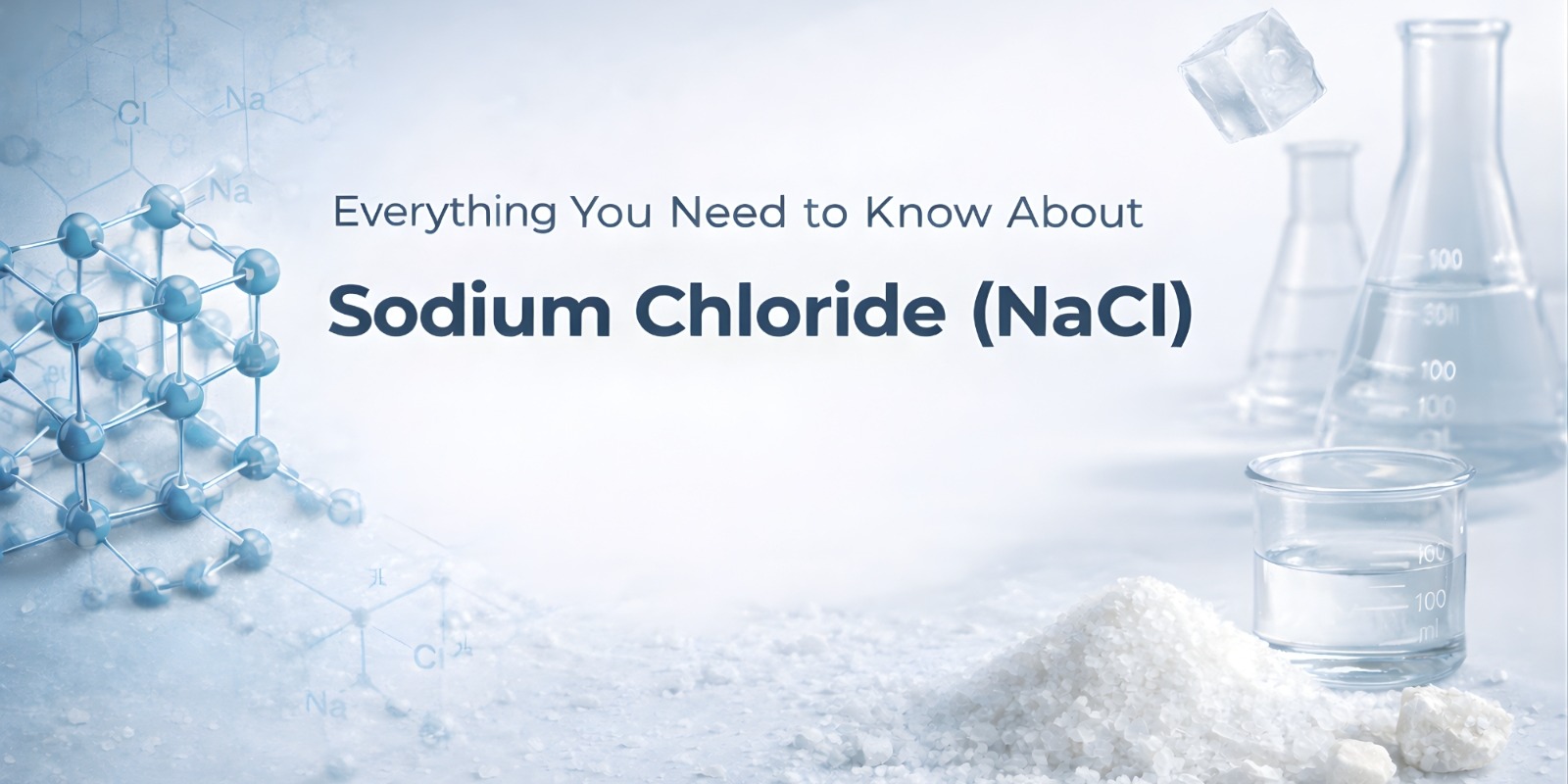
Everything You Need to Know About Sodium Chloride (NaCl)
| Sodium Chloride — At a Glance | |
|---|---|
| Sodium Chloride Meaning | An ionic compound of sodium (Na) and chlorine (Cl), commonly known as common salt or table salt |
| Sodium Chloride Formula / NaCl Chemical Formula | NaCl |
| Molecular Weight | 58.44 g/mol |
| Appearance | Colourless to white cubic crystals or fine powder |
| Melting Point | 801°C (1,474°F) |
| Boiling Point | 1,413°C (2,575°F) |
| Density | 2.165 g/mL |
| Solubility | Freely soluble in water (~360 g/L at 20°C) |
| Global Production | ~250–280 million tonnes per year |
| Market Size (2025) | ~USD 26.37 billion (Industrial NaCl) |
There is a strong likelihood that you encountered sodium chloride today—perhaps in your breakfast, in the water softened before reaching your tap, on a road cleared of ice last winter, or within the plastics and chemicals that form the foundation of most modern manufacturing. Sodium chloride, chemically designated as NaCl and known to most simply as "salt," is one of the oldest, most abundant, and economically vital compounds on Earth. Yet, its story extends far beyond the kitchen table.
The applications of sodium chloride span an astonishingly wide range of industries: chemical manufacturing, water treatment, food processing, pharmaceuticals, oil and gas, textiles, de-icing, agriculture, and many more. It serves as the foundational feedstock for the chlor-alkali industry, the backbone of global chemical production, and ranks among the most widely traded industrial minerals in the world. In 2025, the global industrial sodium chloride market was valued at approximately $26.37 billion USD; it is projected to reach $39.48 billion USD by 2035, growing at a compound annual growth rate (CAGR) of 4.3%
This comprehensive guide covers everything you need to know about sodium chloride: its meaning and definition, the chemical formula for NaCl, its physical and chemical properties, its extensive industrial applications, the benefits it offers in each specific use case, how it is produced and graded, the key players in the global supply chain, and the essential factors to consider when purchasing bulk sodium chloride for industrial or commercial purposes.
Sodium Chloride Meaning and Chemical Formula
Let's begin with the basics: What is sodium chloride? What does its chemical formula tell us about its structure?
Fundamentally, sodium chloride is a binary ionic compound formed by the combination of sodium (Na), a soft, highly reactive alkali metal and chlorine (Cl), a harmful, toxic halogen gas. Individually, both sodium and chlorine are hazardous substances. However, when they combine, they form one of the world's most stable, harmless, and essential compounds: sodium chloride. This transformation from reactivity to stability stands as one of the most remarkable examples of ionic bonding in chemistry.
The sodium chloride formula, expressed as NaCl, reflects a 1:1 molar ratio of sodium ions (Na⁺) to chloride ions (Cl⁻). This notation is also universally known as the NaCl chemical formula. When sodium loses one electron, it becomes the positively charged Na⁺ ion. When chlorine gains that electron, it becomes the negatively charged Cl⁻ ion. The powerful electrostatic attraction between these opposite charges forms the ionic bond at the heart of sodium chloride's crystal structure.
Sodium Chloride Properties: Physical and Chemical
A thorough understanding of sodium chloride properties is essential for both scientists and industry professionals who specify, purchase, or work with this compound. Its physical and chemical properties directly determine which applications it is suited for, what handling and storage conditions it requires, and how it behaves in various industrial processes.
The chemical stability of NaCl under ordinary conditions is one of its defining characteristics. Under standard temperature and pressure, sodium chloride is non-flammable, non-explosive, and chemically unreactive toward most common substances. It does not oxidize, does not decompose, and does not react with air or moisture in ways that degrade its purity.
2 NaCl + 2 H₂O → Cl₂ + H₂ + 2 NaOH
Sodium Chloride Uses: A Sector by Sector Breakdown
 -->
-->The uses of sodium chloride span virtually every major industrial sector on the planet. It is difficult to think of another single compound that touches so many different industries, from food to pharmaceuticals, from plastics to paper, from oil wells to swimming pools. Below is a comprehensive sector-by-sector breakdown of the most significant sodium chloride uses.
1. Chemical Manufacturing — The Chlor-Alkali Process
The single largest use of sodium chloride globally is as the primary feedstock for the chlor-alkali industry, which accounts for approximately 38–40% of all industrial NaCl consumption. In the chlor-alkali process, an electrical current is passed through a concentrated brine solution (NaCl dissolved in water) to simultaneously produce three essential industrial chemicals: chlorine gas (Cl₂), sodium hydroxide or caustic soda (NaOH), and hydrogen gas (H₂).
2. Water Treatment — Softening, Purification, and Disinfection
One of the most widespread uses of sodium chloride in modern infrastructure is in water treatment, both at the municipal level and in private and industrial water-softening systems. Hard water contains elevated concentrations of dissolved calcium and magnesium ions (Ca²⁺ and Mg²⁺) that cause scale formation in pipes, boilers, heat exchangers, and appliances, significantly reducing their efficiency and lifespan.
3. Food Processing and Preservation
Food is where most people encounter sodium chloride every day, and its role here goes far beyond flavoring. As a preservative, NaCl inhibits the growth of spoilage-causing microorganisms by reducing the water activity of food, creating an environment where bacteria, yeast, and molds cannot thrive. This preservation principle was understood and applied by civilizations thousands of years before refrigeration existed, and it remains in use today for cured meats, pickles, sauerkraut, fermented vegetables, fish products, and many other preserved foods.
4. Pharmaceutical and Medical Applications
In the pharmaceutical and medical sectors, high-purity sodium chloride plays critical and often life-saving roles. The most widely known medical use is the 0.9% sodium chloride intravenous (IV) solution commonly called normal saline or physiological saline, which is isotonic with human blood plasma and is used globally as a base for IV therapy, fluid replacement in dehydration, a vehicle for medication delivery, and wound irrigation.
5. De-Icing and Road Safety
One of the largest volume uses of sodium chloride in cold-climate countries is as a de-icing agent for roads, highways, airports, bridges, and pavements during winter. When rock salt (coarse NaCl) is applied to ice or compacted snow, it lowers the freezing point of water due to the well-known freezing point depression property of dissolved salts. Sodium chloride solutions have a eutectic point of −21°C at a concentration of approximately 23%, meaning that plain road salt can prevent ice formation and melt existing ice down to this temperature.
6. Oil and Gas Industry
In the oil and gas sector, sodium chloride has several important uses. Brine (a concentrated NaCl solution) is used in drilling mud formulations, the fluids circulated down drill strings during oil and gas well drilling to lubricate the drill bit, carry rock cuttings to the surface, and maintain wellbore pressure. NaCl helps control the density and rheological properties of drilling fluid, preventing well blowouts.
7. Textile and Dyeing Industry
The textile industry is one of the older industrial consumers of sodium chloride, particularly in dyeing processes. NaCl is used as an electrolyte in reactive dyeing of cotton. It promotes the exhaustion of dye from the dye bath onto the fabric by reducing the electrostatic repulsion between the negatively charged dye molecules and the negatively charged cotton fibers. Without salt, the dye uptake efficiency drops significantly, resulting in paler, less uniform coloration.
8. Agriculture
Sodium chloride has specific applications in agriculture, though its use requires careful management as excessive soil salinity is harmful to most crops. In livestock farming, salt blocks and mineral licks are provided to cattle, sheep, horses, and other animals as an essential dietary supplement—sodium and chloride are both critical electrolytes for animal health, muscle function, and digestion.
9. Other Industrial Uses of Sodium Chloride
Pulp and Paper
Pulp and Paper: Sodium chlorate, derived from NaCl electrolysis, is the primary bleaching agent for paper and pulp. NaCl is directly used in the kraft pulping process and for chemical recovery.
Glass Manufacturing
Glass Manufacturing: NaCl is used as a refining agent in glass melting furnaces to remove bubbles and impurities from molten glass, improving clarity and quality.
Rubber Processing
Rubber Processing: Salt is used in the coagulation of natural rubber latex during initial processing, causing the rubber particles to aggregate and separate from the water phase.
Ceramics and Pottery
Ceramics and Pottery: NaCl vapor is used in salt glazing, a historical and contemporary technique where salt is thrown into a kiln at high temperatures to create a distinctive glassy ceramic surface.
Fire Suppression
Fire Suppression: Dry sodium chloride powder is used in Class D fire extinguishers specifically designed for combustible metal fires (magnesium, titanium, lithium, zirconium), where it forms an oxygen-excluding crust over the burning metal.
Refrigeration
Refrigeration: NaCl brine was historically the most widely used refrigerant carrier in industrial refrigeration systems, and it continues to be used in some ice-making and cold storage applications.
Sodium Chloride Benefits: Why It Remains Indispensable
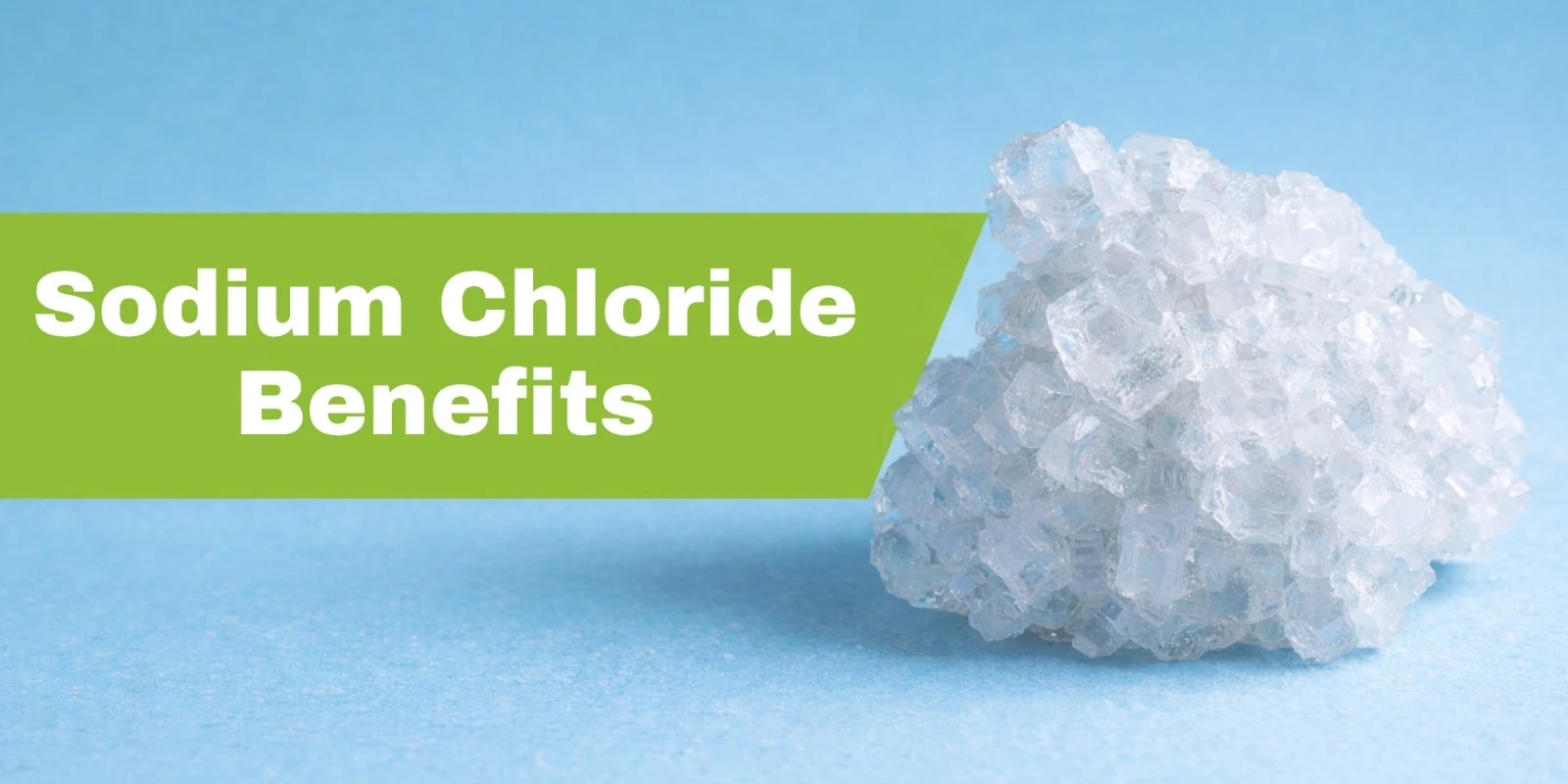
With so many synthetic alternatives available for specific applications, one might ask: why does sodium chloride continue to dominate across so many sectors? The answer lies in a compelling combination of sodium chloride benefits that no single alternative can match across the board.
| Benefit | Explanation |
|---|---|
| Extreme Abundance | NaCl is one of the most plentiful natural minerals on Earth. Its reserves in oceans and underground deposits are effectively inexhaustible, ensuring long-term supply security. |
| Very Low Cost | Because NaCl is so abundant and easy to produce (via solar evaporation or mining), it remains one of the cheapest industrial minerals per tonne, making it economically accessible for high-volume applications. |
| High Chemical Stability | NaCl is stable across a wide range of temperatures, pH levels, and storage conditions. It does not degrade, expire, or react with packaging materials under normal conditions. |
| Versatility Across Grades | NaCl is available in multiple grades: food-grade, pharmaceutical-grade, industrial-grade, and technical-grade, making a single compound suitable for everything from IV fluids to road de-icing. |
| Essential Biological Role | Sodium and chloride are both essential electrolytes for human and animal physiology. This biological necessity sustains permanent demand in the food, pharmaceutical, and agricultural sectors. |
| Effective Electrolyte | NaCl's complete ionic dissociation in water makes it an excellent electrolyte for electrochemical processes, enabling the chlor-alkali industry and a vast range of chemical production. |
| Non-toxic at Normal Doses | Compared to many industrial chemicals, food-grade and pharmaceutical-grade NaCl is safe to handle, non-carcinogenic, non-mutagenic, and FDA-classified as generally recognised as safe (GRAS). |
| Simple Production Process | Unlike many industrial chemicals that require complex multi-step synthesis, NaCl can be produced at an enormous scale using straightforward solar evaporation or mechanical mining. |
Global Sodium Chloride Market: Key Facts and Trends
Understanding the global market for Sodium Chloride is important for industrial buyers, procurement managers, Sodium Chloride exporters, and industrial salt suppliers seeking to navigate supply chains effectively.
| Market Parameter | Data / Insight |
|---|---|
| Global Market Size (2025) | USD 26.37 billion (Industrial NaCl) |
| Projected Market Size (2035) | USD 39.48 billion |
| CAGR (2026–2035) | 4.3% |
| Largest Application Segment | Chemical Processing — ~38.5% share by 2035 |
| Second Largest Application | Water Treatment — ~27.2% share by 2035 |
| Largest Regional Market | North America — ~34.7% by 2035 |
| Second Largest Region | Europe — ~30.1% by 2035 |
| Asia-Pacific Growth | Fastest-growing region driven by India and China |
| India's Global Ranking (NaCl Export) | Ranked 1st globally in NaCl exports (2021, WITS/World Bank) |
| USA Production (2023) | ~42 million tonnes per year |
| Key Global Players | Cargill, K+S, Tata Chemicals, Compass Minerals, ICL Group, INEOS, AkzoNobel Nouryon |
Bulk Sodium Chloride Supply: What Industrial Buyers Need to Know
For manufacturers, utilities, water treatment plants, pharmaceutical companies, and other large-scale consumers, securing a reliable bulk Sodium Chloride supply at the right specification and price is a strategic procurement decision. Here is what to consider when sourcing NaCl in bulk.
Key Sourcing Criteria
Purity and Grade Compliance: Always specify the required NaCl purity percentage and acceptable impurity limits for your application. Pharmaceutical buyers need USP/BP-grade with documented certificates of analysis. Industrial buyers may accept broader purity ranges but still need consistency batch to batch.
Particle Size / Granulometry: NaCl is available in various forms, such as fine powder, medium granules, coarse crystals, pellets, and blocks. The right size depends on your application: fine powder for pharmaceutical and chemical use, coarse granules for water softening, pellets for industrial regeneration, coarse rock for de-icing.
Packaging Options: Bulk sodium chloride supply is available in 25 kg bags, 50 kg bags, jumbo bags (500–1,000 kg), and full bulk tanker or container loads. Match the packaging to your consumption rate and storage infrastructure to minimize handling costs.
Moisture Content: NaCl is slightly hygroscopic. Check moisture specifications carefully. Elevated moisture leads to caking (clumping) during storage and transport, which can disrupt feeding systems in chemical plants or processing lines.
Certifications and Quality Systems: Look for suppliers certified to ISO 9001, FSSAI (for food grade), GMP (for pharmaceutical grade), or other relevant quality standards. Reliable industrial salt suppliers maintain documented quality management systems and conduct regular third-party testing.
Supply Chain Reliability: For large-volume continuous consumers such as chlor-alkali plants or water treatment utilities, supply continuity is critical. Evaluate supplier production capacity, geographic distribution, logistics network, and track record of on-time delivery before committing to a long-term supply contract.
Pricing Transparency: NaCl pricing is influenced by production method, grade, purity, particle size, packaging, and freight. Demand is seasonal (de-icing peaks in winter; water softening demand is relatively stable year-round). Work with sodium chloride exporters and industrial salt suppliers who offer transparent, contract-based pricing to avoid volatile spot market exposure.
About HTMC Group — Industrial Salt Suppliers and Sodium Chloride Exporters
HTMC Group, founded in 1994 and headquartered in Kolkata with primary processing operations in Dausa (Bapi), Rajasthan, is one of India's leading industrial mineral processing and supply companies. With over three decades of experience in mineral sourcing, processing, and distribution, HTMC Group has built a reputation for quality, consistency, and reliability that serves customers across India and international markets.
As experienced industrial salt suppliers and sodium chloride exporters, HTMC Group supplies sodium chloride (NaCl) across multiple grades, industrial, technical, and specialty, tailored to the specific purity and particle size requirements of chemical manufacturing, water treatment, food processing, pharmaceuticals, textiles, and other industries. The company's supply capabilities include both domestic distribution across Indian manufacturing hubs and bulk sodium chloride supply for export.
Conclusion
Sodium Chloride (NaCl) is simultaneously the world's most ordinary and most extraordinary compound. Ordinary because it sits on every kitchen table, dissolved in every ocean, and found in the body of every living animal. Extraordinary because the sodium chloride uses that quiet power in global industry, from chlorine and plastic production to water treatment, pharmaceuticals, food safety, oil drilling, and beyond, which are so vast and varied that it is difficult to overstate their collective economic and social importance.
The sodium chloride properties that make it so universally useful, its ionic stability, high solubility, electrical conductivity in solution, abundant natural occurrence, and ease of production, are precisely the properties that chemical engineers and industrial chemists have been exploiting for over a century. And despite continuous advances in synthetic chemistry, no single compound has emerged that can replace NaCl across its full range of applications.
Frequently Asked Questions About Sodium Chloride
A: It is a compound made of sodium (Na) and chlorine (Cl), commonly known as table salt (NaCl).
A: The formula is NaCl, representing one sodium ion and one chloride ion.
A: White crystalline solid, highly soluble in water, melting point 801°C, and stable in nature.
A: Used in food, water treatment, chemical manufacturing, medicine, and de-icing.
A: Low cost, widely available, chemically stable, and useful in many industrial applications.
Get in touch with us!
×