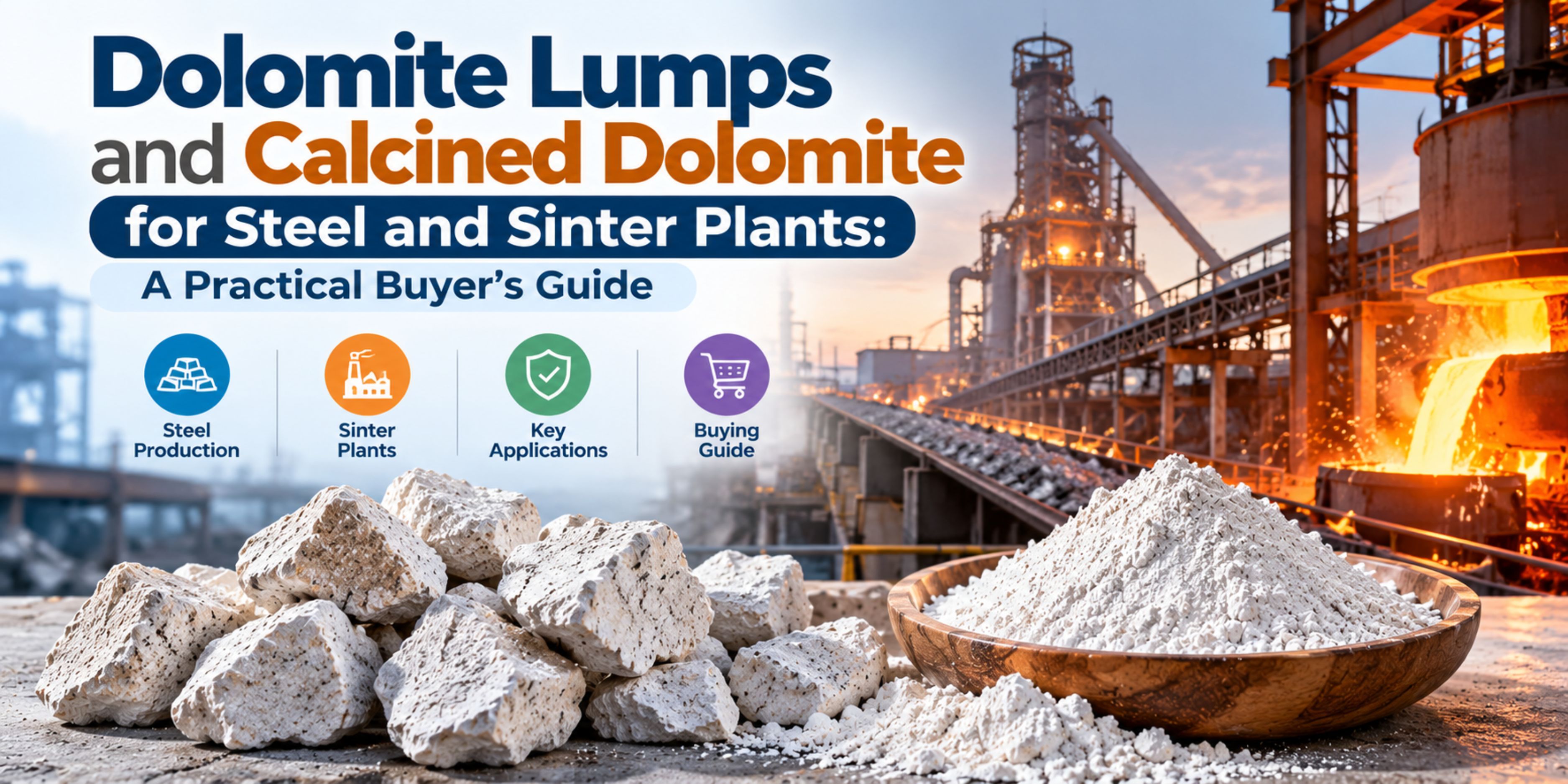
Dolomite Lumps and Calcined Dolomite for Steel and Sinter Plants
Every steel plant and sinter plant needs a steady supply of magnesium and calcium-bearing flux. Without it, slag becomes aggressive, refractory lining wears out faster, and sinter quality becomes hard to control. This is where dolomite comes in.
In this guide, HTMC Group explains in simple words what dolomite lumps are, how the burnt form is made, where each form is used, and what a plant buyer should check before placing an order.
What Are Dolomite Lumps?
Dolomite is a natural mineral made of calcium magnesium carbonate. Its chemical formula is CaMg(CO₃)₂. A typical clean raw stone contains roughly 30 to 32 percent CaO and around 20 to 21 percent MgO, with the rest lost as carbon dioxide when heated.
Dolomite lumps are the raw stone after mining, crushing, and screening into a fixed size range, for example, 10 to 40 mm or 20 to 80 mm. The size depends on the plant and the process. Lumps are the starting point for most steel and sinter applications. They can be used as they are, crushed finer for sinter, or sent to a kiln to make the burnt product.
What Is Calcined Dolomite?
When dolomite stone is heated in a furnace, carbon dioxide is released from it. What remains is a mixture of calcium oxide and magnesium oxide; this is known as calcined dolomite. Those involved in this process also refer to it as burnt dolomite, dolime, or doloma.
A few simple facts help to understand it:
- About 2 tons of raw stone are needed to make 1 ton of the burnt product, because nearly half the weight is lost as CO₂.
- The burnt product is porous, reactive, and hygroscopic. It picks up moisture from the air quickly.
- Light burnt grades are more reactive. Dead-burnt grades are heated at a much higher temperature and are dense and less reactive, mostly used in refractory work.
Because of this, the same stone gives very different products depending on the heat treatment. Always tell your supplier which type you need.
Why Steel Plants Use Dolomite
In steelmaking, slag is not a waste. It is a working tool. A good slag removes impurities like phosphorus and sulfur and protects the furnace lining.
- Protecting refractory lining: Furnace walls are often made of magnesia-based bricks. If slag has too little MgO, it eats into these bricks. By adding metallurgical dolomite to the charge, the plant keeps MgO in slag near saturation. This slows lining wear and can extend furnace life.
- Slag conditioning: Calcium from the dolomite helps to form a fluid and active slag. This improves removal of impurities from the liquid metal.
- Slag splashing: Many converter shops splash MgO-bearing slag on the lining after tapping to build a protective layer. A steady MgO supply makes this practice stable.
- Partial lime replacement: In many shops, burnt dolomite replaces a part of lime. This brings MgO and CaO together in one addition, which keeps the process simple.
Dolomite Lumps vs. Calcined Dolomite in Steel Melting
Plants often ask which is better. The honest answer is that it depends on the furnace, the practice, and the cost.
- Raw dolomite lumps are cheaper per ton. They are stable to store and do not absorb moisture. But the stone must decompose inside the furnace. This takes heat and can cool the bath slightly.
- Burnt lumps are already decomposed. They dissolve into slag faster and do not take extra heat from the furnace. They cost more per ton, but you need less material for the same MgO and CaO effect.
Many shops test both and settle on the one that gives the best total cost per heat, not just the lowest price per ton.
Dolomite for Sinter: Why Sinter Plants Add It
A sinter plant turns iron ore fines into strong lumps that the blast furnace can use. The mix includes ore fines, fuel (coke breeze), flux, and return fines. Blast furnace slag needs a certain MgO level to flow well, and sinter is the preferred route for adding it.
Using dolomite for sinter is popular for a few reasons:
- It supplies both CaO and MgO in one material.
- The CO₂ leaves the stone during sintering, so the blast furnace does not need to spend heat on it.
- MgO improves the low-temperature behavior of sinters, including the reduction degradation index (RDI), in many studies.
- It helps to control slag fluidity in the blast furnace.
In sinter plants, raw dolomite is normally crushed in hammer mills to below 3 mm. Industry practice is to keep around 85 to 90 percent of the material under this size. Coarse particles do not react fully and leave unreacted islands in the sinter. Very fine dust can cause handling and mixing problems.
Using Calcined Dolomite in the Sinter Mix
Many plants now add the burnt form directly into the sinter mix. Industry sources list several advantages, such as better binding of the mix, better machine productivity, improved sinter strength, and lower waste gas volume, since the CO₂ is already removed.
There is also a caution. Research on sinter shows that if burnt dolomite is added in too high a quantity, around 4 percent by weight in one study, unreacted MgO can form clusters. These clusters weaken bonding phases and can reduce strength and reducibility. Other work also shows that high MgO in sinter can lower tumbler strength and raise fuel need if the mix is not adjusted.
The lesson is simple. More is not always better. Set a target MgO level for your sinter and for the blast furnace slag, and work backward to the right dosage. Most sinter plants run MgO in the range of about 1.5 to 3 percent, though the target varies by plant and ore type.
Which Product for Which Plant?
| Plant type | Common choice | Why |
|---|---|---|
| Sinter plant | Crushed raw dolomite or fine burnt dolomite | MgO and CaO supply, slag control |
| Converter (BOF) | Burnt dolomite lumps | Fast slag formation, lining protection |
| Electric arc furnace | Burnt dolomite lumps or raw lumps | Foamy slag, lining life |
| Blast furnace | Through sinter, sometimes direct lumps | MgO balance in slag |
| Refractory use | Dead burnt dolomite | High density, stable at heat |
Key Specifications to Check Before You Buy
Two suppliers can sell the same product name and send very different quality. Ask for a TDS and COA and check these points:
- CaO and MgO content: The burnt lumps available in the market typically contain approximately 55% CaO and 35% MgO. This content is lower in raw stone because it contains CO₂. Mix it according to your recipe.
- Loss on ignition (LOI): For calcined material, a low LOI indicates proper calcination. A high LOI implies incomplete calcination, resulting in a less active product.
- Silica (SiO₂): Silica reduces the useful basic content and forms extra slag. Low silica is preferred.
- Sulphur and phosphorus: Both are harmful to steel quality. Ask for low values.
- Size range and fines: A fixed lump size gives stable feeding. Too many fines are wasted in bins and conveyors.
- Reactivity: Especially for converter use, reactivity decides how fast the material goes into slag.
- Moisture: Raw lumps should be dry. Burnt material must be kept dry from the start.
- Batch consistency: A steady COA across lots is more valuable than one excellent sample.
Handling and Storage Tips
Burnt dolomite reacts with water. It can heat up, break into powder and lose value. A few simple habits help:
- Store under cover and off wet ground.
- Use sealed jumbo bags or covered silos where possible.
- Keep stock levels in line with consumption so material does not sit for months.
- Wear dust masks and eye protection when handling, because the dust is alkaline and irritating.
- Check incoming lots for fines and lumps that have turned to powder.
Raw lumps are far easier. They can be stored in open yards, though a clean surface avoids contamination with soil.
Common Mistakes Plants Make
- Purchasing solely based on price per tonne: Cheaper products with high LOI or silica content can result in a higher cost per heat.
- Overlooking the crushing size in the sinter plant: Improper crushing results in unreacted MgO and non-uniform sinters.
- Excessive MgO dosage: Excessive MgO can impair the strength and reducibility of the sinter.
- Storing burnt material carelessly: Moisture damage is silent and expensive.
- Not testing before switching: A small trial in the plant avoids big surprises.
Why Work With HTMC Group
HTMC Group (HiTech Minerals and Chemicals Group) is an Indian industrial minerals producer with more than 40 years of experience. The group owns and leases mineral reserves, which helps to keep quality and supply steady. It runs processing units with in-house quality labs and supplies to customers in more than 30 countries.
For steel and sinter plants, the points that matter are:
- Dolomite supply backed by own and leased reserves
- Made-to-order sizing for lump or crushed requirements
- Quality checks backed by in-house labs
- Bulk movement planning, including rail rakes and coastal sea routes for cost control
- Technical documents on request, including TDS and COA
Final Thoughts
Whether you run a converter, an electric furnace or a sinter machine, the right dolomite grade can protect your lining, stabilise slag and improve sinter quality. Start by defining your MgO and CaO targets, choose the right form, check the COA carefully and test in small steps.
HTMC Group is ready to support your plant with samples and technical documents. Request a sample + TDS/COA for this application and move to trial with confidence.
Get in Touch with HTMC Group
- Call Us: +91 33 2226 8228, +91 98 1140 9161
- Enquire Now: [email protected]
Frequently Asked Questions (FAQs)
They are used as sources of MgO and CaO. In steel shops, they help protect furnace linings and facilitate the formation of good slag. In sinter plants, they are ground and mixed into the sinter feed.
Raw dolomite is the natural stone with CO₂ still inside. Burnt dolomite has been heated to remove the CO₂, leaving a mix of CaO and MgO. The burnt form is more reactive but needs dry storage.
Raw dolomite is usually crushed to below 3 mm, with about 85 to 90 per cent passing this size. Your plant may set a slightly different limit based on its own results.
Many plants run between about 1.5 and 3 per cent, depending on ore, basicity and blast furnace slag needs. Study your own data and test in small steps.
Yes. Excess MgO can lower sinter strength and reducibility, and unreacted MgO may form clusters. Set a target and do not overdose.
Burnt lumps dissolve faster and take less heat from the bath. Raw lumps cost less per tonne. Compare the total cost per heat before deciding.
Keep it dry, covered and in sealed bags or silos. Avoid long storage, because it absorbs moisture from air and breaks down into powder.
LOI means loss on ignition. For burnt dolomite, low LOI shows that the stone was properly burnt. High LOI means a weaker, less active product.
Ask for the TDS, COA and safety data sheet. Check CaO, MgO, SiO₂, sulphur, phosphorus, LOI, size range and moisture. A sample from the real production lot is also useful.
Contact HTMC Group through htmcgroup.com or the phone numbers above. Share your plant type, size range and chemical targets, and request the sample with TDS and COA.
Contact Us

×