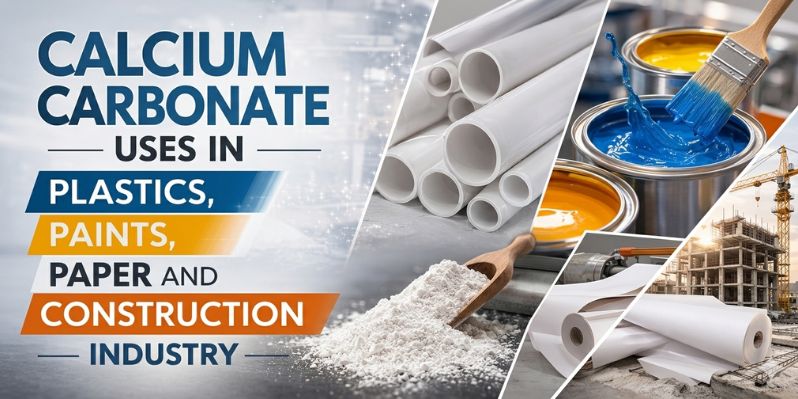
Calcium Carbonate Uses in Plastics, Paints & Construction
Calcium Carbonate Uses in Plastics, Paints, Paper and Construction Industry
That powder is calcium carbonate—and once you start noticing it, you literally cannot stop. I first encountered it not in a chemistry classroom, but on a limestone hill in Rajasthan, where decades of quarrying had carved the face of the rock into a magnificent, sheer white cliff. Pointing to that pale-colored stone, a local geologist simply remarked, "It is in everything." He wasn't exaggerating.
Calcium carbonate uses span an almost unbelievable range of industries—from the plastic bumper on your car to the glossy cover of a luxury magazine, from the paint on a hospital ceiling to the foundation of a motorway. In this guide, we are going to explore exactly what calcium carbonate is, how it is processed, and why its applications in plastics, paints, paper, and construction make it one of the most industrially significant minerals on Earth.
What Is Calcium Carbonate?
Calcium carbonate (CaCO₃) is a naturally occurring mineral found in three primary geological forms: calcite, aragonite, and vaterite. It is the main constituent of limestone, chalk, and marble—rocks that together cover vast portions of the Earth's sedimentary crust. It is also the mineral that forms coral reefs, seashells, and even the microscopic skeletons of ancient marine organisms called coccoliths.o industrial formulations.
Chemically, calcium carbonate is stable, non-toxic, and abundant. It accounts for approximately 4% of the Earth's crust by weight, making it one of the most accessible raw materials on the planet. This combination of abundance, low cost, chemical versatility, and physical tunability is precisely what makes calcium carbonate uses so extraordinarily wide-ranging.
Two Commercial Forms: GCC and PCC
In industrial applications, calcium carbonate comes in two key commercial forms, each with distinct properties and end uses:
1. Ground Calcium Carbonate (GCC): Manufactured by mechanically crushing and finely grinding natural limestone or marble. Particle sizes can be controlled precisely—from coarse grades for construction to ultra-fine grades for premium paper coatings. GCC is the higher-volume, lower-cost form.
2. Precipitated Calcium Carbonate (PCC): Produced through a chemical synthesis process—limestone is calcined to produce lime (CaO), then rehydrated to form slaked lime (Ca(OH)₂), and finally carbonated with CO₂ gas to re-form CaCO₃. PCC crystals have a controlled shape, size, and purity that GCC cannot match, making PCC ideal for high-performance plastics, pharmaceuticals, and premium paper applications. The choice between GCC and PCC depends entirely on the application's requirements—which is why understanding the full spectrum of calcium carbonate uses requires looking at each industry separately.
Calcium Carbonate Uses in the Plastics Industry
If you have ever wondered what gives a plastic bag its stiffness, a PVC pipe its whiteness, or a car dashboard its smooth matte finish—calcium carbonate is a big part of the answer. The plastics industry is one of the largest consumers of calcium carbonate globally, and the relationship between these two materials is a masterclass in mineral engineering.
How Calcium Carbonate Works in Plastics
Calcium carbonate is used as a functional filler in a wide range of polymer matrices, including polyethylene (PE), polypropylene (PP), polyvinyl chloride (PVC), and various engineering plastics. When incorporated at the right particle size and loading level, it delivers a remarkable set of performance benefits.
- Cost reduction: CaCO₃ is significantly cheaper than the polymer resins it partially replaces. In some formulations, loading levels of 20–40% are used to substantially reduce material costs without compromising performance.
- Stiffness and rigidity: Calcium carbonate improves the tensile modulus of plastic components, making them firmer and more dimensionally stable.
- Impact modification: Surface-treated PCC grades act as impact modifiers. When a plastic part is struck, the calcium carbonate particles help absorb and dissipate energy, reducing the risk of cracking or shattering.
- Whiteness and opacity: CaCO₃ is a natural white pigment and opacifier, reducing or replacing the need for expensive titanium dioxide (TiO₂) in white plastic formulations.
- Processing improvements: Fine calcium carbonate improves the flow characteristics of molten plastic, making it easier to process through extruders, injection molding machines, and blown film lines.
Key Plastic Applications
You will find calcium carbonate uses across virtually every plastic product category: rigid PVC pipes and profiles, polyethylene film and bags, masterbatch compounds, automotive interior components, cable insulation, flooring (vinyl and LVT), and even biodegradable plastic formulations where calcium carbonate helps accelerate breakdown in soil. Global consumption of calcium carbonate in plastics is estimated at several million tonnes per year—and growing.
Standing in a PVC pipe manufacturing plant in Gujarat during one of our industry tours, I watched tonnes of fine white GCC powder being blended into the polymer matrix at high speed. The plant manager told me that without calcium carbonate, the cost of every pipe in the country would roughly double. That single observation changed how I look at every piece of white plastic I encounter.
Calcium Carbonate Uses in the Paints and Coatings Industry
The next time you admire a freshly painted wall—the smooth texture, the bright white, the way it catches light evenly—take a moment to appreciate calcium carbonate. It is one of the most important ingredients in architectural and industrial paints, and its calcium carbonate uses in this sector are both functional and aesthetic.d.
The Importance of Calcium Carbonate in Paint Formulations
In paints and coatings, calcium carbonate functions primarily as an extender pigment—a white mineral that partially replaces the more expensive titanium dioxide while maintaining brightness and coverage. But its role goes far beyond simple cost-cutting:
- Extender pigment: GCC and PCC are used to extend the volume of the paint formulation, improving spread rate and reducing per-liter cost without visibly reducing quality.
- Brightness and whiteness: High-purity, fine-particle PCC can achieve brightness levels above 96% ISO—close enough to titanium dioxide to act as a partial substitute in interior flat paints.
- Rheology control: Calcium carbonate helps control the viscosity and flow behavior of paint, giving it the right consistency for brush application, roller application, or spray coating.
- Scrub resistance and durability: In emulsion paints, the right grade of calcium carbonate improves the film's resistance to wet scrubbing, an important quality marker for washable wall paints.
- Matting effect: Coarser grades of GCC create a light-scattering effect that gives paints a matte or satin finish, which is highly sought after in interior design applications.
- Anti-settling properties: Calcium carbonate's plate-like particle structure helps prevent heavier pigments from settling at the bottom of the paint tin during storage.
Specialist Coating Applications
Beyond wall paints, calcium carbonate uses in coatings also include automotive primers, industrial maintenance coatings, road marking paints, marine anti-corrosion coatings, and powder coating applications. Each of these applications requires a specific particle size distribution and surface treatment — a reminder of how sophisticated the world of "simple white powder" actually is.
Calcium Carbonate Uses in the Paper Industry
Here is a fact that surprises almost everyone the first time they hear it: the paper you are reading right now—whether in a notebook, a magazine, or a printed report—almost certainly contains calcium carbonate. The paper industry is, in fact, one of the oldest and most technically sophisticated users of this mineral, with calcium carbonate uses in paper dating back over a century.
Two Distinct Roles: Filler and Coating
In papermaking, calcium carbonate plays two distinct but equally important roles:
As a Filler: Fine PCC is added directly to the paper pulp during the sheet-forming stage, filling the spaces between cellulose fibers. This improves the paper's brightness, opacity, and smoothness while reducing the amount of expensive wood pulp required. Filler levels of 20–30% are common in printing and writing grades of paper.
As a Coating Pigment: Ultra-fine PCC and GCC are used in surface coating slurries applied to the paper surface after sheet formation. Coated papers — including the glossy pages of magazines, brochures, and premium packaging — owe their brightness, smoothness, and ink-receptivity largely to calcium carbonate coating layers.
The Alkaline Papermaking Revolution
One of the most significant technological shifts in the history of papermaking was the transition from acid-based to alkaline (or neutral) papermaking in the latter half of the 20th century. This shift was enabled largely by calcium carbonate, which, unlike kaolin (the traditional filler), is incompatible with acidic chemistry but thrives in alkaline conditions.
Alkaline papers made with calcium carbonate fillers are more durable, brighter, and longer-lasting than their acid-made predecessors. Archival documents, legal papers, and library books produced on alkaline paper can last for centuries without yellowing or becoming brittle. Calcium carbonate, in this sense, is quite literally helping to preserve human knowledge.
Calcium Carbonate Uses in the Construction Industry
Of all the industries that depend on calcium carbonate, none consumes it in greater volumes than construction. When you look at the built environment around you—the roads, the bridges, the buildings, the pavements—you are looking at calcium carbonate uses on a truly monumental scale.
Limestone as a Direct Building Material
Limestone — the raw rock form of calcium carbonate — has been used directly as a building material for thousands of years. The Great Pyramid of Giza is largely composed of limestone blocks. The Colosseum in Rome used limestone extensively. In India, the temples of Rajasthan, the forts of the Mughal era, and countless vernacular buildings were constructed from locally quarried limestone. Its durability, workability, and aesthetic beauty have made it a timeless building material.
Calcium Carbonate in Cement and Concrete
The most important calcium carbonate use in modern construction is as the primary raw material for Portland cement — the binder that holds concrete together and makes it the most widely used construction material in the world. Limestone (CaCO₃) is heated in a kiln to approximately 1,450°C, where it decomposes to form lime (CaO) and CO₂—a process called calcination. This lime is then ground with gypsum and other materials to produce cement clinker.
Global cement production stands at over 4 billion tons per year. Since limestone accounts for roughly 80% of cement's raw material input, the calcium carbonate uses embedded in global cement production represent a staggering scale of mineral consumption. Every high-rise, every day, every motorway flyover exists because of calcium carbonate.
Other Construction Applications
Beyond cement, calcium carbonate uses in construction are diverse and pervasive:
- Aggregate: Crushed limestone is used as aggregate in concrete mixes, road sub-bases, and railway ballast—providing the bulk and structural integrity needed for load-bearing applications.
- Asphalt and road surfacing: Fine limestone powder (calcium carbonate filler) is added to asphalt mixes to improve binding, durability, and resistance to deformation under traffic loading.
- Plaster and render: Calcium carbonate is a key ingredient in gypsum plaster, lime plaster, and cement render, giving interior and exterior wall finishes their smooth texture and adhesive strength.
- Floor and roof tiles: Ground calcium carbonate is used as a filler in ceramic and vinyl floor tiles, improving dimensional stability, surface hardness, and fire resistance.
- Glass wool insulation: CaCO₃ is used in the production of glass wool and mineral wool insulation products, helping to regulate thermal and acoustic performance in buildings.
- White pigment for exterior finishes: High-brightness GCC is used in exterior textured coatings and masonry paints, where its UV stability and durability outperform many synthetic alternatives.
Calcium Carbonate Uses Across Industries: Quick Reference Table
| Industry | Primary Form Used | Key Calcium Carbonate Uses |
|---|---|---|
| Plastics | GCC & PCC (ultra-fine) | Filler, impact modifier, whitening agent, cost reducer |
| Paints & Coatings | PCC & GCC | Extender pigment, brightness booster, rheology controller |
| Paper | PCC (precipitated) | Coating pigment, filler, alkaline papermaking, brightness |
| Construction | GCC (bulk ground) | Cement additive, concrete filler, plaster, asphalt, flooring |
| Rubber | PCC (nano-grade) | Reinforcement filler, whitening, processing aid |
| Pharmaceuticals | High-purity PCC | Antacid, calcium supplement, tablet binder/filler |
| Agriculture | Ground limestone (GCC) | Soil pH correction (liming), animal feed supplement |
| Glass | GCC (high-purity) | Flux agent, chemical stabiliser in soda-lime glass |
Why Calcium Carbonate Matters More Than Ever
We are living in a moment when the demand for calcium carbonate is accelerating—not just because of population growth and urbanization, but because of the material's growing role in sustainability.
In the plastics industry, calcium carbonate is enabling the development of lighter, thinner packaging that uses less polymer resin—reducing plastic waste at the source. In construction, high-efficiency calcium carbonate fillers are helping to reduce the clinker content of cement, cutting the industry's enormous carbon footprint per ton of concrete produced. In paper, alkaline papermaking with calcium carbonate has eliminated the use of environmentally damaging acids from the manufacturing process.
Even in agriculture—a sector we have not focused on in this post—calcium carbonate uses in soil liming help neutralize acidic soils and improve crop yields, directly contributing to food security for billions of people.
The mineral that built ancient temples and whitened medieval chalk cliffs is now at the heart of some of the most pressing industrial and environmental challenges of the 21st century. Not bad for a humble white rock.
Conclusion: The Mineral in Everything
From the plastic casing of your smartphone to the glossy pages of a magazine, from the paint on a hospital wall to the concrete of a motorway bridge—the use of calcium carbonate is so deeply interwoven with modern life that it is almost impossible to spot. But once you start looking, you find it everywhere.
Understanding calcium carbonate is akin to understanding the mineral backbone of industrial civilization. It is a story of chemistry and geology, of ancient seas and modern factories, of limestone quarries and high-tech processing plants. And it is a story that is still being written—as new applications for calcium carbonate are being discovered in batteries, biodegradable plastics, carbon capture technologies and beyond.
Get in touch with us!
×