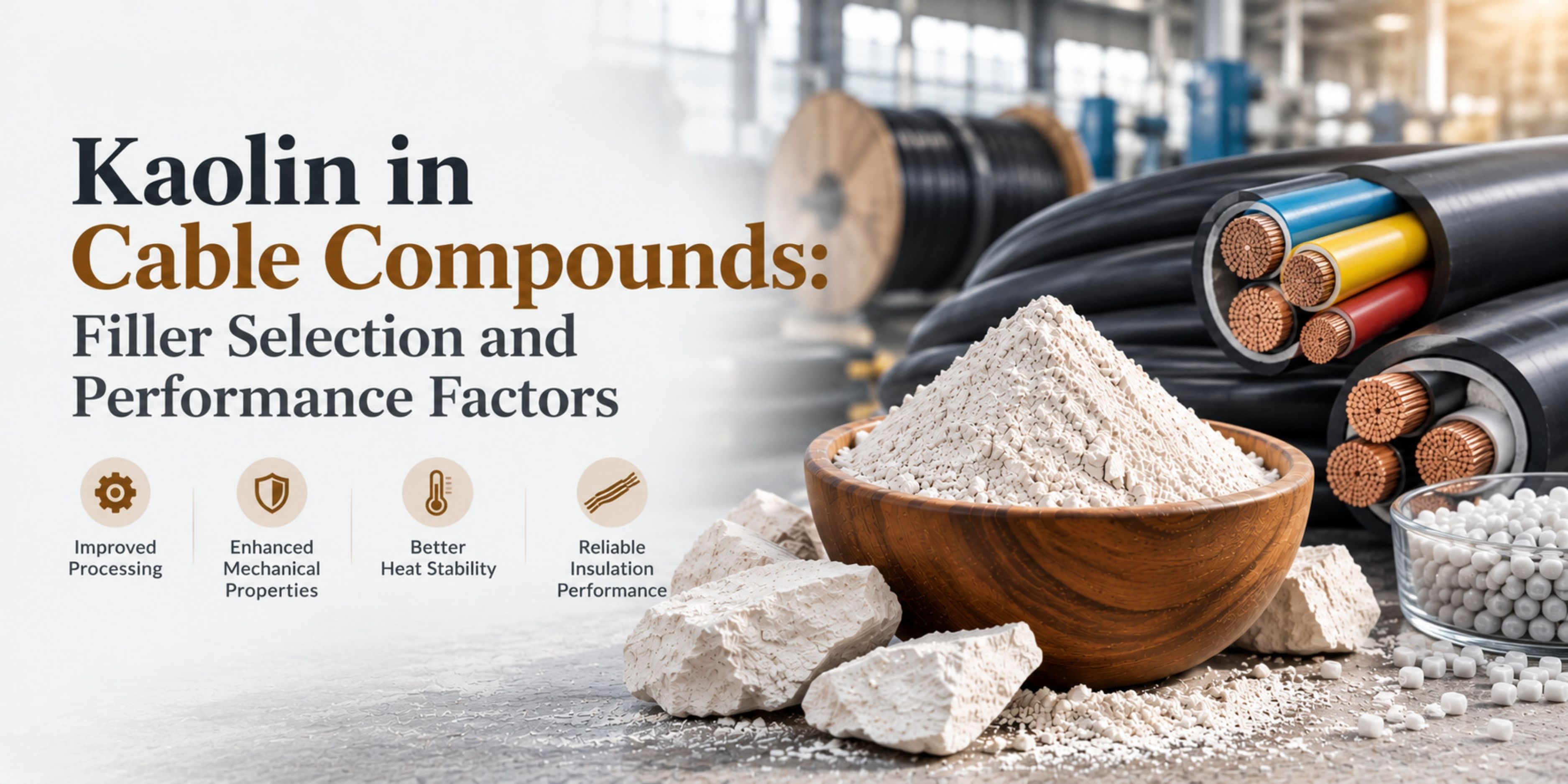
Calcium Carbonate in Wire and Cable Compounds: Applications and Benefits
Every wire and cable that carries power, signal, or data depends on more than just copper and plastic. The compound wrapped around the conductor, whether it's PVC insulation, a rubber jacket, or an XLPE sheath, needs the right balance of strength, flexibility, thermal stability and insulation performance to work reliably for decades in extreme conditions. Calcium carbonate plays a quiet but essential role in getting that balance right, which is why calcium carbonate in wire and calcium carbonate in cable compounds have become a standard part of formulations across the electrical, telecom, automotive and renewable energy cable industries worldwide.
At HTMC Group, our ground calcium carbonate (GCC) grades are engineered specifically for polymer compounding, giving cable manufacturers across the globe a filler that improves mechanical performance while keeping production costs under control. This article takes a deep look at how calcium carbonate functions inside a cable compound, the correct dosage, its effect on electrical performance, processing behaviour, its limitations, global market data, and how to choose the right grade for your production line.
What Is Calcium Carbonate's Role in Wire and Cable Compounds?
Calcium carbonate is used in the wire and cable industry primarily as a functional filler within the polymer compound, most commonly PVC, but also in rubber and cross-linked polyethylene (XLPE) formulations. Rather than being an inert bulking agent, it interacts with the polymer matrix to improve tensile strength, dimensional stability and processing behaviour, while also reducing the overall material cost of the compound. This makes it a core ingredient for manufacturers producing electrical wiring, power cables, telecommunications cables, control cables and automotive wiring harnesses.
During compounding, calcium carbonate is blended with resin, plasticizers, stabilizers, lubricants and pigments before the mixture is extruded onto the conductor. Because it is chemically stable, non-toxic, and thermally resistant up to very high temperatures, it can be processed under the heat and pressure conditions of cable extrusion without breaking down or affecting the finished product's electrical safety.
Applications Across Different Cable Polymers (PVC, Rubber, XLPE)
PVC Insulation and Sheathing
In PVC-based wire and cable compounds, calcium carbonate is blended with resin, plasticizers and stabilizers during the compounding stage. It improves flexibility and surface finish while partially replacing more expensive polymer content, which lowers the overall cost per meter of cable produced without compromising performance. This is the single largest use case for calcium carbonate in the cable industry globally, since PVC remains the dominant insulation material for building wire, appliance cords and low-voltage power cables.
Rubber-Insulated Cables
For rubber cable jackets used in outdoor, mining and industrial settings, calcium carbonate increases tensile strength and elasticity, helping the finished cable withstand repeated flexing, temperature swings and harsh environmental exposure. This is especially important for cables used in construction equipment, ports, and heavy industrial machinery, where mechanical stress is constant.
XLPE Power Cables
Cross-linked polyethylene cables use calcium carbonate to support thermal stability and consistent insulation performance, which matters in high-voltage and high-stress power transmission applications, including underground and submarine power cables used in national grid infrastructure. Loading levels here tend to be lower than in PVC, since XLPE compounds are more sensitive to filler impact on dielectric strength.
Automotive and EV Wiring Harnesses
The rapid global shift toward electric vehicles has expanded demand for lightweight, heat-resistant, flexible wiring compounds. Calcium carbonate helps automotive cable manufacturers meet strength and thermal requirements while managing raw material costs across large production volumes.
Flame-Retardant Cable Compounds
High surface-area grades of calcium carbonate are used in flame-retardant formulations for their ability to absorb HCl gas released during combustion. This helps cable manufacturers meet low-smoke, low-toxicity fire safety standards required in buildings, transport systems and public infrastructure across markets that enforce strict fire codes, including the EU, UK, and Gulf countries.
Telecommunications and Data Cables
As global data infrastructure expands, calcium carbonate is also used in the outer jacketing of telecom and fiber-optic support cables, where dimensional stability and consistent extrusion quality directly affect cable lifespan.
Key Benefits of Using Calcium Carbonate in Cable Compounds
- Cost efficiency – acts as a cost-effective extender that reduces dependency on higher-priced polymer resin, directly improving compound economics at scale
- Improved mechanical strength – enhances tensile strength and impact resistance of the finished cable
- Better dimensional stability – helps the compound retain its shape and thickness during extrusion and under sustained heat exposure
- Enhanced thermal performance – supports heat transfer and thermal stability within the insulation layer
- Smooth processing – fine, consistent particle size improves extrusion efficiency and reduces equipment wear over long production runs
- Fire safety support – select grades assist in HCl gas retention for flame-retardant cable formulations
- Non-toxic and stable – odourless, chemically stable, and safe for use in compounds that must meet international electrical safety norms
- Environmentally favourable – as a naturally occurring mineral, it supports compound formulations that align with tightening environmental compliance standards worldwide
Loading and Dosage Guidelines
The right calcium carbonate dosage depends on the cable type, target mechanical properties and cost targets, but most PVC wire and cable compounds use calcium carbonate loading somewhere between 15% and 45% by weight of the total formulation. Lower loadings, generally in the 15–25% range, are preferred where dielectric performance and flexibility are the priority, such as in internal insulation layers. Higher loadings, up to around 40–45%, are more common in outer sheathing and jacketing compounds, where cost reduction and bulk strength matter more than fine electrical tolerances.
As a general rule, increasing calcium carbonate loading improves tensile strength up to a certain point, after which excess loading can reduce elongation and impact resistance. Compounders typically run trial batches to identify the loading level that balances cost savings with the mechanical and electrical specifications required for that specific cable grade.
Effect on Electrical Properties
Calcium carbonate's impact on a cable's electrical performance depends heavily on particle size, purity, moisture content and loading level. At correctly controlled dosages, well-dispersed calcium carbonate has minimal negative effect on dielectric strength and volume resistivity, and in flame-retardant compounds, it actively supports safety performance through HCl gas absorption during combustion.
However, at higher loadings or with lower-purity, coarser grades, insulation resistance and dielectric strength can decline, since impurities and larger particles create weak points within the insulation layer. Moisture content is a particularly sensitive factor: even small amounts of retained moisture in the filler can lead to voids or micro-cracks during extrusion, which directly compromise electrical insulation performance. This is why cable-grade calcium carbonate needs tightly controlled moisture levels and consistent purity, rather than generic industrial-grade material.
Surface-Treated vs Uncoated Calcium Carbonate
Uncoated (natural) calcium carbonate is more economical and works well in compounds where cost reduction is the primary goal and mechanical/electrical tolerances are less demanding, such as basic sheathing layers. It's simpler to source and process but tends to disperse less evenly at higher loadings.
Surface-treated calcium carbonate, typically coated with stearic acid or other fatty acid compounds, bonds more effectively with the polymer matrix. This coating:
- Improves compatibility between the filler and the polymer, reducing agglomeration
- Enhances dispersion, leading to more consistent mechanical and electrical properties across the compound
- Reduces melt viscosity, making processing and extrusion smoother
- Allows higher filler loading without a proportional loss in impact strength or flexibility
For insulation layers and higher-performance cable compounds, surface-treated grades are generally the better choice despite the slightly higher cost, since the improved dispersion and processing stability often offset the price difference through reduced production issues.
Dispersion in the Polymer Matrix
Good dispersion is one of the most important and most overlooked factors in calcium carbonate-filled cable compounds. Poorly dispersed filler tends to form agglomerates, clusters of particles that haven't broken apart and spread evenly through the polymer. These agglomerates create weak points that can lower tensile strength, reduce elongation at break, and, more critically for cables, create localized zones of lower dielectric strength that increase the risk of electrical failure under stress.
Dispersion quality depends on three main factors: the particle size and surface treatment of the calcium carbonate, the compounding equipment and shear applied during mixing, and the compatibility between the coating and the base polymer. Finer, surface-treated grades generally disperse more evenly with less mixing energy, which is one reason cable compounders are willing to pay a premium for consistent, well-processed GCC over cheaper, variable-quality alternatives.
Processing and Extrusion Behaviour
Calcium carbonate directly affects how a cable compound behaves during extrusion, the stage where the insulation or sheathing is applied onto the conductor at high speed and temperature. Well-processed, surface-treated calcium carbonate reduces melt viscosity, which improves flow through the extruder die, reduces the load on processing equipment, and supports higher line speeds without surface defects.
Poor-quality or inconsistent calcium carbonate, on the other hand, can cause uneven melt flow, surface roughness, die build-up, and increased wear on screws and dies over time, all of which raise maintenance costs and slow production. Moisture content is again a critical factor here: excess moisture in the filler can flash off as steam during extrusion, causing bubbles, voids or surface defects in the finished cable. This is why consistent drying and quality control at the filler production stage matter as much as the mineral's inherent properties.
Limitations of Using Calcium Carbonate in Cable Compounds
While calcium carbonate offers strong cost and performance benefits, it isn't a universal solution and does come with trade-offs that compounders need to manage:
- Loading ceiling: beyond a certain percentage (typically above 40–45% in most PVC formulations), further loading tends to reduce elongation, impact strength and flexibility rather than improving properties further
- Electrical performance sensitivity: at high loadings or with impure/coarse grades, dielectric strength and insulation resistance can decline, making calcium carbonate less suitable for very high-voltage or ultra-high-reliability insulation layers without careful formulation
- Moisture sensitivity: even small amounts of retained moisture can cause processing defects or long-term insulation degradation, requiring tight quality control at the sourcing stage
- Not a substitute for flame retardants alone: while high surface-area grades assist with HCl gas absorption, calcium carbonate works best in combination with dedicated flame-retardant additives, not as a standalone fire-safety solution
- Dispersion dependency: the benefits of calcium carbonate are only realised with proper dispersion; poor mixing can offset or even reverse expected performance gains
- Grade dependency: uncoated, low-purity or inconsistent grades can introduce more processing and performance problems than they solve, making supplier quality control essential
Understanding these limitations is what separates a well-engineered cable compound from one that simply uses calcium carbonate as a cheap filler without accounting for its behaviour at scale.
Deep Analytics: Global Calcium Carbonate & Wire-Cable Market Overview
To understand why calcium carbonate demand in the cable industry keeps rising, it helps to look at both markets side by side.
Global Calcium Carbonate Market
Multiple industry research firms currently place the global calcium carbonate market somewhere in the range of USD 37 billion to USD 59 billion for 2025, depending on methodology and scope, with most analysts projecting the market to roughly double by the early-to-mid 2030s at compound annual growth rates ranging from about 3% to 8%. On a volume basis, one widely cited estimate places the market at approximately 165–170 million tons in 2026, expected to approach 195+ million tons by 2031. Ground calcium carbonate (GCC), the form primarily used in cable and plastics compounding, consistently represents the largest product segment, generally holding somewhere between 43% and 67% of overall market share depending on the report, thanks to its natural abundance, cost advantage and processing versatility.
Global Wire and Cable Market
The global wire and cable market was valued at approximately USD 233 billion in 2025 and is projected to grow to somewhere between USD 245–255 billion in 2026, with longer-term forecasts placing the market above USD 410 billion by 2034, reflecting a compound annual growth rate of roughly 6.5% to 6.6%. This growth is being driven by rising investment in power transmission and distribution infrastructure, rapid urbanisation, expanding data and telecom networks, and the accelerating global rollout of electric vehicles and renewable energy grids.
What This Means for Filler Demand
As global cable production scales to meet this growth, and as fire-safety and environmental regulations tighten across major markets, demand for reliable, high-purity, cost-effective fillers like calcium carbonate is expected to rise in step. Compounders are increasingly seeking suppliers who can guarantee batch-to-batch consistency at large volumes, rather than sourcing from fragmented, unregulated local suppliers.
Grade Selection by Application
| Cable Application | Recommended Form | Particle Size | Coating | Typical Loading |
|---|---|---|---|---|
| PVC building wire insulation | GCC | 1–5 microns | Surface-treated | 15–25% |
| PVC outer sheathing | GCC | 5–10 microns | Uncoated or treated | 30–45% |
| Rubber cable jackets | GCC | 3–8 microns | Surface-treated | 20–35% |
| XLPE power cable insulation | GCC / fine PCC | 1–3 microns | Surface-treated | 10–20% |
| Flame-retardant compounds | High surface-area GCC/PCC | 1–5 microns | Surface-treated | Varies with FR additive package |
| Automotive/EV wiring | GCC | 1–5 microns | Surface-treated | 15–30% |
Ground calcium carbonate (GCC), produced by mechanically grinding natural limestone, is the more widely used and cost-effective option for bulk insulation and sheathing compounds. Precipitated calcium carbonate (PCC), produced through a controlled chemical reaction, offers finer particle size and higher purity, and is reserved for specialised, high-performance formulations, including certain flame-retardant compounds that rely on higher surface area for HCl gas absorption. Most standard wire and cable applications rely primarily on GCC.
Quality Parameters Buyers Should Check Before Sourcing
Before finalising a calcium carbonate supplier for cable compounding, manufacturers should verify:
- Particle size distribution (D50/D97 values) and consistency across batches
- Whiteness and brightness index
- Moisture content, which affects extrusion stability and electrical insulation quality
- CaCO3 purity percentage and impurity/heavy-metal limits
- Availability of surface-coated or uncoated grades as needed
- Certificate of Analysis (COA) provided with every shipment
- Supplier's ability to maintain consistent supply for large, recurring order volumes
Why Choose HTMC Group
HTMC Group supplies calcium carbonate specifically processed and quality-checked for polymer and cable compounding applications, not just generic industrial use. Cable manufacturers around the world choose HTMC Group because of:
- Consistent particle size distribution, batch after batch, so compound performance doesn't vary between production runs
- High purity and controlled whiteness, supporting both mechanical performance and surface finish requirements
- Customised grades, including surface-treated options, available for PVC, rubber and XLPE cable formulations based on the manufacturer's specific compounding needs
- Tightly controlled moisture content, protecting both extrusion stability and electrical insulation performance
- Reliable bulk supply and export logistics, backed by JIT-based warehousing to keep cable production lines running without material delays, for buyers across Asia, the Middle East, Europe and beyond
- Certified quality documentation, including COA/COC support for every batch, so buyers can verify consistency before it reaches the production floor
- Technical support from a team that understands filler behaviour in polymer systems, not just mineral supply
Get in Touch with HTMC Group
Looking for reliable calcium carbonate for your wire and cable compounds? HTMC Group supplies high-purity Ground Calcium Carbonate (GCC), including surface-treated grades, tailored to your PVC, rubber, or XLPE formulation needs.
Get in touch with our team today for technical data sheets, sample requests, or bulk pricing.
- Call Us: +91 33 2226 8228, +91 98 1140 9161
- Enquire Now: [email protected]
Frequently Asked Questions
It offers a strong balance of cost-efficiency, mechanical improvement and processing ease, and is compatible with the most widely used cable polymers like PVC, rubber and XLPE.
Most formulations use between 15% and 45% by weight, with lower loadings for insulation layers that need better dielectric performance and higher loadings for outer sheathing where cost reduction matters more.
When used at the correct particle size, purity and loading level, calcium carbonate maintains and, in flame-retardant formulations, actively supports insulation and safety performance. At excessive loading or with impure grades, dielectric strength can decline.
Surface-treated grades disperse more evenly, process more smoothly and allow higher loading without a proportional loss in mechanical properties, making them the better choice for insulation layers and higher-performance compounds.
Most cable manufacturers use grades in the 1–10 micron range, with finer grades preferred for insulation layers and coarser grades acceptable for outer sheathing.
Yes, certain high surface-area grades absorb HCl gas released during combustion, which helps formulations meet low-smoke and low-toxicity fire safety standards, though it works best alongside dedicated flame-retardant additives.
GCC is the more common and cost-effective choice for standard bulk insulation and sheathing compounds, while PCC is typically reserved for specialised, high-performance or flame-retardant formulations that need finer particle size and higher purity.
Beyond a certain loading threshold, it can reduce elongation and impact strength, is sensitive to moisture during processing, and needs good dispersion and the right grade selection to avoid weakening electrical performance.
As the global wire and cable market continues expanding toward an estimated USD 400+ billion by the mid-2030s, driven by power infrastructure, EV wiring and telecom expansion, demand for reliable, high-purity fillers like calcium carbonate is expected to grow in parallel across all major regions.
Contact Us
Get in touch with us!
×