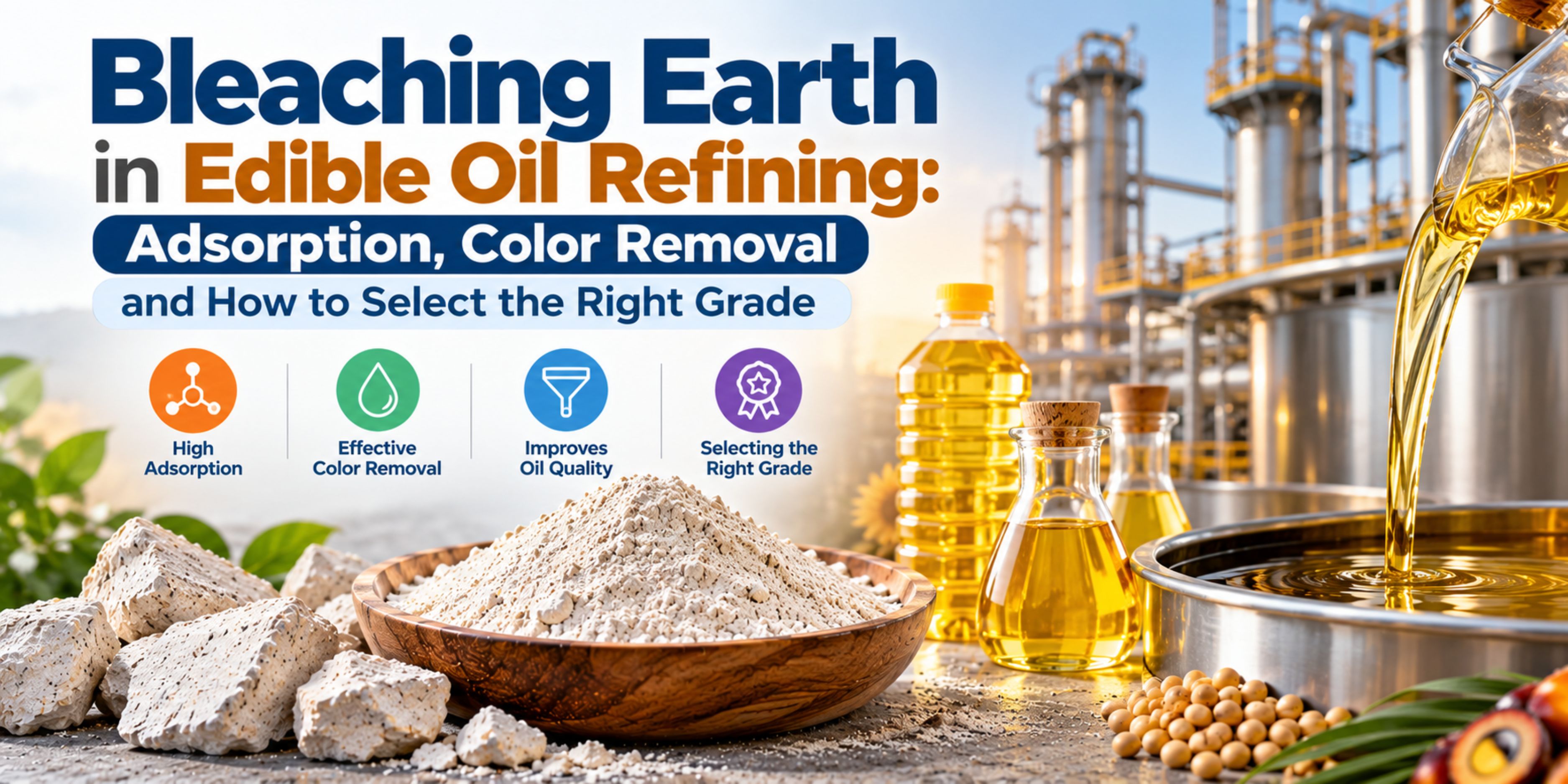
How Bleaching Earth Cleans Edible Oil and How to Pick the Right Grade
A bottle of cooking oil looks clear, light and clean. But the crude oil it came from was often dark, cloudy and full of unwanted compounds. A big part of that change happens in one step called bleaching, and the hero of this step is a special clay called bleaching earth.
In this guide, HTMC Group explains in simple language how bleaching earth in edible oil refining works, what it removes, which factors control results, and how a refinery can select the right grade without overspending.
Where Bleaching Fits in Edible Oil Refining
Crude edible oil goes through several steps before it reaches the consumer. A common route looks like this:
- Degumming removes gums and phospholipids.
- Neutralisation removes free fatty acids (in chemical refining).
- Bleaching removes colour, trace metals and other impurities.
- Deodorisation removes odour, taste compounds and remaining volatile matter.
Bleaching sits in the middle for a reason. It cleans up what the earlier steps leave behind and prepares the oil for the high heat of deodorisation. If bleaching is weak, the oil can turn dark again at high temperature and develop poor taste and shorter shelf life.
What Is Bleaching Earth?
Bleaching earth, also called bleaching clay or activated clay, is a fine powder made from natural clay minerals such as bentonite or fuller's earth. Some clays work in their natural form. Many others are treated with acid to open up their structure and increase their surface activity. These are called acid activated bleaching earths.
The key feature of this clay is its large internal surface area. A small spoon of the powder has a surface area far bigger than it looks, and this surface is where the work happens.
How Adsorption Works in Bleaching
Bleaching earth does not "bleach" oil by a chemical reaction like household bleach. Chemical bleaching can harm flavour and oil stability, so it is not used for edible oils. Instead, the clay works by adsorption.
Adsorption means that unwanted molecules stick to the surface of the clay particles. Think of the clay as millions of tiny magnets for impurities. The oil flows around the particles, and colour bodies and other contaminants attach to the clay surface and pores. After enough contact time, the clay is filtered out together with what it has captured. The clean oil moves on.
Several features of the clay help this process:
- Surface area and pore size. A more accessible surface means more places for impurities to attach.
- Surface acidity. Active sites help attract and hold polar compounds like pigments and phosphatides.
- Particle size. Smaller particles contact the oil faster but can slow down filtration.
- Moisture level. The right moisture helps activity, but too much wastes capacity.
What Does Bleaching Earth Remove from Oil?
This is where the word "colour removal" is only part of the story. In practice, the clay takes out many impurities at once:
- Carotenoids. These are the orange and red pigments, very common in palm oil.
- Chlorophyll. This is the green pigment, a big issue in canola, soybean and some other seed oils. It is also harmful because it can speed up oxidation in light.
- Phosphatides and soaps. Traces left after degumming or neutralisation are adsorbed by the clay.
- Trace metals. Iron and copper speed up rancidity. Removing them improves oil stability.
- Oxidation products. Compounds from early oil damage are also reduced, which helps flavour and shelf life.
This is why bleaching earth in edible oil refining is judged by more than just a colour reading. A good grade improves colour, taste stability, filter life and the final quality after deodorisation.
Key Factors That Control Bleaching Results
Even the best clay can underperform if the process is not tuned. These are the main controls.
- Dosage. Dosage is usually a fraction of a percent to a couple of percent of the oil weight, depending on oil type and quality. Too little leaves colour and metals behind. Too much raises cost and increases oil loss.
- Temperature. Bleaching is commonly done at around 90 to 110 degrees Celsius. Higher temperatures can speed up adsorption but may damage oil quality if pushed too far.
- Contact time. Usually 20 to 30 minutes is enough. Longer time adds cost and does not always add benefit.
- Vacuum. Bleaching under vacuum reduces contact with air, which limits oxidation. Research notes that low pH earths often respond better to vacuum bleaching in terms of colour removal and oil stability.
- Moisture and mixing. Good mixing keeps the clay evenly spread in the oil. Poor mixing creates dead zones with weak adsorption.
- Quality of incoming oil. Poorly degummed oil with high phosphorus needs more clay. Investing in a good degumming step often reduces bleaching cost.
- Acid pre-treatment. Adding a small amount of citric or phosphoric acid before bleaching can help remove phosphorus and metals, but the effect on colour depends on the earth type and the dose.
Natural vs Acid Activated Bleaching Earth
Refiners usually choose between two broad types.
- Natural bleaching earth is mostly used as mined and processed. It is milder, often has lower free acidity and can give a lower rise in free fatty acids. It suits oils with lower colour load.
- Acid-activated bleaching earth is treated with acid to boost surface area and activity. It handles darker oils and difficult pigments such as chlorophyll better. One study on palm oil also observed that oil bleached with the activated type showed a higher free fatty acid level than oil bleached with the natural type, so the right balance matters.
Neither is always better. The best choice depends on the oil, the target colour, the process and the budget.
Bleaching Earth and Other Adsorbents
Some plants also use activated carbon or acid-treated silica along with clay. Silica is useful for removing phospholipids and chlorophyll before the clay step. Patent studies report that using silica first can reduce the quantity of earth needed, and the total adsorbent used in a dual treatment can be lower than clay alone. Activated carbon is sometimes added in small amounts for specific colour issues, though it is costlier and can slow filtration.
For most edible oil plants, a well-chosen bleaching earth remains the main workhorse.
How to Select the Right Bleaching Earth
Selection should be based on trials, not only on a catalogue. Here is a simple checklist.
- Know your oil. Palm, soybean, sunflower, rapeseed, rice bran and cottonseed oils all behave differently. Palm needs strong carotene removal. Rapeseed and soybean often need chlorophyll control.
- Define your targets. Decide your needed colour values, residual phosphorus, metal limits and peroxide value after bleaching and after deodorisation.
- Check activity. Ask for the bleaching performance data and test it on your own oil under your own conditions.
- Check free acidity and pH. High residual acidity can raise free fatty acids in the oil and cause corrosion issues.
- Check moisture. Moisture changes the effective dose and clay behaviour.
- Check particle size and filtration rate. A grade that bleaches well but blocks the filter wastes time and money.
- Check oil retention. Spent earth holds a lot of oil, and this is a real loss. Choose a grade that gives good bleaching at the lowest dose and retains less oil.
- Check food safety documents. Ask for COA, TDS, safety data and relevant certifications. Heavy metal limits and clean production practices matter for food contact materials.
- Check consistency. A refinery runs every day. Batch-to-batch stability is as important as peak performance.
Reducing Cost in Bleaching
Bleaching earth is a major consumable cost. These practical steps can bring it down:
- Improve degumming so that less phosphorus reaches the bleacher.
- Run dosage trials in small steps to find the true optimum.
- Keep vacuum and temperature steady.
- Maintain filters well so that oil is recovered from the cake.
- Consider combined adsorbent routes where they suit your oil.
Look at the total cost, not only the price per ton. A higher-priced grade used at a lower dose can be cheaper in practice.
Spent Bleaching Earth: Handle with Care
After use, the clay is called spent bleaching earth, and it holds a large amount of oil. Research has noted that this by-product creates environmental challenges in many refineries, and some studies have explored recovery and reuse after oil extraction and heat treatment. In practice, spent earth with a lot of unsaturated oil can heat up and even catch fire by itself when exposed to air, so safe handling and cooling are important. Many plants send spent clay to authorised users such as brick, cement or biogas units, while following local rules.
Common Mistakes to Avoid
- Choosing only by price. A cheap earth that needs a higher dose often costs more.
- Skipping plant trials. Lab results help, but plant conditions can differ.
- Ignoring degumming quality. Poor upstream control overloads the clay.
- Overdosing. More clay does not always mean better oil. It can increase oil loss and free fatty acids.
- Poor storage. Bleaching earth absorbs moisture from air. Store it dry and sealed.
Why Work With HTMC Group
HTMC Group (HiTech Minerals and Chemicals Group) is an Indian industrial minerals manufacturer and supplier, with more than 40 years of experience and customers in over 30 countries. The group works with mineral reserves, in-house labs and certified processing facilities, and its range includes bleaching clay along with kaolin, bentonite, talc and other minerals.
For edible oil refiners, the useful points are:
- Application-focused technical discussion
- Quality checks backed by in-house labs
- Made-to-order options for specific needs
- Planned bulk supply and logistics
- Documents on request, including TDS and COA
Final Thoughts
Good bleaching is a balance of the right clay, the right dose and steady process control. When you understand how adsorption works, it becomes easier to compare grades, cut waste and protect your oil quality. Start with your oil type and targets, run side-by-side trials, and judge each grade by total cost and final oil quality.
HTMC Group is ready to support your refinery with samples and technical documents. Request Sample + TDS/COA for this application and take the next step with confidence.
Get in Touch with HTMC Group
- Call Us: +91 33 2226 8228, +91 98 1140 9161
- Enquire Now: [email protected]
Frequently Asked Questions
It adsorbs colour pigments, phosphatides, soaps, trace metals and some oxidation products from the oil. This gives a lighter colour and better stability.
No. The main action is adsorption, where impurities stick to the surface of the clay. Chemical bleaching is generally not used for edible oils because it can harm flavour and stability.
Natural earth is used with little or no acid treatment and is milder. Acid-activated earth has a more open structure and higher activity, so it removes difficult pigments better.
It depends on the oil type, quality and target colour. Many plants use a fraction of a percent up to a couple of percent of oil weight. Run trials to find your own best dose.
Plants commonly work around 90 to 110 degrees Celsius under vacuum. The best setting depends on the oil and the earth, so confirm with trials.
About 20 to 30 minutes is typical. Longer times rarely give much extra benefit.
The clay is porous and fine, so oil stays trapped in the filter cake. This is a real yield loss, so oil retention is worth checking when selecting a grade.
Yes. Too much clay raises cost, increases oil loss and may raise free fatty acid levels, depending on the earth type.
Keep it in sealed bags in a dry place, away from moisture and strong odours. Damp earth loses activity.
Contact HTMC Group through htmcgroup.com or call the numbers above. Share your oil type and targets, and request a sample with TDS and COA.
Contact Us

×