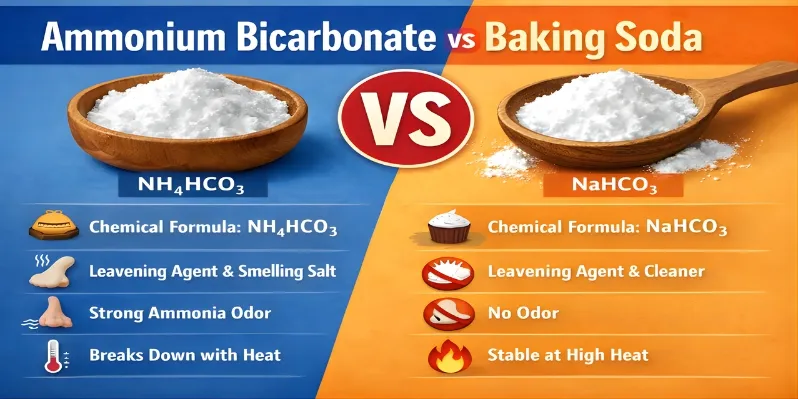
Ammonium Bicarbonate vs. Baking Soda: Key Differences Explained
Leavening agents play a vital role in food processing, baking, and several industrial applications. Two commonly compared compounds are ammonium bicarbonate and baking soda. Although both release gases that cause dough to rise, their chemical behavior, applications, and suitability differ significantly.
Understanding ammonium bicarbonate vs. baking soda helps bakers, food manufacturers, and industrial users choose the right ingredient for consistent results. This guide explains their composition, reactions, uses, advantages, and limitations clearly and practically.
What Is Ammonium Bicarbonate?
Ammonium bicarbonate is an inorganic compound with the chemical formula NH₄HCO₃. It appears as a white crystalline powder and is commonly known as baker’s ammonia.
When heated, ammonium bicarbonate breaks down completely into:
- Ammonia gas
- Carbon dioxide
- Water vapor
Because it decomposes fully without leaving residue, it is especially useful in thin, dry baked goods.
Key Characteristics
- Strong ammonia smell before baking
- Decomposes at low temperatures
- Leaves no alkaline residue
- Not suitable for moist or thick products
What Is Baking Soda?
Baking soda, scientifically known as sodium bicarbonate (NaHCO₃), is one of the most widely used leavening agents. It requires an acid and moisture to activate and release carbon dioxide.
Unlike ammonium bicarbonate, baking soda does not fully decompose unless combined with acidic ingredients.
Key Characteristics
- Mild alkaline taste if overused
- Requires acid for activation
- Leaves sodium carbonate residue
- Works well in moist and thick foods
Ammonium Bicarbonate vs. Baking Soda: Chemical Reaction
The fundamental difference lies in how each compound reacts during heating.
Ammonium Bicarbonate Reaction
- Activates with heat alone
Baking Soda Reaction
- Needs acid (like lemon juice, vinegar, or yogurt)
- Produces CO₂ and sodium carbonate
- It can leave an aftertaste if not balanced
This chemical difference explains why ammonium bicarbonate is preferred for crisp products, while baking soda suits cakes and breads.
Texture and Taste Comparison
Ammonium Bicarbonate
- Creates a very light and crisp texture
- Ideal for dry-baked items
- No residual taste after baking
- The ammonia smell disappears when baked properly
Baking Soda
- Produces a soft and fluffy texture
- Suitable for moist products
- Can taste bitter if excess is used
- Retains moisture better
This is a crucial factor in the ammonium bicarbonate vs. baking soda comparison for baking applications.
Common Uses in the Food Industry
Uses of Ammonium Bicarbonate
- Cookies and biscuits
- Crackers
- Wafers
- Flat bakery products
- Traditional baked snacks
Uses of Baking Soda
- Cakes and muffins
- Bread and pizza dough
- Pancakes and waffles
- Fried foods
- Household cooking
Ammonium bicarbonate is rarely used in home kitchens due to its strong odor before baking, while baking soda is a household staple.
Industrial Applications
Beyond food, both compounds are used in various industries.
Ammonium Bicarbonate Applications
- Fertilizer intermediate
- Fire extinguishing powders
- Pharmaceutical processing
- Textile and leather treatment
Baking Soda Applications
- Cleaning and deodorizing products
- pH regulation
- Water treatment
- Fire extinguishers
- Chemical manufacturing
Health and Safety Considerations
Ammonium Bicarbonate Safety
- Safe when used within food limits
- Ammonia fully evaporates during baking
- Not suitable for thick or underbaked items
Baking Soda Safety
- Safe in recommended quantities
- Excess intake may affect sodium levels.
- Overuse can cause digestive discomfort.
Both compounds are approved for food use when applied correctly.
Environmental and Storage Differences
Ammonium bicarbonate is sensitive to heat and moisture and must be stored in airtight containers. Baking soda is more stable and has a longer shelf life.
From an environmental standpoint, both compounds break down into naturally occurring elements and pose minimal environmental risk when handled responsibly.
Conclusion
Understanding the difference between ammonium bicarbonate and baking soda helps achieve better results in baking and industrial use. While both are leavening agents, their chemistry, performance, and suitability vary widely. Ammonium bicarbonate excels in crisp, dry products where complete gas release is essential. Baking soda remains the go-to choice for moist, acid-based recipes and everyday cooking. Choosing the right compound ensures consistent quality, better taste, and optimal performance in both food and industrial applications.
×